


The Ocean Conservation Administration (OCA) has added four juvenile Indo-Pacific humpback dolphins to its individual identification catalog after the young dolphins gradually developed distinguishable features.
The OCA on Tuesday announced the results of last year’s monitoring of the species, commonly known as Chinese white dolphins (Sousa chinensis), along Taiwan’s western coast.
During the survey period, researchers completed round-trip routes along coastal waters from Miaoli County to Tainan, accumulating more than 2,500km of effective survey effort and nearly 155 hours of monitoring, the agency said.
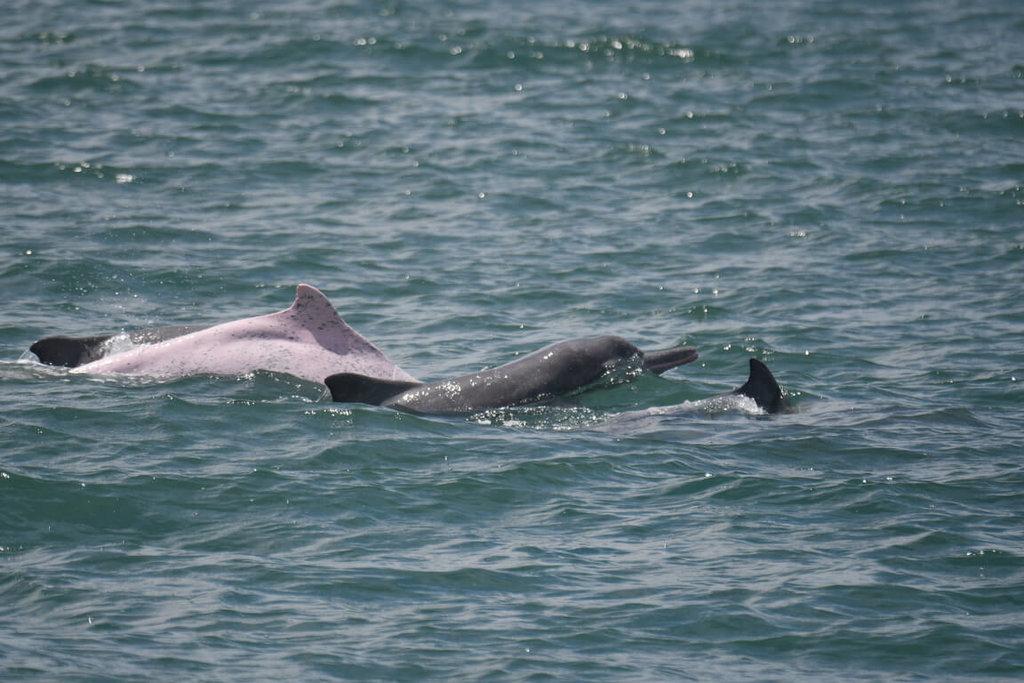
Photo courtesy of the Ocean Conservation Administration
There were 17 sightings of white dolphins, with eight instances of cows caring for young calves, it said.
Researchers identified 30 individual dolphins and recorded 25 sightings of calves, four of which gradually developed distinct identifying characteristics, such as visible spots and notches, during continued observation, it said.
They have been formally added to the identification catalog and assigned the codes OCA071 through OCA074, it said.
The successful establishment of identification records for the calves indicates ongoing reproduction within the population and the survival of young dolphins, while also highlighting the importance of long-term monitoring data, it said.
White dolphins primarily inhabit nearshore and estuarine waters along the western coast, ranging from Miaoli to Tainan, it said.
About 90 percent of identified individuals were found to move across waters spanning more than three counties or cities, demonstrating cross-regional movement patterns, it said.
The findings suggested that the dolphins’ habitat use covers nearshore environments across multiple jurisdictions, meaning they may face different environmental pressures in different areas, it said.
This underscored the importance of cross-county conservation cooperation and coordinated management, it added.
Meanwhile, the agency said it placed two sets of passive acoustic monitoring devices in the waters of Yunlin County to collect echolocation signals from dolphins and data on sounds produced by fish.
Acoustic monitoring could supplement visual surveys by providing activity data under different times and environmental conditions, it added.
The findings showed that dolphin echolocation activity was detectable at night and more frequent during high tide, it said.
Researchers believed that it is closely related to foraging behavior and the distribution of fish resources, it added.
Apart from routine sea surveys, reports from fishermen also provide real-time observation data, it said.
The agency said it would continue to strengthen cooperation among government agencies, across regions and with civil groups to advance scientific monitoring and habitat management.

LOUD AND PROUD Taiwan might have taken a drubbing against Australia and Japan, but you might not know it from the enthusiasm and numbers of the fans Taiwan might not be expected to win the World Baseball Classic (WBC) but their fans are making their presence felt in Tokyo, with tens of thousands decked out in the team’s blue, blowing horns and singing songs. Taiwanese fans have packed out the Tokyo Dome for all three of their games so far and even threatened to drown out home team supporters when their team played Japan on Friday. They blew trumpets, chanted for their favorite players and had their own cheerleading squad who dance on a stage during the game. The team struggled to match that exuberance on the field, with
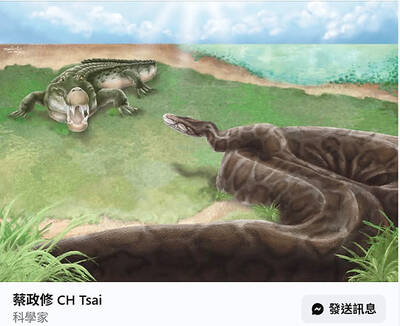
Taiwanese paleontologists have discovered fossil evidence that pythons up to 4m long inhabited Taiwan during the Pleistocene epoch, reporting their findings in the international scientific journal Historical Biology. National Taiwan University (NTU) Institute of Ecology and Evolutionary Biology associate professor Tsai Cheng-hsiu (蔡政修) led the team that discovered the largest snake fossil ever found in Taiwan. The single trunk vertebra was discovered in Tainan at the Chiting Formation, dated to between 400,000 and 800,000 years ago in the Middle Pleistocene, the paper said. The area also produced Taiwan’s first avian fossil, as well as crocodile, mammoth, saber-toothed cat and rhinoceros fossils, it said. Discoveries

Taiwanese paleontologists have discovered fossil evidence that pythons up to 4m long inhabited Taiwan during the Pleistocene epoch, reporting their findings in the international scientific journal Historical Biology. National Taiwan University (NTU) Institute of Ecology and Evolutionary Biology associate professor Tsai Cheng-hsiu (蔡政修) led the team that discovered the largest snake fossil ever found in Taiwan. A single trunk vertebra was discovered in Tainan at the Chiting Formation, dated to between 800,000 to 400,000 years ago in the Middle Pleistocene, the paper said. The area also produced Taiwan’s first avian fossil, as well as crocodile, mammoth, sabre-toothed cat and rhinoceros fossils, it said. Discoveries

Whether Japan would help defend Taiwan in case of a cross-strait conflict would depend on the US and the extent to which Japan would be allowed to act under the US-Japan Security Treaty, former Japanese minister of defense Satoshi Morimoto said. As China has not given up on the idea of invading Taiwan by force, to what extent Japan could support US military action would hinge on Washington’s intention and its negotiation with Tokyo, Morimoto said in an interview with the Liberty Times (sister paper of the Taipei Times) yesterday. There has to be sufficient mutual recognition of how Japan could provide


 RSS
RSS