


The Executive Yuan yesterday approved draft legal amendments to impose harsher penalties on scammers, and require fraud suspects to quickly reach a settlement with their victims if they want to be considered for a reduced sentence.
The Cabinet approved the draft revisions to the Fraud Crime Hazard Prevention Act (詐欺犯罪危害防制條例), which only came into force last year.
The proposed changes must now be reviewed by the legislature in order to become law.

Photo: Taipei Times
Under the version approved yesterday, the threshold for defining “large scale” fraud — and thus incurring three to 10 years in prison and a fine of up to NT$30 million (US$964,797) — would be lowered from NT$5 million to NT$1 million in fraudulent gains.
The draft bill would also add new penalty tiers, mandating five to 12 years imprisonment and a maximum fine of NT$300 million for people convicted of making more than NT$10 million via fraud.
People who made at least NT$100 million via fraud would face a minimum sentence of seven years imprisonment and a maximum fine of NT$500 million, according to the draft amendments.
The bill also includes a provision aimed at helping fraud victims quickly receive compensation.
To be considered for a reduced sentence or no sentence, a fraudster would have to turn themselves into the authorities, reach a financial settlement with their victims, and fully pay the settlement within six months of being taken into custody.
The draft bill also stated that if a fraud suspect was living a “lavish” or “wasteful” lifestyle (compared to an average person) prior to compensating or reaching a settlement with their victims, that behavior could be considered as a factor in their sentencing.
During the Cabinet meeting, Premier Cho Jung-tai (卓榮泰) told ministers that the government has made combating fraud a top priority.
Every month, financial losses to fraud in Taiwan exceed NT$1 billion, though the overall number of cases has been coming down, Cho said, Cabinet spokesperson Michelle Lee (李慧芝) said.
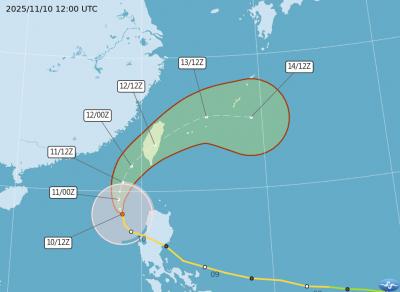
The Central Weather Administration (CWA) today issued a sea warning for Typhoon Fung-wong effective from 5:30pm, while local governments canceled school and work for tomorrow. A land warning is expected to be issued tomorrow morning before it is expected to make landfall on Wednesday, the agency said. Taoyuan, and well as Yilan, Hualien and Penghu counties canceled work and school for tomorrow, as well as mountainous district of Taipei and New Taipei City. For updated information on closures, please visit the Directorate-General of Personnel Administration Web site. As of 5pm today, Fung-wong was about 490km south-southwest of Oluanpi (鵝鑾鼻), Taiwan's southernmost point.

Almost a quarter of volunteer soldiers who signed up from 2021 to last year have sought early discharge, the Legislative Yuan’s Budget Center said in a report. The report said that 12,884 of 52,674 people who volunteered in the period had sought an early exit from the military, returning NT$895.96 million (US$28.86 million) to the government. In 2021, there was a 105.34 percent rise in the volunteer recruitment rate, but the number has steadily declined since then, missing recruitment targets, the Chinese-language United Daily News said, citing the report. In 2021, only 521 volunteers dropped out of the military, the report said, citing
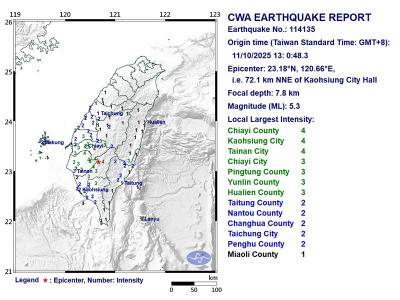
A magnitude 5.3 earthquake struck Kaohsiung at 1pm today, the Central Weather Administration said. The epicenter was in Jiasian District (甲仙), 72.1km north-northeast of Kaohsiung City Hall, at a depth of 7.8km, agency data showed. There were no immediate reports of damage. The earthquake's intensity, which gauges the actual effects of a temblor, was highest in Kaohsiung and Tainan, where it measured a 4 on Taiwan's seven-tier intensity scale. It also measured a 3 in parts of Chiayi City, as well as Pingtung, Yunlin and Hualien counties, data showed.

Nearly 5 million people have signed up to receive the government’s NT$10,000 (US$322) universal cash handout since registration opened on Wednesday last week, with deposits expected to begin tomorrow, the Ministry of Finance said yesterday. After a staggered sign-up last week — based on the final digit of the applicant’s national ID or Alien Resident Certificate number — online registration is open to all eligible Taiwanese nationals, foreign permanent residents and spouses of Taiwanese nationals. Banks are expected to start issuing deposits from 6pm today, the ministry said. Those who completed registration by yesterday are expected to receive their NT$10,000 tomorrow, National Treasury


 RSS
RSS