


The government has room to improve in terms of attracting international visitors to Taiwan, as the number of inbound travelers has so far only returned to 30 percent of the level recorded in 2019, tourism experts told a public hearing yesterday.
The legislature’s Transportation Committee organized the hearing to discuss actions that could be taken by the government and private sector to boost the tourism industry in the post-COVID-19 era.
Huang Cheng-tsung (黃正聰), an associate professor at Providence University’s Department of Tourism, said that the number of inbound and outbound passengers together has over the past few months reached 40 to 50 percent of the level seen before the COVID-19 pandemic, peaking during the Lunar New Year holiday and 228 Memorial Day long weekend.
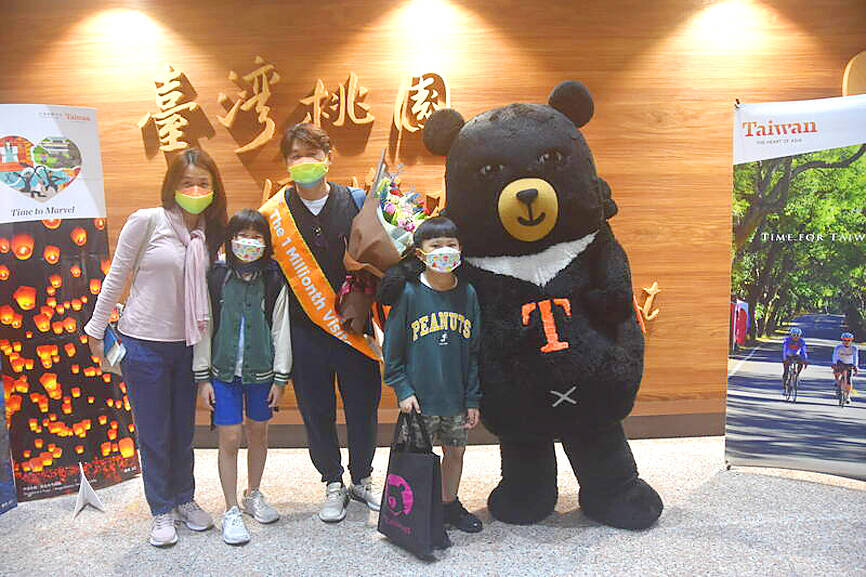
Photo courtesy of the Tourism Bureau
Taiwan’s recovery rate is slower than Australia, New Zealand, and European and North American countries, he said.
“This shows that Taiwan is having a slower recovery in international travel,” Huang said.
However, the number of inbound travelers has only returned to 30 percent of the 2019 level, while the number of outbound travelers rebounded to 50 to 60 percent of the 2019 level, he said.
“The large tourism deficit shows there is still a lot of room for improvement in attracting travelers from other countries,” Huang said.
Lee Ye-horng (李貽鴻), an adjunct associate professor at Ming Chuan University’s Department of Leisure and Recreation Management, said a majority of international visitors now come from Southeast Asian countries.
On average, they have less spending power than people from other countries and stay mainly in Taipei, Lee said.
“In addition to those who arrive for tourism purposes, others who come to study, shop, visit relatives, access healthcare services and undergo training, as well as those who are here for business and religious purposes, should all be considered tourists,” Lee said. “As such, all administrative agencies should jointly participate in marketing efforts to promote tours to Taiwan.”
Minister of Transportation and Communications Wang Kwo-tsai (王國材) said that the number of inbound visitors on Saturday last week surpassed 1 million, exceeding the target of 820,000 that the Tourism Bureau set for the first quarter.
“The bureau has also offered incentives to attract individual and group travelers from overseas,” Wang said, adding that whether Chinese tourists are allowed to visit Taiwan hinges on Beijing’s regulations.
Separately, the Tourism Bureau and Taiwan International Ports Corp (TIPC) participated together in Seatrade Cruise Global, the largest cruise industry gathering in the world. It started on Monday in Fort Lauderdale, Florida.
“Since Taiwan eased its COVID-19 restrictions in October last year, 310 cruise ships are forecast to berth in Taiwan this year, nearly half of the number forecast in 2019,” said Wang Jing-rong (王錦榮), general manager of TIPC’s Kaohsiung branch.
“This shows that international cruise companies still have confidence in Taiwan’s cruise tour market,” he said. “To attract more cruise ships to berth in Taiwan, we are offering cruise companies the most favorable terms. Hopefully, the cruise ship market will prosper as before.”
THE HAWAII FACTOR: While a 1965 opinion said an attack on Hawaii would not trigger Article 5, the text of the treaty suggests the state is covered, the report says NATO could be drawn into a conflict in the Taiwan Strait if Chinese forces attacked the US mainland or Hawaii, a NATO Defense College report published on Monday says. The report, written by James Lee, an assistant research fellow at Academia Sinica’s Institute of European and American Studies, states that under certain conditions a Taiwan contingency could trigger Article 5 of NATO, under which an attack against any member of the alliance is considered an attack against all members, necessitating a response. Article 6 of the North Atlantic Treaty specifies that an armed attack in the territory of any member in Europe,
FLU SEASON: Twenty-six severe cases were reported from Tuesday last week to Monday, including a seven-year-old girl diagnosed with influenza-associated encephalopathy Nearly 140,000 people sought medical assistance for diarrhea last week, the Centers for Disease Control (CDC) said on Tuesday. From April 7 to Saturday last week, 139,848 people sought medical help for diarrhea-related illness, a 15.7 percent increase from last week’s 120,868 reports, CDC Epidemic Intelligence Center Deputy Director Lee Chia-lin (李佳琳) said. The number of people who reported diarrhea-related illness last week was the fourth highest in the same time period over the past decade, Lee said. Over the past four weeks, 203 mass illness cases had been reported, nearly four times higher than the 54 cases documented in the same period
Heat advisories were in effect for nine administrative regions yesterday afternoon as warm southwesterly winds pushed temperatures above 38°C in parts of southern Taiwan, the Central Weather Administration (CWA) said. As of 3:30pm yesterday, Tainan’s Yujing District (玉井) had recorded the day’s highest temperature of 39.7°C, though the measurement will not be included in Taiwan’s official heat records since Yujing is an automatic rather than manually operated weather station, the CWA said. Highs recorded in other areas were 38.7°C in Kaohsiung’s Neimen District (內門), 38.2°C in Chiayi City and 38.1°C in Pingtung’s Sandimen Township (三地門), CWA data showed. The spell of scorching
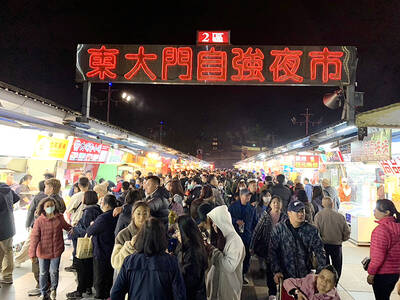
HOSPITALITY HIT: Hotels in Hualien have an occupancy rate of 10 percent, down from 30 percent before the earthquake, a Tourism Administration official said The Executive Yuan yesterday unveiled a stimulus package of vouchers and subsidies to revive tourism in Hualien County following a quake measuring 7.2 on the Richter scale. The tremor on April 3, which killed at least 17 people and left two others missing, caused the county an estimated NT$3 billion (US$92.7 million) in damages. The Ministry of Economic Affairs is to issue vouchers worth NT$200 at the price of NT$100 for purchases at the Dongdamen Night Market (東大門夜市) in Hualien City to boost spending, a ministry official told a news conference after a Cabinet meeting in Taipei. The ministry plans to issue 18,400


 RSS
RSS