


The Chinese Communist Party (CCP) is willing to sacrifice its economy to pursue its dynamic “zero COVID-19” approach, which it considers a cornerstone policy to maintain political stability, an analysis commissioned by the Mainland Affairs Council (MAC) said.
The policy remains Beijing’s guiding principle to mitigate the COVID-19 pandemic, as statements released on China’s National Day on Oct. 1 and at the CCP National Congress later that month showed, the report said.
A report released during the congress contains the word “security” 50 times, which reflects the CCP’s mindset, it said.
A lockdown of Shanghai in the spring affected more than 24 million people, with specific areas in the city bereft of food and tens of thousands displaced for mandatory quarantines at dedicated facilities, the MAC report said.
The CCP has adopted more than 120 military-style catchphrases to soothe the Chinese public, keep morale high and guide public opinion, it said.
Chinese President Xi Jinping’s (習近平) declaration that Beijing would not waver in its pandemic policy at the congress shows that China is attempting to use its handling of COVID-19 outbreaks to prove the superiority of its political system, it said.
As Xi starts his third term as CCP secretary-general, any relaxation of the policy would imperil his credibility, especially if it leads to a larger outbreak of the disease, the MAC report said, adding that any dent to his credibility would further call into question whether he can extend his rule beyond the third term.
Xi seeks to ensure that his tenure is not seen as a time of political instability, it said.
Adherence to the pandemic policy would affect China’s economy and slow its GDP growth, potentially sparking public discontent, it said.
However, small protests, such as when a person put up banners calling for Xi’s resignation in Beijing’s Haidian District just before the congress, are just perceived as “noise” by the CCP, and are insufficient to bring down its rule, the MAC report said.
Taipei should observe how China’s pandemic policy affects the Taiwanese economy, including the livelihood of entrepreneurs and small businesses, as well as how Taiwanese businesspeople returning from China can make a living in the nation, it said.
The government should also pay attention to potential supply chain disruptions, shrinking cross-strait trade and rising prices of goods due to the pandemic policy, it said.
However, a declining GDP, supply chain disruptions, rising prices due to supply chain realignment, a slump in China’s service sector, higher unemployment and loss of investment might be an “acceptable cost” for the CCP, as it primarily seeks political stability, the MAC report said.
THE HAWAII FACTOR: While a 1965 opinion said an attack on Hawaii would not trigger Article 5, the text of the treaty suggests the state is covered, the report says NATO could be drawn into a conflict in the Taiwan Strait if Chinese forces attacked the US mainland or Hawaii, a NATO Defense College report published on Monday says. The report, written by James Lee, an assistant research fellow at Academia Sinica’s Institute of European and American Studies, states that under certain conditions a Taiwan contingency could trigger Article 5 of NATO, under which an attack against any member of the alliance is considered an attack against all members, necessitating a response. Article 6 of the North Atlantic Treaty specifies that an armed attack in the territory of any member in Europe,
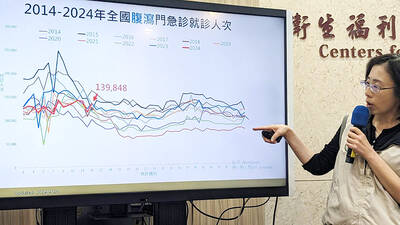
FLU SEASON: Twenty-six severe cases were reported from Tuesday last week to Monday, including a seven-year-old girl diagnosed with influenza-associated encephalopathy Nearly 140,000 people sought medical assistance for diarrhea last week, the Centers for Disease Control (CDC) said on Tuesday. From April 7 to Saturday last week, 139,848 people sought medical help for diarrhea-related illness, a 15.7 percent increase from last week’s 120,868 reports, CDC Epidemic Intelligence Center Deputy Director Lee Chia-lin (李佳琳) said. The number of people who reported diarrhea-related illness last week was the fourth highest in the same time period over the past decade, Lee said. Over the past four weeks, 203 mass illness cases had been reported, nearly four times higher than the 54 cases documented in the same period
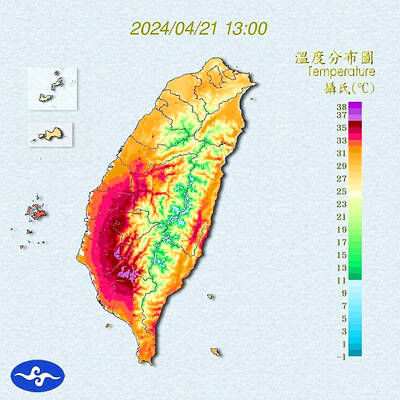
Heat advisories were in effect for nine administrative regions yesterday afternoon as warm southwesterly winds pushed temperatures above 38°C in parts of southern Taiwan, the Central Weather Administration (CWA) said. As of 3:30pm yesterday, Tainan’s Yujing District (玉井) had recorded the day’s highest temperature of 39.7°C, though the measurement will not be included in Taiwan’s official heat records since Yujing is an automatic rather than manually operated weather station, the CWA said. Highs recorded in other areas were 38.7°C in Kaohsiung’s Neimen District (內門), 38.2°C in Chiayi City and 38.1°C in Pingtung’s Sandimen Township (三地門), CWA data showed. The spell of scorching
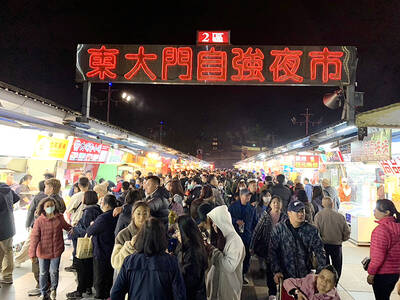
HOSPITALITY HIT: Hotels in Hualien have an occupancy rate of 10 percent, down from 30 percent before the earthquake, a Tourism Administration official said The Executive Yuan yesterday unveiled a stimulus package of vouchers and subsidies to revive tourism in Hualien County following a quake measuring 7.2 on the Richter scale. The tremor on April 3, which killed at least 17 people and left two others missing, caused the county an estimated NT$3 billion (US$92.7 million) in damages. The Ministry of Economic Affairs is to issue vouchers worth NT$200 at the price of NT$100 for purchases at the Dongdamen Night Market (東大門夜市) in Hualien City to boost spending, a ministry official told a news conference after a Cabinet meeting in Taipei. The ministry plans to issue 18,400


 RSS
RSS