


The navy should develop deep-sea rescue capabilities amid preparations to launch a prototype submarine by September next year, Democratic Progressive Party (DPP) Legislator Tsai Shih-ying (蔡適應) said on Friday.
Although the first of the navy’s new auxiliary rescue and salvage vessels is to be completed next year, the ship lacks a large center well, deep submergence rescue vehicle, hypobaric chamber and systems to facilitate deep dives, Tsai told the Liberty Times (the Taipei Times’ sister newspaper).
This means the capabilities of the rescue vessel to conduct submarine rescue missions are extremely limited, and sailors trapped in a stricken submarine would have to wait for extraction by Japanese or US rescue services, he said.

Photo: Liao Chen-huei, Taipei Times
The navy should develop rescue ships that are better than the one being built, he said.
The improvements could be funded by money formerly earmarked to buy Sikorsky MH-60R helicopters from the US, a plan that has been scrapped, he said.
A defense official speaking on condition of anonymity said that the salvage ship was not designed to deal with stricken submarines and its diving bell cannot be used deeper than 91m.
The navy recognizes that the class of vessel needs improvements, and modifications would be implemented according to a five-year reconfiguration plan as set out in this year’s defense budget, the official said.
Until rescue ships with the upgrades are built, Taiwan would have to rely on foreign partners should disaster strike, the official said.
Submarine rescues require a high level of technical sophistication that goes beyond having the right hardware, said Shu Hsiao-huang (舒孝煌), an analyst at the Institute for National Defense and Security Research.
“Installing emergency communications devices and escape equipment are some of the options that can be considered,” Shu said.
Su Tzu-yun (蘇紫雲), a senior analyst at the government-funded institute, said that the limited deep-sea rescue capability of the ship being built was probably caused by diplomatic issues or budget constraints.
In the short term, the navy should learn from foreign experiences of submarine rescue operations and make better use of dual-use technology developed by oil well operators, deep-sea salvagers and others in the private sector, Su said.
Additionally, the navy should consider utilizing commercial saturation diving technology, which enables divers to operate as deep as 500m if supported by sonar, underwater remotely operated vehicles and diving bells, he said.
Such divers could be military trained or contracted from the private sector, he said, adding that rescue and escape capabilities are crucial to the morale of submarine crews.
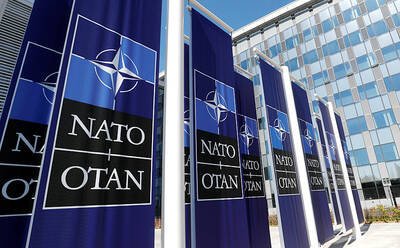
THE HAWAII FACTOR: While a 1965 opinion said an attack on Hawaii would not trigger Article 5, the text of the treaty suggests the state is covered, the report says NATO could be drawn into a conflict in the Taiwan Strait if Chinese forces attacked the US mainland or Hawaii, a NATO Defense College report published on Monday says. The report, written by James Lee, an assistant research fellow at Academia Sinica’s Institute of European and American Studies, states that under certain conditions a Taiwan contingency could trigger Article 5 of NATO, under which an attack against any member of the alliance is considered an attack against all members, necessitating a response. Article 6 of the North Atlantic Treaty specifies that an armed attack in the territory of any member in Europe,
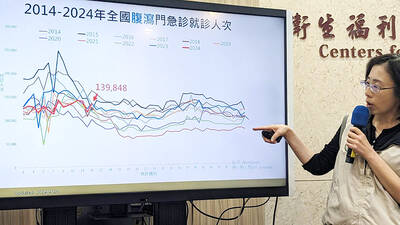
FLU SEASON: Twenty-six severe cases were reported from Tuesday last week to Monday, including a seven-year-old girl diagnosed with influenza-associated encephalopathy Nearly 140,000 people sought medical assistance for diarrhea last week, the Centers for Disease Control (CDC) said on Tuesday. From April 7 to Saturday last week, 139,848 people sought medical help for diarrhea-related illness, a 15.7 percent increase from last week’s 120,868 reports, CDC Epidemic Intelligence Center Deputy Director Lee Chia-lin (李佳琳) said. The number of people who reported diarrhea-related illness last week was the fourth highest in the same time period over the past decade, Lee said. Over the past four weeks, 203 mass illness cases had been reported, nearly four times higher than the 54 cases documented in the same period
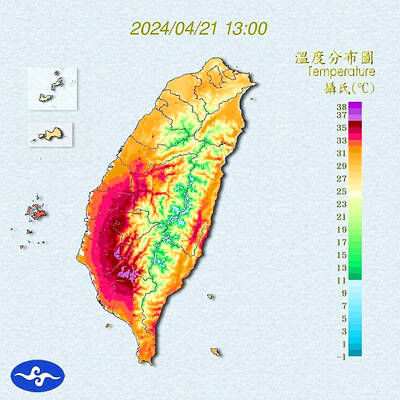
Heat advisories were in effect for nine administrative regions yesterday afternoon as warm southwesterly winds pushed temperatures above 38°C in parts of southern Taiwan, the Central Weather Administration (CWA) said. As of 3:30pm yesterday, Tainan’s Yujing District (玉井) had recorded the day’s highest temperature of 39.7°C, though the measurement will not be included in Taiwan’s official heat records since Yujing is an automatic rather than manually operated weather station, the CWA said. Highs recorded in other areas were 38.7°C in Kaohsiung’s Neimen District (內門), 38.2°C in Chiayi City and 38.1°C in Pingtung’s Sandimen Township (三地門), CWA data showed. The spell of scorching
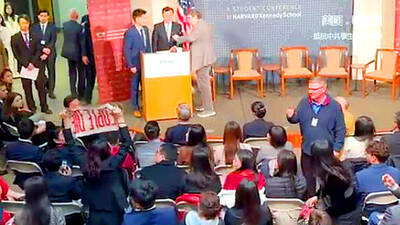
A group of Taiwanese-American and Tibetan-American students at Harvard University on Saturday disrupted Chinese Ambassador to the US Xie Feng’s (謝鋒) speech at the school, accusing him of being responsible for numerous human rights violations. Four students — two Taiwanese Americans and two from Tibet — held up banners inside a conference hall where Xie was delivering a speech at the opening ceremony of the Harvard Kennedy School China Conference 2024. In a video clip provided by the Coalition of Students Resisting the CCP (Chinese Communist Party), Taiwanese-American Cosette Wu (吳亭樺) and Tibetan-American Tsering Yangchen are seen holding banners that together read:


 RSS
RSS