


Twenty-three adolescents, aged 12 to 17, have experienced myocarditis or pericarditis after having their first dose of a COVID-19 vaccine in Taiwan, but studies have “implied” that delaying the second dose could reduce the incidence rate, the Central Epidemic Command Center (CECC) said yesterday.
The CECC on Monday announced that adolescents aged 12 to 17, who had received a first dose of the Pfizer-BioNTech COVID-19 vaccine, should receive a second dose, and that it was preparing to start on-campus vaccinations in the middle of this month.
Addressing concerns about myocarditis or pericarditis occurring after a person receives a messenger RNA (mRNA) vaccination (Pfizer-BioNTech or Moderna), especially in male adolescents and young adults, and more often after the second dose, the CECC yesterday released data on related cases.

Photo: Chou Hsiang-yun, Taipei Times
Centers for Disease Control (CDC) physician Chen Wan-ching (陳婉青) said that as of Wednesday last week, 23 adolescents had experienced myocarditis or pericarditis after a Pfizer-BioNTech shot.
Of the cases, 19 were male and four female, 20 were hospitalized, and 18 have been discharged, she said, adding that most of the cases experienced mild symptoms.
Of the 16 cases reported between Sept. 22 and Nov. 3, 14 were reported within 14 days of receiving the shot, while the other two were reported on the 27th and the 31st day after vaccination, Chen said, adding that 75 percent were found to have abnormal cardiac enzymes and 73 percent had abnormal electrocardiographic results.
Studies and reports from other countries say that the incidence rate of post-vaccination myocarditis or pericarditis is unclear, due to differences in the reporting and diagnosis mechanisms in different countries, but more than 80 percent of cases are male, the majority are aged 30 or under, and about 70 to 90 percent of the cases occurred after the second vaccine shot, she said.
Lee Ping-ing (李秉穎), convener of the Ministry of Health and Welfare’s Advisory Committee on Immunization Practices (ACIP), said the committee had previously suggested delaying the second vaccine shot for adolescents, but on Sunday agreed that they should receive one, because the benefits outweigh the risks.
The ACIP suggested that adolescents receive their second shot at least 12 weeks after the first, because studies have found that getting a second shot of the Pfizer-BioNTech vaccine after an interval of six to 14 weeks does not reduce the neutralizing antibody levels or cell-mediated responses, he said.
Although there is no clear evidence that a longer interval between doses of an mRNA vaccine reduces the incidence rate of myocarditis or pericarditis after the second dose, data from Canada, the EU and the UK have “implied” that it could, Lee said.
The British government recommends that those aged 16 and 17 receive their second dose of the Pfizer-BioNTech vaccine at least 12 weeks after the first, he added.
It is suggested that adolescents get a second vaccine shot, because new variants of concern continue to emerge and the risk of myocarditis, pericarditis or other serious complications is higher from contracting COVID-19 than from getting vaccinated, Lee said.
“However, we urge parents and adolescents, especially young men, to be on high alert for ... myocarditis or pericarditis for 28 days after vaccination,” he said, adding that people should seek immediate medical attention if they experience chest pain, chest tightness or discomfort, an irregular heartbeat, fainting, shortness of breath or an intolerance to exercise.
“We recommend getting a second vaccine shot, but it is totally their choice, not compulsory,” he added.
Asked what brand of vaccine people should take if they are getting a booster shot, Lee said that people who have received two doses of an mRNA vaccine should receive a third dose of the same brand, while those who received two doses of an adenoviral vector vaccine (AstraZeneca) can get another dose of the same brand or an mRNA vaccine.
CDC Deputy Director-General Chuang Jen-hsiang (莊人祥), the CECC’s spokesman, said no new local infections or deaths were reported yesterday, but there were five imported cases from Australia, the Czech Republic and the Netherlands.

Former president Ma Ying-jeou’s (馬英九) mention of Taiwan’s official name during a meeting with Chinese President Xi Jinping (習近平) on Wednesday was likely a deliberate political play, academics said. “As I see it, it was intentional,” National Chengchi University Graduate Institute of East Asian Studies professor Wang Hsin-hsien (王信賢) said of Ma’s initial use of the “Republic of China” (ROC) to refer to the wider concept of “the Chinese nation.” Ma quickly corrected himself, and his office later described his use of the two similar-sounding yet politically distinct terms as “purely a gaffe.” Given Ma was reading from a script, the supposed slipup
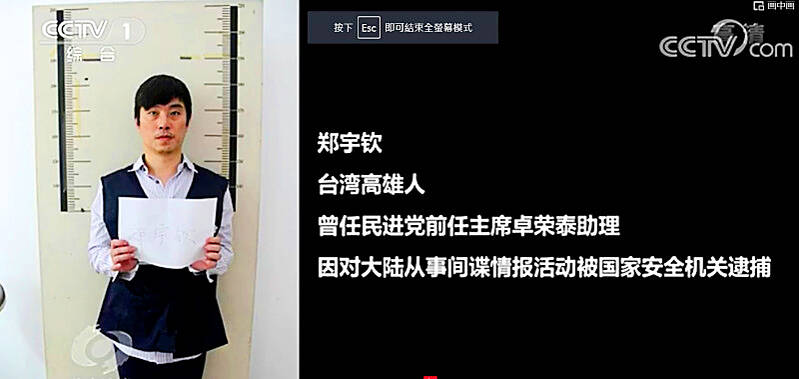
Former Czech Republic-based Taiwanese researcher Cheng Yu-chin (鄭宇欽) has been sentenced to seven years in prison on espionage-related charges, China’s Ministry of State Security announced yesterday. China said Cheng was a spy for Taiwan who “masqueraded as a professor” and that he was previously an assistant to former Cabinet secretary-general Cho Jung-tai (卓榮泰). President-elect William Lai (賴清德) on Wednesday last week announced Cho would be his premier when Lai is inaugurated next month. Today is China’s “National Security Education Day.” The Chinese ministry yesterday released a video online showing arrests over the past 10 years of people alleged to be
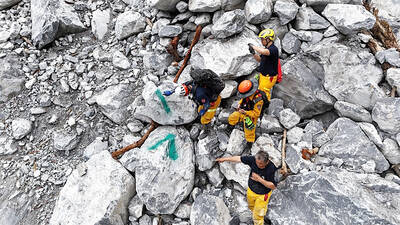
The bodies of two individuals were recovered and three additional bodies were discovered on the Shakadang Trail (砂卡礑) in Taroko National Park, eight days after the devastating earthquake in Hualien County, search-and-rescue personnel said. The rescuers reported that they retrieved the bodies of a man and a girl, suspected to be the father and daughter from the Yu (游) family, 500m from the entrance of the trail on Wednesday. The rescue team added that despite the discovery of the two bodies on Friday last week, they had been unable to retrieve them until Wednesday due to the heavy equipment needed to lift

THE HAWAII FACTOR: While a 1965 opinion said an attack on Hawaii would not trigger Article 5, the text of the treaty suggests the state is covered, the report says NATO could be drawn into a conflict in the Taiwan Strait if Chinese forces attacked the US mainland or Hawaii, a NATO Defense College report published on Monday says. The report, written by James Lee, an assistant research fellow at Academia Sinica’s Institute of European and American Studies, states that under certain conditions a Taiwan contingency could trigger Article 5 of NATO, under which an attack against any member of the alliance is considered an attack against all members, necessitating a response. Article 6 of the North Atlantic Treaty specifies that an armed attack in the territory of any member in Europe,


 RSS
RSS