


A supporter and opponent of a referendum question on restarting construction of the Fourth Nuclear Power Plant in New Taipei City’s Gongliao District (貢寮) staked out their positions during a televised presentation yesterday.
Nuclear power advocate Huang Shih-hsiu (黃士修), who initiated the vote to unseal the mothballed plant, said that should it be cleared for use, it would save the government NT$60 billion (US$2.16 billion) in renewable energy costs, and would pay for itself after five years.
Writing off the plant altogether would bankrupt Taiwan Power Co (Taipower), he said.
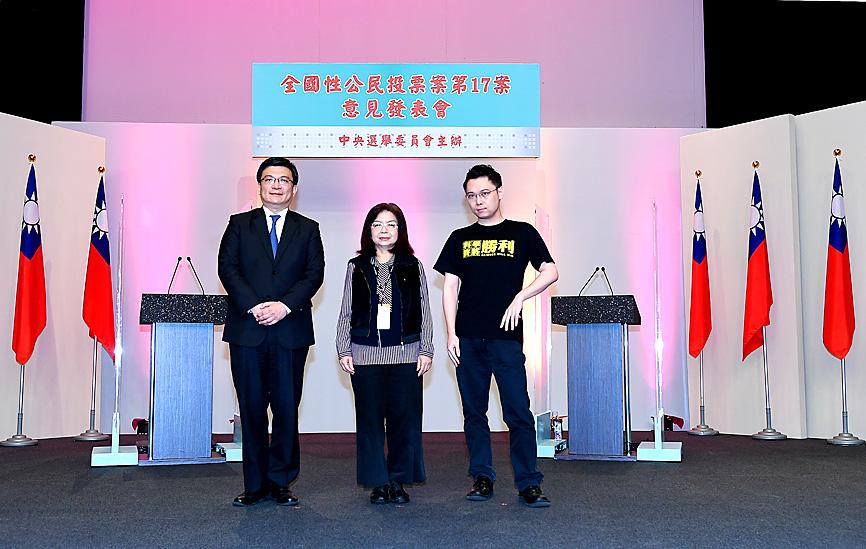
Photo courtesy of the Central Election Commission via CNA
Each quote the government provides on restarting construction varies, Huang said, citing statements ranging from NT$80 billion to NT$200 billion, adding that Taipower and National Tsing Hua University researchers have pegged potential revenue at NT$50 billion over five years while providing 20 billion kilowatt-hours of power per year.
The Ministry of Economic Affairs is “distorting the truth” by saying that commercialization plans are not supported by safety test data and cannot be approved by the Atomic Energy Council, as the ministry on Aug 20, 2014, said that the first unit completed safety inspections and met official standards, Huang said.
The council has not conducted a review on the system’s trial run data, produced before the plant was sealed and not equivalent to data that could be provided by further tests, he added.
Regarding the logistics of restarting a mothballed nuclear power facility, Huang said that the Watts Bar Nuclear Power Plant in Tennessee had its second unit successfully restarted in 2016 after being sealed away for 28 years.
Vice Minister of Economic Affairs Tseng Wen-sheng (曾文生) argued against restarting construction on the plant.
Tseng said that Huang was mistaken in citing “trial run data,” as Huang was referring to a ministry-conducted safety inspection.
The council has conducted 187 tests of the plant since 2007, 32 of which have failed, Tseng said.
“Saying the plant has completed safety tests is a lie,” he said.
Huang did not address post-processing and storage of nuclear waste in Taiwan, Tseng said, adding there is no consensus regarding how to store the current nuclear waste supplies.
Tseng said that a Central Geological Survey Center report from 2019 showed a 93.9km long fault line off the coast of where the unfinished nuclear power plant now sits.
“We must carefully consider the effect of the fault line becoming active, and if it could affect a fault line under the plant,” he said.
Yesterday was the first of five televised discussions on a national four-question referendum scheduled for Dec. 18.
The next four presentations are scheduled for Nov. 18, Nov. 24, Dec. 2 and Dec. 11, and can be watched at https://web.cec.gov.tw/referendum/hearing/110rmedia.
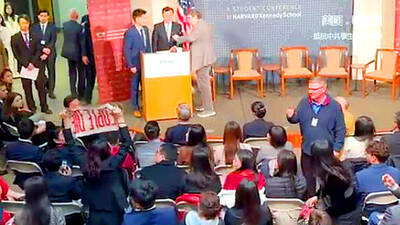
A group of Taiwanese-American and Tibetan-American students at Harvard University on Saturday disrupted Chinese Ambassador to the US Xie Feng’s (謝鋒) speech at the school, accusing him of being responsible for numerous human rights violations. Four students — two Taiwanese Americans and two from Tibet — held up banners inside a conference hall where Xie was delivering a speech at the opening ceremony of the Harvard Kennedy School China Conference 2024. In a video clip provided by the Coalition of Students Resisting the CCP (Chinese Communist Party), Taiwanese-American Cosette Wu (吳亭樺) and Tibetan-American Tsering Yangchen are seen holding banners that together read:

UNAWARE: Many people sit for long hours every day and eat unhealthy foods, putting them at greater risk of developing one of the ‘three highs,’ an expert said More than 30 percent of adults aged 40 or older who underwent a government-funded health exam were unaware they had at least one of the “three highs” — high blood pressure, high blood lipids or high blood sugar, the Health Promotion Administration (HPA) said yesterday. Among adults aged 40 or older who said they did not have any of the “three highs” before taking the health exam, more than 30 percent were found to have at least one of them, Adult Preventive Health Examination Service data from 2022 showed. People with long-term medical conditions such as hypertension or diabetes usually do not
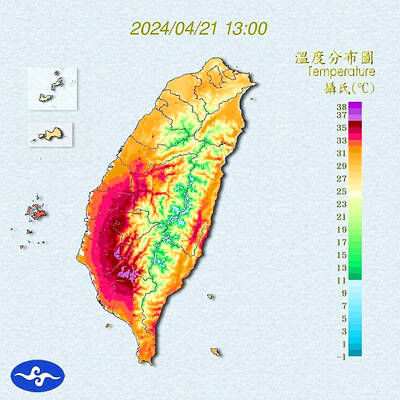
Heat advisories were in effect for nine administrative regions yesterday afternoon as warm southwesterly winds pushed temperatures above 38°C in parts of southern Taiwan, the Central Weather Administration (CWA) said. As of 3:30pm yesterday, Tainan’s Yujing District (玉井) had recorded the day’s highest temperature of 39.7°C, though the measurement will not be included in Taiwan’s official heat records since Yujing is an automatic rather than manually operated weather station, the CWA said. Highs recorded in other areas were 38.7°C in Kaohsiung’s Neimen District (內門), 38.2°C in Chiayi City and 38.1°C in Pingtung’s Sandimen Township (三地門), CWA data showed. The spell of scorching
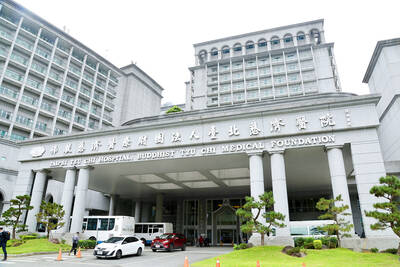
POLICE INVESTIGATING: A man said he quit his job as a nurse at Taipei Tzu Chi Hospital as he had been ‘disgusted’ by the behavior of his colleagues A man yesterday morning wrote online that he had witnessed nurses taking photographs and touching anesthetized patients inappropriately in Taipei Tzu Chi Hospital’s operating theaters. The man surnamed Huang (黃) wrote on the Professional Technology Temple bulletin board that during his six-month stint as a nurse at the hospital, he had seen nurses taking pictures of patients, including of their private parts, after they were anesthetized. Some nurses had also touched patients inappropriately and children were among those photographed, he said. Huang said this “disgusted” him “so much” that “he felt the need to reveal these unethical acts in the operating theater


 RSS
RSS