


A coalition of advocacy groups on Friday called on the government not to hold videoconferences to discuss land development projects, saying that the practice could harm the public’s right to take part in civic affairs.
Urban planning, eminent domain and environmental impact assessment hearings are among those to be held virtually by Ministry of the Interior departments, beginning this week, Environmental Rights Foundation fellow Hsu Po-jen (許博任) said.
He made the remark at a virtual news conference held jointly by the foundation, the Taiwan Human Rights Association and the Environmental Jurist Association, among others.
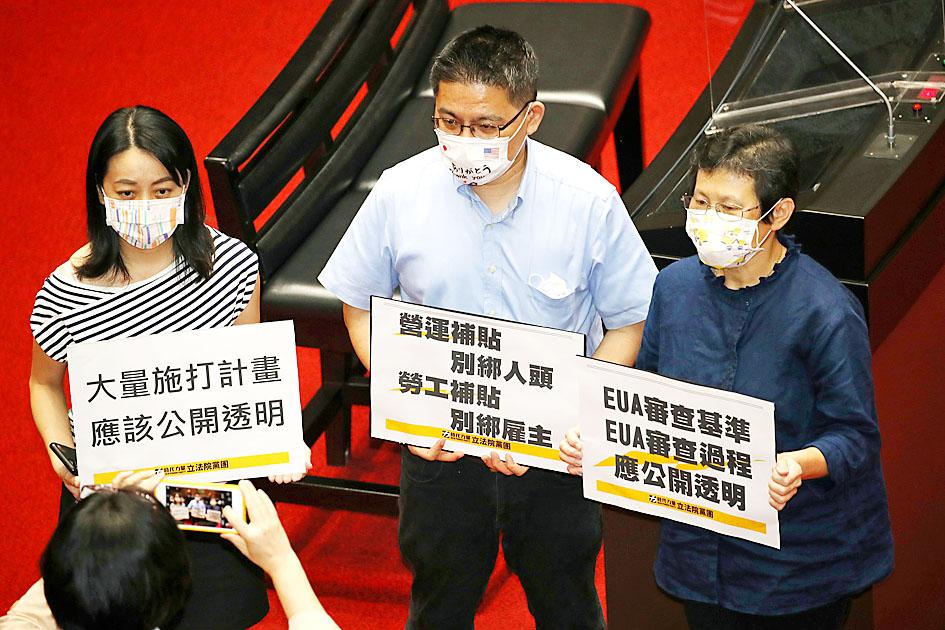
Photo: CNA
In making the decision, the ministry cited its wish to avoid unnecessary delays to development projects due to a COVID-19 outbreak in Taiwan, but the hearings are to be held with no consistent guidelines to ensure fairness across departments, Hsu said.
Environmental impact assessment panels allow outcalls for the public to speak at a meeting or provide live broadcasts, but they have no guidelines to avoid hearing controversial cases online, he said.
Meanwhile, the Land Expropriation Commission refrains from hearing a contested case online, but offers no mechanism for members of the public to take part in its hearings, he said.
No ministerial department has announced information about an online hearing, even a week before it was scheduled to convene, he said.
For the government to hold online public hearings, it should announce essential information about the issue ahead of time, broadcast the meeting on a public platform, allow the public to participate in real time and not hold virtual meetings on controversial issues, he said.
In addition, the government should not assume that all members of the public have access to fast and reliable Internet to watch the hearings, he said, adding that officials should be aware of the “digital gap.”
The government should write a sunset clause for virtual public hearings so that they would not be utilized after the pandemic is over, the groups cited New Power Party (NPP) Legislator Chen Jiau-hua (陳椒華) as saying in a news release.
Videoconference hearings need to have clear rules to include community members, as they and generations of their descendants could be affected by the government’s actions, NPP Legislator Chiu Hsien-chih (邱顯智) was quoted as saying.
The current form of virtual public hearings is not conducive to public participation, which could violate their legal rights, he said, adding that the hearings should cease until legal concerns are addressed.
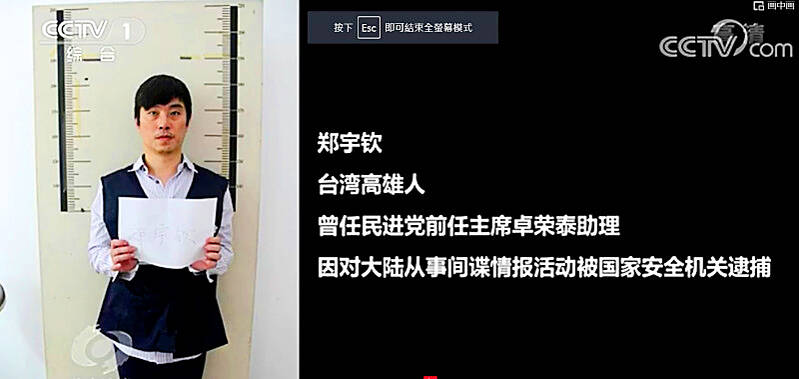
Former Czech Republic-based Taiwanese researcher Cheng Yu-chin (鄭宇欽) has been sentenced to seven years in prison on espionage-related charges, China’s Ministry of State Security announced yesterday. China said Cheng was a spy for Taiwan who “masqueraded as a professor” and that he was previously an assistant to former Cabinet secretary-general Cho Jung-tai (卓榮泰). President-elect William Lai (賴清德) on Wednesday last week announced Cho would be his premier when Lai is inaugurated next month. Today is China’s “National Security Education Day.” The Chinese ministry yesterday released a video online showing arrests over the past 10 years of people alleged to be

THE HAWAII FACTOR: While a 1965 opinion said an attack on Hawaii would not trigger Article 5, the text of the treaty suggests the state is covered, the report says NATO could be drawn into a conflict in the Taiwan Strait if Chinese forces attacked the US mainland or Hawaii, a NATO Defense College report published on Monday says. The report, written by James Lee, an assistant research fellow at Academia Sinica’s Institute of European and American Studies, states that under certain conditions a Taiwan contingency could trigger Article 5 of NATO, under which an attack against any member of the alliance is considered an attack against all members, necessitating a response. Article 6 of the North Atlantic Treaty specifies that an armed attack in the territory of any member in Europe,

LIKE FAMILY: People now treat dogs and cats as family members. They receive the same medical treatments and tests as humans do, a veterinary association official said The number of pet dogs and cats in Taiwan has officially outnumbered the number of human newborns last year, data from the Ministry of Agriculture’s pet registration information system showed. As of last year, Taiwan had 94,544 registered pet dogs and 137,652 pet cats, the data showed. By contrast, 135,571 babies were born last year. Demand for medical care for pet animals has also risen. As of Feb. 29, there were 5,773 veterinarians in Taiwan, 3,993 of whom were for pet animals, statistics from the Animal and Plant Health Inspection Agency showed. In 2022, the nation had 3,077 pediatricians. As of last

XINJIANG: Officials are conducting a report into amending an existing law or to enact a special law to prohibit goods using forced labor Taiwan is mulling an amendment prohibiting the importation of goods using forced labor, similar to the Uyghur Forced Labor Prevention Act (UFLPA) passed by the US Congress in 2021 that imposed limits on goods produced using forced labor in China’s Xinjiang region. A government official who wished to remain anonymous said yesterday that as the US customs law explicitly prohibits the importation of goods made using forced labor, in 2021 it passed the specialized UFLPA to limit the importation of cotton and other goods from China’s Xinjiang Uyghur region. Taiwan does not have the legal basis to prohibit the importation of goods


 RSS
RSS