


The Central Epidemic Command Center (CECC) yesterday announced that the first day of the new semester would be postponed to at least Feb. 22, so that schools would have more time to disinfect their campuses and prepare COVID-19 prevention measures.
Minister of Health and Welfare Chen Shih-chung (陳時中), who heads the center, said that the global spread of COVID-19 has slowed slightly, but the situation remains serious, so people should still practice personal protection measures.
The protective equipment and supplies on school campuses are relatively sufficient, and disease prevention rules and supplementary measures are more comprehensive than the same time last year, Minister of Education Pan Wen-chung (潘文忠) said at the CECC’s news conference.
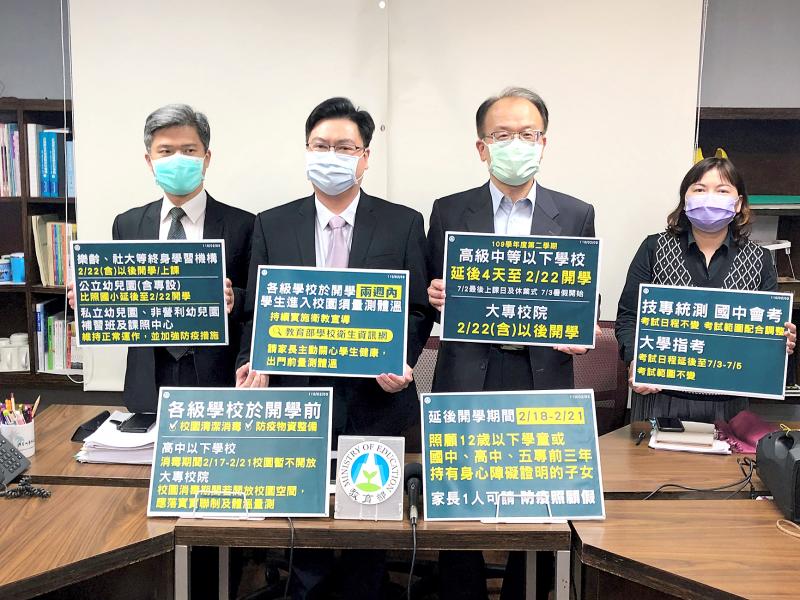
Photo: CNA
However, as the semester was planned to start on Feb. 18, only two days after the seven-day Lunar New Year holiday, the ministry postponed it for a few days to make sure that schools have enough time to thoroughly clean and disinfect their campuses before students return, he said.
For schools from senior high and below, including public preschools, the first day of school would be postponed by four days to Feb. 22, while the last day of school would be postponed to July 2, Pan said, adding that the summer vacation would begin on July 3.
For higher-education institutions, the new semester could start on or after Feb. 22, he said, adding that senior citizen learning centers, community colleges and lifelong learning facilities could also open on or after Feb. 22.
As for private preschools, non-profit preschools, cram schools or after-school childcare centers, they would enhance COVID-19 prevention measures, he said, adding that these facilities still operate during the winter vacation, so daily cleaning and disinfection is maintained.
The Joint College Entrance Examination, originally scheduled from July 1 to July 3, would be postponed to July 3 to July 5, and the test content would not change, Pan said.
The dates of the joint entrance exams for four-year technical colleges and two-year junior colleges on May 1 and May 2, as well as the Comprehensive Assessment Program for Junior High School Students exams on May 15 and May 16, would not change, but the test content might be modified and announced later, he said.
Schools must complete campus disinfection from Feb. 17 to 21, and should be closed to visitors on those dates, he said, adding that if university campuses are open during this period, they are required to gather people’s names and contact information, and measure their temperatures.
Parents of children under the age of 12 or of an older child with disabilities can ask their employer for “disease prevention childcare leave” from Feb. 18 to Feb. 21, due to the semester being postponed, Pan said.
The Ministry of Labor said that employers must approve the request, and are prohibited from marking the employees as absent or forcing them to take other types of leave, or punishing them in any way for taking disease prevention childcare leave, he said.
“We urge parents to pay particular attention to their children’s health, such as by measuring their temperature before they go to school every day,” Pan said.
“We encourage children that are feeling ill to rest at home, or seek medical attention if needed,” he said, adding that “schools should not mark them as absent, so they can feel safe staying home.”

Former president Ma Ying-jeou’s (馬英九) mention of Taiwan’s official name during a meeting with Chinese President Xi Jinping (習近平) on Wednesday was likely a deliberate political play, academics said. “As I see it, it was intentional,” National Chengchi University Graduate Institute of East Asian Studies professor Wang Hsin-hsien (王信賢) said of Ma’s initial use of the “Republic of China” (ROC) to refer to the wider concept of “the Chinese nation.” Ma quickly corrected himself, and his office later described his use of the two similar-sounding yet politically distinct terms as “purely a gaffe.” Given Ma was reading from a script, the supposed slipup
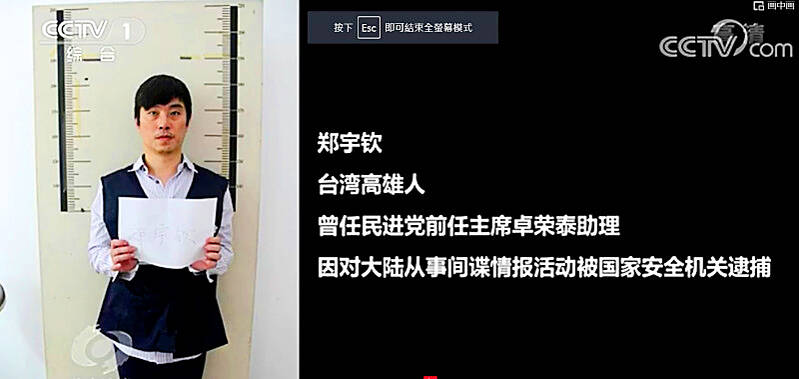
Former Czech Republic-based Taiwanese researcher Cheng Yu-chin (鄭宇欽) has been sentenced to seven years in prison on espionage-related charges, China’s Ministry of State Security announced yesterday. China said Cheng was a spy for Taiwan who “masqueraded as a professor” and that he was previously an assistant to former Cabinet secretary-general Cho Jung-tai (卓榮泰). President-elect William Lai (賴清德) on Wednesday last week announced Cho would be his premier when Lai is inaugurated next month. Today is China’s “National Security Education Day.” The Chinese ministry yesterday released a video online showing arrests over the past 10 years of people alleged to be

THE HAWAII FACTOR: While a 1965 opinion said an attack on Hawaii would not trigger Article 5, the text of the treaty suggests the state is covered, the report says NATO could be drawn into a conflict in the Taiwan Strait if Chinese forces attacked the US mainland or Hawaii, a NATO Defense College report published on Monday says. The report, written by James Lee, an assistant research fellow at Academia Sinica’s Institute of European and American Studies, states that under certain conditions a Taiwan contingency could trigger Article 5 of NATO, under which an attack against any member of the alliance is considered an attack against all members, necessitating a response. Article 6 of the North Atlantic Treaty specifies that an armed attack in the territory of any member in Europe,
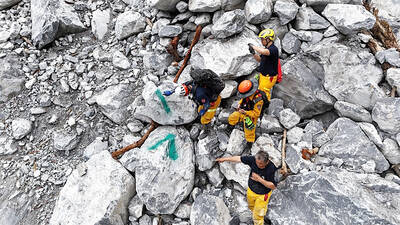
The bodies of two individuals were recovered and three additional bodies were discovered on the Shakadang Trail (砂卡礑) in Taroko National Park, eight days after the devastating earthquake in Hualien County, search-and-rescue personnel said. The rescuers reported that they retrieved the bodies of a man and a girl, suspected to be the father and daughter from the Yu (游) family, 500m from the entrance of the trail on Wednesday. The rescue team added that despite the discovery of the two bodies on Friday last week, they had been unable to retrieve them until Wednesday due to the heavy equipment needed to lift


 RSS
RSS