


Life expectancy in Taiwan last year hit a new high of 80.9 years after a decade of increasing steadily, the Ministry of the Interior said on Wednesday.
The average life expectancy for men was 77.7 and 84.2 for women, both records, the ministry said.
Over the past decade, life expectancy in Taiwan has been rising steadily from 79 in 2009 mainly because of improved healthcare, heightened awareness of food safety, an improved quality of life and the rising popularity of fitness programs, the ministry said.
The cities with the highest life expectancies last year were Taipei (83.86 years), New Taipei City (81.52), Hsinchu City (81.43), Taoyuan (81.09) and Taichung (80.83), ministry data showed.
Hualien and Taitung counties were at the bottom of the list, with average life expectancies of 77.06 and 76.33 years respectively, the data showed.
Western parts of the country most likely have a higher average life expectancy than eastern areas because of lifestyle factors and better access to medical resources, the ministry said.
However, the gap between eastern and western areas has narrowed over the past decade, it said, adding that Taitung County saw the biggest spike in life expectancy in Taiwan last year.
Taiwan’s crude death rate last year was 7.44 per 1,000 people, with 175,546 deaths recorded, the data showed.
That was an increase of 2,846 deaths from the previous year, when the crude death rate was 7.32 per 1,000 people, the data showed.
The standardized mortality ratio, which adjusts for a population’s age structure, was 408.2 per 100,000 people last year, a 1.6 percent decrease from the previous year, the data showed.
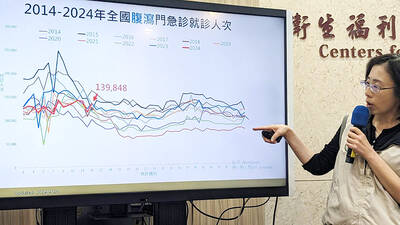
FLU SEASON: Twenty-six severe cases were reported from Tuesday last week to Monday, including a seven-year-old girl diagnosed with influenza-associated encephalopathy Nearly 140,000 people sought medical assistance for diarrhea last week, the Centers for Disease Control (CDC) said on Tuesday. From April 7 to Saturday last week, 139,848 people sought medical help for diarrhea-related illness, a 15.7 percent increase from last week’s 120,868 reports, CDC Epidemic Intelligence Center Deputy Director Lee Chia-lin (李佳琳) said. The number of people who reported diarrhea-related illness last week was the fourth highest in the same time period over the past decade, Lee said. Over the past four weeks, 203 mass illness cases had been reported, nearly four times higher than the 54 cases documented in the same period

A group of Taiwanese-American and Tibetan-American students at Harvard University on Saturday disrupted Chinese Ambassador to the US Xie Feng’s (謝鋒) speech at the school, accusing him of being responsible for numerous human rights violations. Four students — two Taiwanese Americans and two from Tibet — held up banners inside a conference hall where Xie was delivering a speech at the opening ceremony of the Harvard Kennedy School China Conference 2024. In a video clip provided by the Coalition of Students Resisting the CCP (Chinese Communist Party), Taiwanese-American Cosette Wu (吳亭樺) and Tibetan-American Tsering Yangchen are seen holding banners that together read:
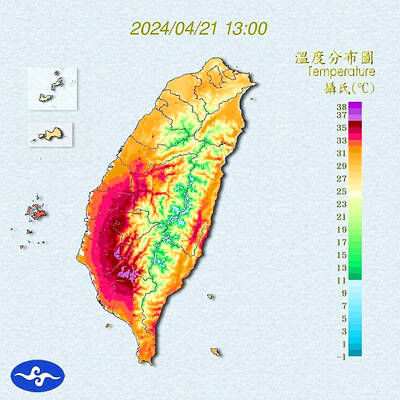
Heat advisories were in effect for nine administrative regions yesterday afternoon as warm southwesterly winds pushed temperatures above 38°C in parts of southern Taiwan, the Central Weather Administration (CWA) said. As of 3:30pm yesterday, Tainan’s Yujing District (玉井) had recorded the day’s highest temperature of 39.7°C, though the measurement will not be included in Taiwan’s official heat records since Yujing is an automatic rather than manually operated weather station, the CWA said. Highs recorded in other areas were 38.7°C in Kaohsiung’s Neimen District (內門), 38.2°C in Chiayi City and 38.1°C in Pingtung’s Sandimen Township (三地門), CWA data showed. The spell of scorching

UNAWARE: Many people sit for long hours every day and eat unhealthy foods, putting them at greater risk of developing one of the ‘three highs,’ an expert said More than 30 percent of adults aged 40 or older who underwent a government-funded health exam were unaware they had at least one of the “three highs” — high blood pressure, high blood lipids or high blood sugar, the Health Promotion Administration (HPA) said yesterday. Among adults aged 40 or older who said they did not have any of the “three highs” before taking the health exam, more than 30 percent were found to have at least one of them, Adult Preventive Health Examination Service data from 2022 showed. People with long-term medical conditions such as hypertension or diabetes usually do not


 RSS
RSS