


The National Human Rights Museum in Taipei has unveiled an exhibition on a 1954 incident on Green Island (綠島) during the Martial Law period.
The show focuses on an event at the island’s New Life Correction Center, a detention facility for political prisoners during the White Terror era, the Human Rights museum director Chen Chun-hung (陳俊宏) said on Tuesday.
The White Terror era refers to the suppression of political dissidents, when the then-Chinese Nationalist Party (KMT) regime subsequently imposed martial law, which was only lifted on July 15, 1987.

Photo provided by the National Human Rights Museum
The incident occurred after political prisoners refused to cooperate in a KMT propaganda scheme, which required them to write letters in blood and receive tattoos praising the government’s success in “re-educating” them, Chen said.
The military then ordered a retrial of the prisoners, and raised the sentences of 14 to capital punishment, Chen added.
Although some former political prisoners tried to shed light on the incident after martial law was lifted, it was largely forgotten, Chen said.
Through recordings and historical documents, the museum wants to draw attention to human rights abuses in the name of national security, the director said.
Recordings of interviews with survivors are juxtaposed with declassified government files to give insight into the story, as well as to commemorate the lives lost during that period, curator Lin Fu-kai (林傳凱) said.
The exhibition “Huge Waves Arrive — Revealing the truths and redressing the case of ‘re-rebellion’ at the New Life Correction Center on Green Island” (大浪襲來 — 綠島新生訓導處「再叛亂案」的真相與平反) opened on Friday last week and ends on April 25 next year in Green Island’s White Terror Memorial Park.
Lectures on the topic are to be held in New Taipei City’s Jing-Mei White Terror Memorial Park, Taichung, Tainan and Kaohsiung.
Due to the COVID-19 pandemic, the museum is also offering a 360-degree virtual tour of the show on their Web site.
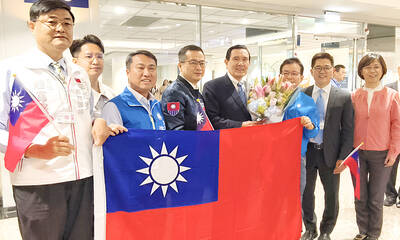
Former president Ma Ying-jeou’s (馬英九) mention of Taiwan’s official name during a meeting with Chinese President Xi Jinping (習近平) on Wednesday was likely a deliberate political play, academics said. “As I see it, it was intentional,” National Chengchi University Graduate Institute of East Asian Studies professor Wang Hsin-hsien (王信賢) said of Ma’s initial use of the “Republic of China” (ROC) to refer to the wider concept of “the Chinese nation.” Ma quickly corrected himself, and his office later described his use of the two similar-sounding yet politically distinct terms as “purely a gaffe.” Given Ma was reading from a script, the supposed slipup
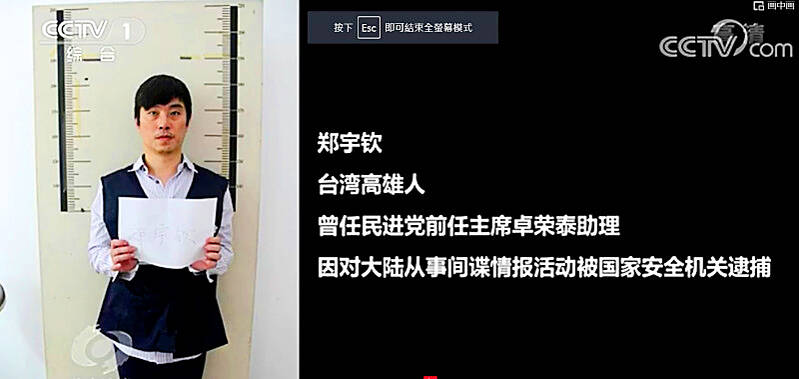
Former Czech Republic-based Taiwanese researcher Cheng Yu-chin (鄭宇欽) has been sentenced to seven years in prison on espionage-related charges, China’s Ministry of State Security announced yesterday. China said Cheng was a spy for Taiwan who “masqueraded as a professor” and that he was previously an assistant to former Cabinet secretary-general Cho Jung-tai (卓榮泰). President-elect William Lai (賴清德) on Wednesday last week announced Cho would be his premier when Lai is inaugurated next month. Today is China’s “National Security Education Day.” The Chinese ministry yesterday released a video online showing arrests over the past 10 years of people alleged to be
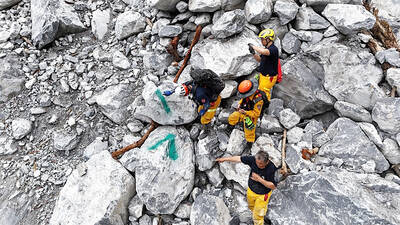
The bodies of two individuals were recovered and three additional bodies were discovered on the Shakadang Trail (砂卡礑) in Taroko National Park, eight days after the devastating earthquake in Hualien County, search-and-rescue personnel said. The rescuers reported that they retrieved the bodies of a man and a girl, suspected to be the father and daughter from the Yu (游) family, 500m from the entrance of the trail on Wednesday. The rescue team added that despite the discovery of the two bodies on Friday last week, they had been unable to retrieve them until Wednesday due to the heavy equipment needed to lift
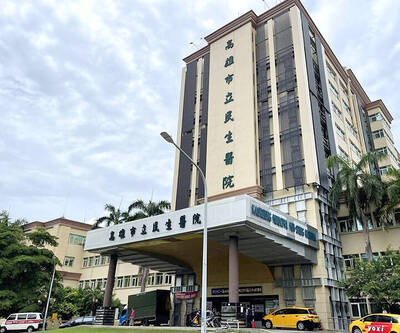
MIX-UP: Kaohsiung Municipal Min-Sheng Hospital director Yen Chia-chi was suspended from his duties after surgeons operated on the wrong patient last week The Kaohsiung Department of Health yesterday fined Kaohsiung Municipal Min-Sheng Hospital NT$500,0000 for misidentifying two patients and consequently causing one of them to undergo the wrong surgery last week. The hospital’s director Yen Chia-chi (顏家祺) was suspended from his duties. The surgeon who was scheduled to operate on the patient was given a major demerit and is subject to subsequent disciplinary actions. Demerits were given to the anesthesiologist, the nurse in the operation room, the nurse in the ward and the worker who helped transfer the patient from the ward to the operation room for having failed to verify the patient’s identity. Meanwhile, the


 RSS
RSS