


A medical team from Taipei Medical University Hospital (TMUH) has begun a one-month aid project in Eswatini, which has reported more than 100 cases of COVID-19, hospital superintendent Chen Ray-jade (陳瑞杰) said on Tuesday.
Since 2008, TMUH has been responsible for medical missions in Eswatini, the only African country that has official ties with Taiwan, Chen said.
Following a request by the Eswatini Ministry of Health, four TMUH doctors arrived at the nation’s Lubombo Referral Hospital on May 1, Chen said, adding that the hospital was established with the support of the Ministry of Health and Welfare and TMUH.
The team — infectious disease specialist Chen Li-yuan (陳立遠), pulmonologist Li Shu-liang (黎書亮), respiratory therapist Lee Hsin-yu (李芯妤) and nurse Lin Yu-Hsuan (林侑暄) — aims to enhance Eswatini’s critical care with clinical assistance and training programs, he said.
Daily video conferences have been held between TMUH and the hospital to discuss the latest preventive measures and treatments, he added.
Eswatini is not a large country, with a population of about 1 million, he said, adding that there is a wide rural-urban gap with regards to healthcare resources, and the nation lacks experience in dealing with an epidemic or pandemic.
Disinfection products, such as alcohol-based sanitizers, are scarce in the nation, he added.
As Eswatini has reported hospital-acquired COVID-19 infections, the most pressing matter for the team is to eradicate the possibility of further transmissions among healthcare personnel, as it could lead to large-scale community infections, he said.
Facilities and routes at the hospital should be redesigned to better meet disease-prevention requirements, while local medical teams would be trained to attend to severely ill patients safely, and to wear and take off a surgical gown correctly, he said.
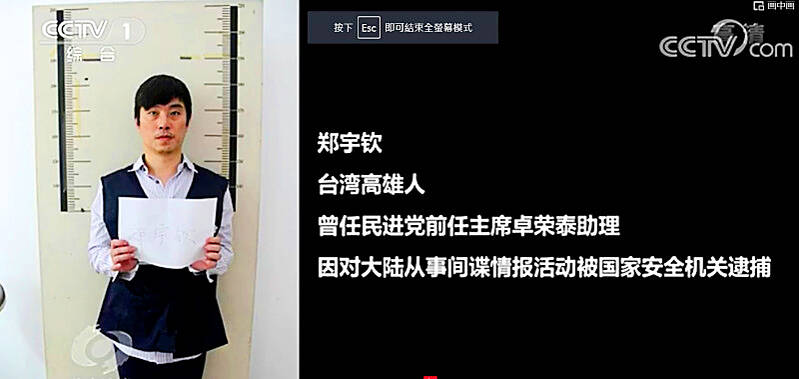
Former Czech Republic-based Taiwanese researcher Cheng Yu-chin (鄭宇欽) has been sentenced to seven years in prison on espionage-related charges, China’s Ministry of State Security announced yesterday. China said Cheng was a spy for Taiwan who “masqueraded as a professor” and that he was previously an assistant to former Cabinet secretary-general Cho Jung-tai (卓榮泰). President-elect William Lai (賴清德) on Wednesday last week announced Cho would be his premier when Lai is inaugurated next month. Today is China’s “National Security Education Day.” The Chinese ministry yesterday released a video online showing arrests over the past 10 years of people alleged to be

THE HAWAII FACTOR: While a 1965 opinion said an attack on Hawaii would not trigger Article 5, the text of the treaty suggests the state is covered, the report says NATO could be drawn into a conflict in the Taiwan Strait if Chinese forces attacked the US mainland or Hawaii, a NATO Defense College report published on Monday says. The report, written by James Lee, an assistant research fellow at Academia Sinica’s Institute of European and American Studies, states that under certain conditions a Taiwan contingency could trigger Article 5 of NATO, under which an attack against any member of the alliance is considered an attack against all members, necessitating a response. Article 6 of the North Atlantic Treaty specifies that an armed attack in the territory of any member in Europe,
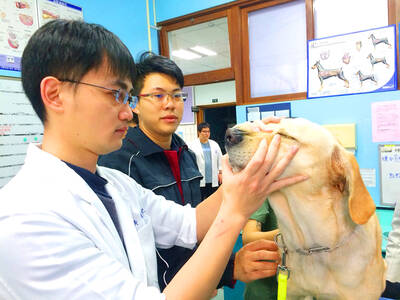
LIKE FAMILY: People now treat dogs and cats as family members. They receive the same medical treatments and tests as humans do, a veterinary association official said The number of pet dogs and cats in Taiwan has officially outnumbered the number of human newborns last year, data from the Ministry of Agriculture’s pet registration information system showed. As of last year, Taiwan had 94,544 registered pet dogs and 137,652 pet cats, the data showed. By contrast, 135,571 babies were born last year. Demand for medical care for pet animals has also risen. As of Feb. 29, there were 5,773 veterinarians in Taiwan, 3,993 of whom were for pet animals, statistics from the Animal and Plant Health Inspection Agency showed. In 2022, the nation had 3,077 pediatricians. As of last

XINJIANG: Officials are conducting a report into amending an existing law or to enact a special law to prohibit goods using forced labor Taiwan is mulling an amendment prohibiting the importation of goods using forced labor, similar to the Uyghur Forced Labor Prevention Act (UFLPA) passed by the US Congress in 2021 that imposed limits on goods produced using forced labor in China’s Xinjiang region. A government official who wished to remain anonymous said yesterday that as the US customs law explicitly prohibits the importation of goods made using forced labor, in 2021 it passed the specialized UFLPA to limit the importation of cotton and other goods from China’s Xinjiang Uyghur region. Taiwan does not have the legal basis to prohibit the importation of goods


 RSS
RSS