


Deputy Minister of Education Lin Teng-chiao (林騰蛟) yesterday said that the ministry formally informed National Taiwan University (NTU) of its decision to appoint professor Kuan Chung-ming (管中閔) as the university’s president on Tuesday.
“If the public has concerns over the president’s eligibility, the university should make investigations and openly clarify things,” Lin said, at a meeting of the legislature’s Education and Culture Committee.
Meanwhile, NTU said in a statement: “The university has received the approval notice from the ministry and is currently planning the presidential transition according to procedures.”
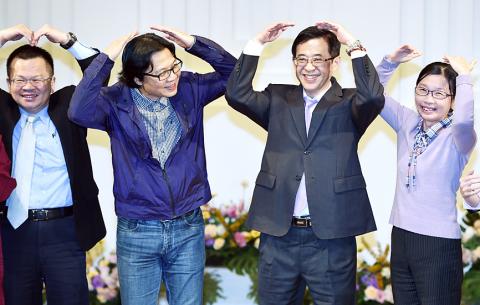
Photo: Liao Chen-huei, Taipei Times
It would also “deal with the administrative appeal,” filed in June to request that the ministry appoint Kuan, the university said.
Although Kuan’s appointment has been approved, whether he would take office on Jan. 8 remains uncertain due to an administrative litigation and a number of administrative appeals that are still ongoing.
While the university and Kuan each filed an administrative appeal in June, NTU professor and presidential candidate Wu Ruey-Beei (吳瑞北) in September filed an administrative litigation against the ministry and NTU.
Wu requested that the university relaunch the election, arguing that Kuan’s appointment would be unfair to fellow candidates due to a conflict of interest in the election process.
Following the ministry’s announcement on Monday that it would appoint Kuan, Wu on Tuesday filed for a provisional injunction with the Taipei High Administrative Court, demanding that Kuan not be appointed until a court ruling is made.
When asked if the results of the administrative appeals and administrative litigation would affect Kuan’s appointment, then-minister of education Yeh Jiunn-rong (葉俊榮) on Monday said that the ministry would respect the court’s rulings.
“If other candidates do not agree with the decision, they can still seek legal remedy. Their right to seek legal remedy has not changed,” he said.
Meanwhile, lawyer Lin Hsien-tung (林憲同) on Tuesday reported Yeh to the Taipei District Prosecutors’ Office for alleged corruption.
According to the Constitution and the University Act (大學法), the Ministry of Education has the authority to make the final decision regarding the the appointment of NTU’s president, Lin said.
Yeh’s rejection of Kuan’s appointment in an internal review in August and the ministry’s response to the university’s administrative appeal show that the ministry did not recognize the legitimacy of NTU’s presidential election, he said.
Knowing that there were flaws in the election process and that Kuan did not possess the qualifications to serve as NTU president, Yeh, who resigned on Tuesday, still announced on Monday that the ministry would “reluctantly agree” to appointing Kuan, he said.
Yeh’s decision has damaged the nation’s system and profited Kuan, he said, adding that he suspects Yeh of violating Article 6 of the Anti-Corruption Act (貪污治罪條例).
The Ministry of Education rejected Kuan’s appointment in April on the grounds that there were procedural flaws in the election.
It ordered them to redo the election, but the university refused and filed an administrative appeal with the Executive Yuan.
The appeal is currently being reviewed by the Executive Yuan’s Petitions and Appeals Committee.
In the report he filed with the prosecutor’s office, Lin also accused Kuan of possibly making a false entry in a public document — a potential crime under the Criminal Code — and Taiwan Mobile vice chairman Richard Tsai (蔡明興) of giving Kuan an unfair advantage.
Kuan failed to disclose that he had served as an independent director at Taiwan Mobile and taught in China during his time in public office when he signed up to participate in NTU’s presidential election, Lin said in his report.
Since NTU’s presidential selection committee is authorized by the Ministry of Education, the documents pertaining to the selection of the university’s president are official documents that were produced in a public capacity, he said, adding that Tsai, who was on the presidential selection committee and should have, according to the Administrative Procedure Act (行政程序法), recused himself from the election, Lin added.

UPGRADE: The Kang Ding-class frigate is replacing its Chaparall missiles with Tien Chien II and Hua Yang VLS, which would provide it with long-range, 360° air defense Taiwan plans to produce 1,200 to 1,376 Hai Chien II missiles (海劍二, Sea Sword II) — also known as TC-2N — to serve as the standard air defense system of the navy’s surface combatant fleet, a source said yesterday. Last week, the Hai Chien II, the naval version of the Tien Kung II missile (天劍二, Sky Sword II), completed a live-fire test in waters off the National Chungshan Institute of Science and Technology’s Jiupeng facility (九鵬) in Pingtung County’s Manjhou Township (滿州). The MIM72 Chaparral and other dated air defense missiles that currently arm Taiwanese ships have inadequate range to combat Chinese

REASONS FOR TRAVEL: An assistant professor said that proposed amendments to penalize drivers if they used drugs overseas would not deter people from traveling People who operate a motor vehicle under the influence of marijuana would have their driver’s license revoked, even if they used the substance while overseas, the Ministry of Transportation and Communications said yesterday, citing proposed amendments to the Road Traffic Management and Penalty Act (道路交通管理處罰條例). The amendments would also authorize the government to revoke the licenses of people determined to have used Category 1 or Category 2 narcotics, even if they were not operating a vehicle while under the influence of drugs, as well as ban them from taking the license test for three years, the ministry said. People aged 18 or
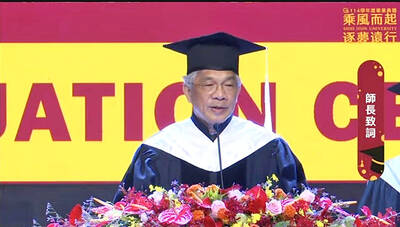
Shih Hsin University President Chen Ching-he (陳清河) yesterday issued a public apology for comments made in his commencement speech last week, stating that he has asked the school to suspend his duties and halt his wages for two months as a show of contrition. At the commencement ceremony on May 30, Chen said, “If you don’t manage your time well, or your own emotions, or your health, then I am telling every one of you — put a quick end to ‘you,’ because the world has no need for ‘you.’” The comments have sparked significant controversy online, and Chen through an open
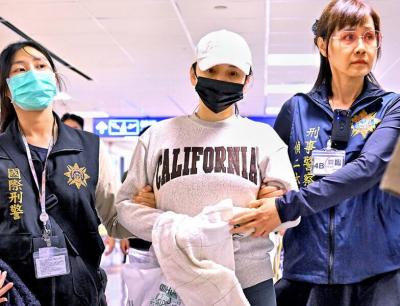
Johanne Liou (劉喬安), a Taiwanese woman who shot to unwanted fame during the Sunflower movement protests in 2014, returned to Taiwan last night after being deported from the US. She is to stand trial in Taiwan for charges involving embezzlement, fraud and drug crimes. The Criminal Investigation Bureau (CIB) said it took her into custody at Taiwan Taoyuan International Airport and would first question her before transferring her to the New Taipei District Prosecutors’ Office. She was arrested upon disembarking a flight from San Francisco that landed shortly before 7pm. Liou absconded to the US in 2019 after jumping bail


 RSS
RSS