


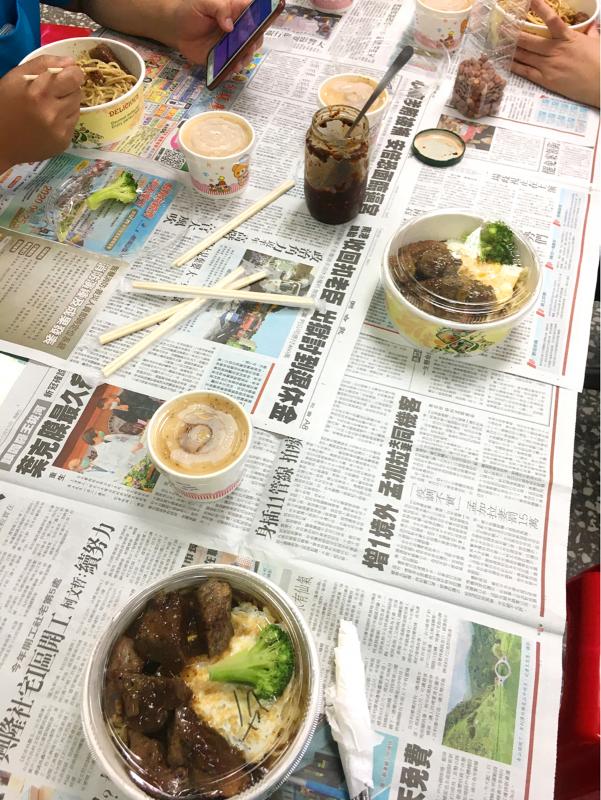
Habits can vary a lot from north to south, but the most important thing is to respect one another. Someone used the PTT bulletin board system to share an experience about how a friend took his northern girlfriend back to his home in south Taiwan for a family meal, but to his surprise, as soon as his girlfriend saw newspaper being used as a tablecloth, she complained that it was “really gross.” The couple then got into an argument over it.
The person wrote a post on PTT’s “Gossiping” board under the heading “Do northerners think that spreading newspaper to eat off is unhygienic?” He said that the previous week a friend had taken his northern girlfriend home for a meal. The man’s mother prepared a big spread of tasty food for their guest, but unexpectedly the girlfriend thought that covering the table with newspaper was unhygienic, on the grounds that it smelled of ink and no one knew whether anyone had taken the newspaper to read in the toilet. The boyfriend disagreed. He thought that spreading newspaper was very convenient because you could just drop bones on it, then wrap them up in it and throw them away after your meal instead of having to wipe the table. This difference of opinions got the young couple into a fight. The original poster was puzzled by the whole thing and asked, “Don’t northerners spread newspaper at mealtime?”
After the post appeared, it became a topic of heated debate. Most people agreed that using newspaper as a tablecloth is not very hygienic. As someone said, “When you hold a newspaper, your hands will be blackened by the ink, so it is really not a good idea.” Other comments included: “It is ugly and dirty.” “At least use leaflets. Newspaper is thin and absorbs water, and it has a funny smell.” “At least buy some blank newsprint paper to use. It’s yucky if it’s covered in ink.” “Seriously, for your health’s sake, don’t use newspaper as a tablecloth.”
Screen grab from PTT 圖片擷取自PTT
Another group of people took the view that using newspaper as a tablecloth is very convenient. Some of the comments were: “Using newspaper is ultra-convenient — What a bunch of snobs!” “Anyone can see that spreading newspaper is more convenient — If you had to wipe tables every day you would know what a drag it is.” “What’s the problem? Did anyone tell you to eat the newspaper?”
(Translated by Julian Clegg, Taipei Times)
南北習慣大不同,彼此尊重是最重要的事情。PTT一名網友分享,朋友帶北部女友回南部老家吃飯,想不到女友一看到桌上鋪著報紙卻大嫌「超噁心」,小倆口因此吵了起來。
Screen grab from PTT 圖片擷取自PTT
一名網友在PTT八卦板發表文章,「北部人覺得吃飯鋪報紙很沒衛生?」,他表示,上週朋友帶北部女友回家吃飯,男方媽媽準備了一大桌好料宴請,想不到女友卻覺得桌上鋪報紙很沒衛生,理由是有油墨味道,也不知道有沒有人帶報紙進廁所看過;男方則是認為鋪報紙很方便,骨頭可以直接丟,吃完包起來直接丟,不用擦桌子,觀念差異讓小倆口因此吵了起來。原作者則是相當好奇,「北部人都不鋪報紙吃飯的嗎?」
文章發出後,引起網友熱議,多數人認同鋪報紙確實不衛生,「拿報紙手會被油墨沾黑,真的不是很合適。」、「難看又很髒」、「至少拿宣傳單吧,報紙又薄又吸水有味道」、「至少也買白報紙來用,都是油墨真的噁心」、「認真,為了健康不要用報紙墊餐桌」。
另一派人馬則認為鋪報紙很方便,「鋪報紙超方便,一堆假掰人」、「鋪報紙明明比較方便,天天擦桌子就知道有多煩」、「還好吧?有人叫你吃報紙嗎?」。
(自由時報)
Language tip
You can say that something is “disgusting,” “revolting” or “vile,” but in informal speech you might use words like “nasty,” “yucky,” “icky” or “gross.”

A: Artificial intelligence technology has been causing controversy lately: a student was caught cheating with AI to win the grand prize in an art contest. B: That’s so absurd. Does this mean that AI paints better than humans? A: Maybe. Luckily, the student was later disqualified. B: And more absurdly, it’s becoming more and more popular to use AI technology to “resurrect” people. A: Yeah, some netizens even posted videos featuring the late singer CoCo Lee, who was “resurrected” by them with AI software. A: 人工智慧的爭議不斷,有學生違規使用AI參加美術展,甚至贏得首獎。 B: 真誇張,這是不是代表AI比人類還強大? A: 或許吧,幸好得獎資格被取消。 B: 還有更誇張的︰讓死者重現的「AI復活」技術越來越熱門。 A: 對啊,還有網友製作已故歌后李玟「復活」的影片呢! (By Eddy Chang, Taipei Times/台北時報張聖恩)
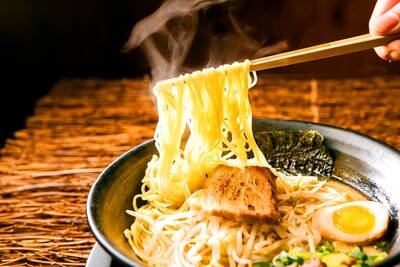
It’s no secret that Japanese people have a deep affection for noodles. Like in the rest of East Asia, noodles are an important staple food, second only to rice. Japanese people have enjoyed noodles for over 1,000 years. The first noodles came from China and were introduced around 800 CE. As time passed, noodles in Japan not only became widespread but also developed some unique Japanese characteristics. The three most popular types of noodles in Japan are ramen, soba, and udon. Ramen, typically made from wheat flour, is usually thin and firm. The dough is kneaded and left to
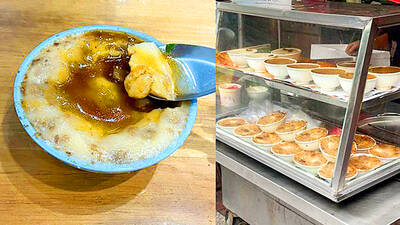
Rice is an essential ingredient in Taiwanese cuisine. Many foods are made of rice, adding more variety to our cooking, such as rice cake, or “gui.” Wagui is made by steaming rice flour batter in a bowl. The term “gui” refers to a type of food made from rice, while “wa” refers to a bowl. The pronunciation of “gui” in Taiwanese Hokkien is similar to the word for “nobility” in Chinese, so it is common for people to prepare various types of gui, including wagui, as offerings to the gods or ancestors,. 米是台灣重要的主食,用米製成的食品十分多元,豐富我們的飲食,如米做成的「粿」。粿的意思是米做成的糕點,碗粿是將在來米漿倒入碗中蒸熟,因而得名。粿因為音同「貴」,因此碗粿等粿食常用作供品祭拜神明和祖先。 nobility (n.) 高貴,高尚;貴族 offering (n.) 供品 While Taiwan may not be
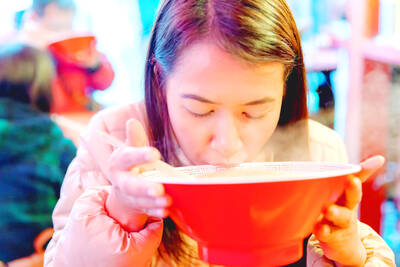
Continued from yesterday(延續自昨日) https://www.taipeitimes.com/News/lang As with many aspects of Japanese culture, there is etiquette to follow when you enjoy noodles. To fully experience noodles like a local on your next visit to Japan, consider these simple guidelines. First, be careful where you put your chopsticks. Don’t leave them sticking up in the broth or set them at the side of the bowl. When you have finished eating or if you’re taking a break, place them on the chopstick rest next to the bowl. Also, it is impolite to wave chopsticks around or bring them above mouth-level. Second, don’t take too


 RSS
RSS