


President William Lai (賴清德) today announced a new population strategy with 18 measures to counter Taiwan’s low birthrate and aging population, from monthly subsidies for children up to age 18, to expanded assisted reproduction assistance and policies to create a more family-friendly workplace culture.
Raising children would no longer be the responsibility of the parents alone, but a joint effort by the state, society and businesses, Lai told a news conference at the Presidential Office following a meeting on the nation’s population strategy.
The strategy would move Taiwan fully beyond subsidy-based childcare and toward a publicly supported childcare model, he said.
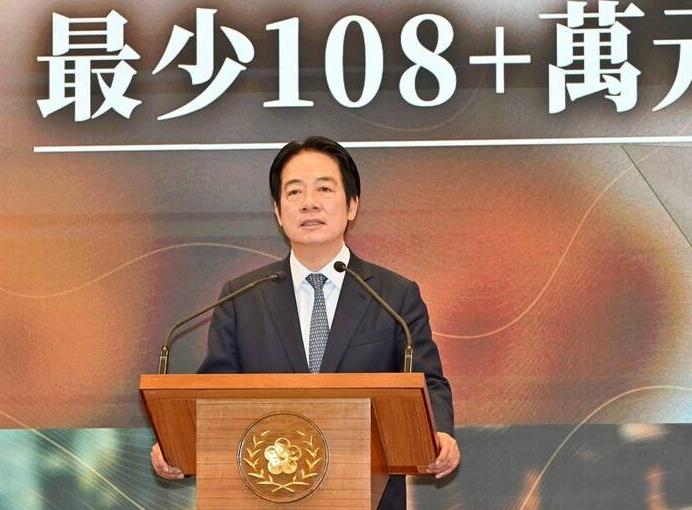
Photo: Tien Yu-hua, Taipei Times
The policy package would require an estimated additional annual budget of NT$205 billion (US$6.52 billion), with total planned funding of NT$380 billion, Presidential Office Deputy Secretary-General Xavier Chang (張惇涵) said.
The 18 strategies are separated into three stages — childbirth, childrearing and education — and four key strategies: increased subsidies, lighter loads, greater flexibility and expanded care, the Presidential Office said.
The policies address five priority areas: a secure start for families, strengthened childcare, investing more in education, family-friendly workplaces and easing housing pressures, it said.
The policy package would benefit both parents equally to support them in balancing childcare responsibilities with work, Lai said.
“An advanced country must never force anyone — especially women — to choose between career and family,” he said.
The policies encompass tax reductions for families with children; extended marriage leave, maternity leave and paternity leave; and maternity insurance benefits.
One of the strategies is to provide a monthly NT$5,000 subsidy to families with children aged up to six, while families with children aged six to 18 would be granted an NT$2,500 monthly payment, with the government investing another NT$2,500 into an interest-generating account that the child may withdraw at age 18.
Those savings accounts would have returns guaranteed at no less than the interest rate of a two-year fixed deposit, and would contain at least NT$360,000 once the child reaches 18, Chang said.
Investing in children is an investment in all three generations of a family, Lai said, adding that the policy aims to support children as they enter the next stage of their lives.
Another notable policy would expand subsidies for assisted reproduction, providing more funding for those under 40 compared with those aged under 45, to encourage earlier treatments with higher efficacy rates, Chang said.
Lai also directed the Executive Yuan to establish a task force to implement the new population strategy and monitor progress, convened by Premier Cho Jung-tai (卓榮泰).
Additional reporting by CNA
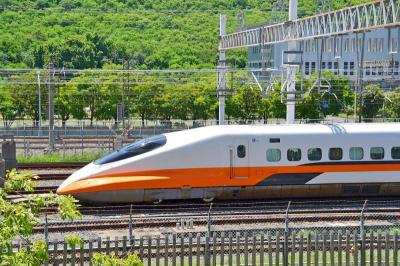
A signaling system malfunction disrupted high-speed rail (HSR) services beginning at 8am today, with trains temporarily reduced to three northbound and three southbound trains per hour as authorities conduct inspections. The malfunction occurred on a section of track in Miaoli County during pre-operation checks early this morning, forcing northbound and southbound trains to use a single track, the HSR operator said. The regular schedule has been replaced with three hourly trains offering only nonreserved seating in each direction, stopping at every station, it said, adding that business class cars would still have reserved seating. Departures from terminal stations are scheduled at the top
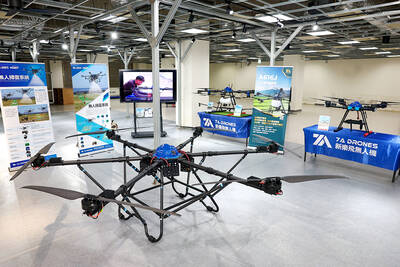
DRONE CENTRAL: Taiwan aims to become Asia’s democratic hub for drones, with most exports focused on high-quality military-grade models, an official said Taiwan’s drone industry is expected to expand significantly by 2030, producing 100,000 units per month and exporting half of them, the Ministry of Economic Affairs said yesterday. Current drone production capacity is about 15,000 units per month, but the industry can quickly scale up as demand increases, Industrial Development Administration Director-General Chiou Chyou-huey (邱求慧) told a news conference in Taipei. Taiwan’s drone output grew 2.5-fold last year to NT$12.9 billion (US$408.3 million) under a government program to develop the uncrewed vehicle sector, he said. The Executive Yuan in October last year approved plans to invest NT$44.2 billion into domestic production of uncrewed aerial
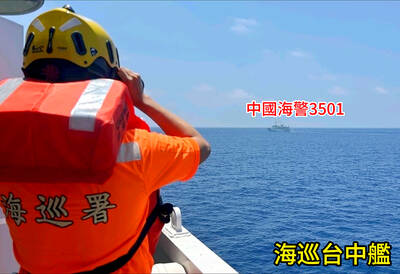
VERBOSE VESSELS: A CGA cutter and a China Coast Guard exchanged verbal barbs for more than a day in Taiwanese-controlled waters before the Chinese vessel left The Taiwanese and Chinese coast guards had a standoff near the strategically located Pratas Islands (Dongsha Islands, 東沙群島) in the north of the South China Sea, the Coast Guard Administration (CGA) said yesterday. The two sides engaged in intense radio exchanges over sovereignty claims during the 33-hour standoff. China Coast Guard vessel 3501 eventually left the restricted waters, 26.6 nautical miles (49.2km) west of the Pratas Islands, at 5pm yesterday, the CGA said. Lying approximately between southern Taiwan and Hong Kong, the Taiwan-controlled Pratas are seen by some security experts as vulnerable to Chinese attack due to their distance — more than
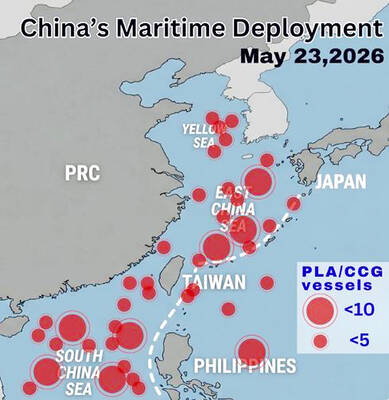
WARNING: China should stop engaging in actions that undermine regional peace and stability, as it would only build resentment among people across the Strait, the CGA said China has deployed more than 100 navy, coast guard and other vessels in waters from the Yellow Sea to the South China Sea and the western Pacific since US President Donald Trump and Chinese President Xi Jinping (習近平) met in Beijing, National Security Council Secretary-General Joseph Wu (吳釗燮) said yesterday. “In this part of the world, #China is the one & only PROBLEM wrecking the #StatusQuo & threatening regional peace & stability,” Wu wrote on X. In a separate post, he said Beijing was coercing Taiwan’s maritime domain, calling it illegal and provocative, after the Coast Guard Administration (CGA) expelled a


 RSS
RSS