


US President Donald Trump said a deal with Iran on the war in the Middle East, including opening the Strait of Hormuz, has been “largely negotiated” after calls with Israel and other allies in the region over the weekend.
But other officials counseled caution yesterday, with US Secretary of State Marco Rubio noting that “significant progress, although not final progress has been made” in the negotiations.
Rubio, on a visit to India for meetings with Indian, Australian and Japanese officials, said he hoped that there would be good news soon.
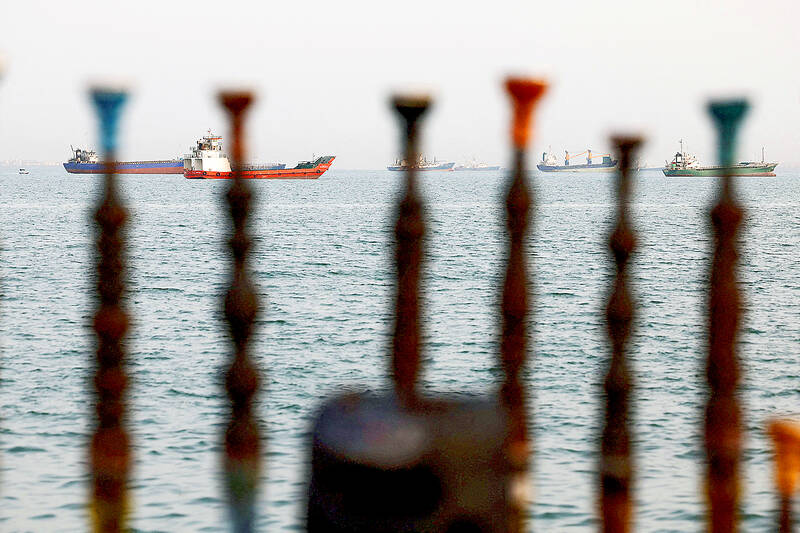
Photo: Reuters
The negotiations have succeeded in one of Trump’s main aims, Rubio said, “that is a world that no longer has to be in fear or worry about an Iranian nuclear weapon.”
Trump said on Saturday he had spoken with leaders from Saudi Arabia, the United Arab Emirates, Qatar, Pakistan, Turkey, Egypt, Jordan and Bahrain and separately with Israel.
“Final aspects and details of the Deal are currently being discussed, and will be announced shortly,” Trump said on social media, without amplification.
The announcement ended a week in which the US weighed a new round of attacks on Iran that would break a fragile ceasefire.
The potential deal would include Iran’s commitment that it would not pursue a nuclear weapon and Tehran agreed to give up its stockpile of highly enriched uranium, according to two regional officials.
One official, with direct knowledge of the negotiations, said how Iran would give up its highly enriched uranium would be negotiated over the course of a 60-day period.
It is likely that a part of the amount would be diluted, while the rest would be transferred to a third country, potentially Russia, he said.
Iran has 440.9kg of uranium that is enriched up to 60 percent purity, a short, technical step from weapons-grade levels of 90 percent, according to the International Atomic Energy Agency.
The Strait of Hormuz would be opened in parallel with the US ending its blockade of Iran’s ports, said the official.
The US would allow Iran to sell its oil through sanctions waivers, said an official who has been briefed on the negotiations. Sanctions relief and release of Iran’s frozen funds would be negotiated during the 60-day time frame, he said.
Both officials said the draft deal includes an end of the war between Israel and Hezbollah, as well as a commitment of not interfering in the domestic affairs of countries in the region. The officials spoke on condition of anonymity to discuss closed-door deliberations.
Twelve weeks have passed since the US and Israel attacked Iran on Feb. 28, killing top Iranian officials, including its supreme leader, and interrupting nuclear talks between the US and Iran for the second time in less than a year. Iran fired at Israel and at neighbors hosting US forces, shaking Gulf nations that considered themselves safe havens in a tough region.
A ceasefire has held since April 7. However, Iran’s decision to effectively close the Strait of Hormuz for ships carrying regional oil, natural gas and other cargo has brought global concern and economic pain.

DRONE CENTRAL: Taiwan aims to become Asia’s democratic hub for drones, with most exports focused on high-quality military-grade models, an official said Taiwan’s drone industry is expected to expand significantly by 2030, producing 100,000 units per month and exporting half of them, the Ministry of Economic Affairs said yesterday. Current drone production capacity is about 15,000 units per month, but the industry can quickly scale up as demand increases, Industrial Development Administration Director-General Chiou Chyou-huey (邱求慧) told a news conference in Taipei. Taiwan’s drone output grew 2.5-fold last year to NT$12.9 billion (US$408.3 million) under a government program to develop the uncrewed vehicle sector, he said. The Executive Yuan in October last year approved plans to invest NT$44.2 billion into domestic production of uncrewed aerial
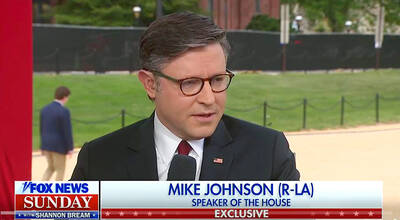
RESOLUTE BACKING: Two Republican senators are planning to introduce legislation that would impose immediate sanctions on China if it attempts to invade Taiwan US House of Representatives Speaker Mike Johnson on Sunday reaffirmed US congressional support for Taiwan, saying the US and “all freedom-loving people” have a stake in preventing China from seizing Taiwan by force. Johnson made the remarks in an interview with Fox News Sunday on US President Donald Trump’s summit with Chinese President Xi Jinping (習近平) last week. In an interview that aired on Friday on Fox News, just as Trump wrapped up a high-stakes visit to China, he said he has yet to green-light a new US$14 billion arms package to Taiwan and that it “depends on China.” “It’s a very good
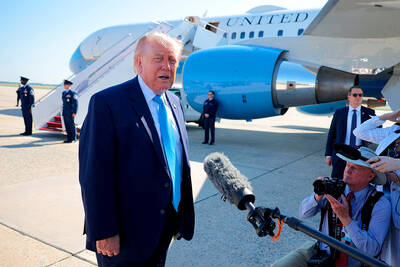
US President Donald Trump yesterday said he would speak to President William Lai (賴清德) as his administration considers whether to move ahead with a US$14 billion weapons sale to Taiwan — a potential arms deal that has drawn criticism from China. “Well, I’ll speak to him. I speak to everybody,” Trump told reporters yesterday when asked if he had any plans to call his counterpart, although he did not offer a time frame for when such a conversation could take place. Trump previously said he would speak to the person “that’s running Taiwan,” without specifying who he meant. “We have that situation very

SPEAKING UP: If he had the opportunity to talk with Trump, Lai said he would tell the US president that China was undermining peace in the region The future of Taiwan must not be decided by external forces nor can it be held hostage by fear, division or short-term gain, President William Lai (賴清德) said yesterday in an address marking the second anniversary of his inauguration. Speaking at the Presidential Office, Lai said democracy is the most important part of Taiwan’s identity, and it is not a gift from heaven. Taiwan’s democracy is rooted in the sacrifices and devotion of many generations, and while differences are inevitable, he urged the ruling and opposition parties to demonstrate unity in confronting external threats and upholding national interests. “Taiwan’s future cannot be decided


 RSS
RSS