


The Centers for Disease Control (CDC) yesterday confirmed the nation’s first case of mpox clade Ib and another case of hantavirus in northern Taiwan.
Two new cases of mpox were confirmed this month: a local case involving a man in his 40s in northern Taiwan and an imported case involving a man in his 20s, CDC Epidemic Intelligence Center Director Guo Hung-wei (郭宏偉) said.
Through genotyping to identify the virus strains, the imported case was confirmed to be mpox clade Ib.
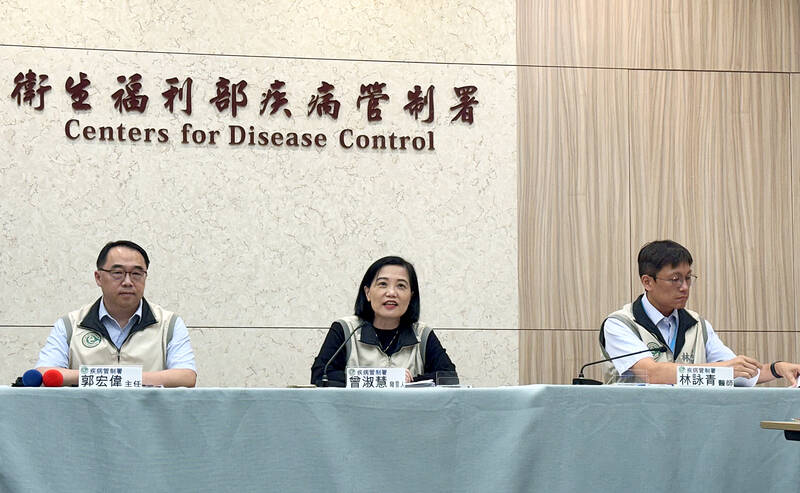
Photo: CNA
This is the first case of this variant in Taiwan since mpox was listed as a notifiable communicable disease in 2022, he said.
Both men had not been vaccinated against mpox, he said.
A total of 530 cases — 493 local and 37 imported — have been reported since mpox was listed as a notifiable communicable disease, including 14 cases — 12 local and two imported — this year, he said.
CDC physician Lin Yung-ching (林詠青) said the latest imported case reported that he had unprotected sex with anonymous partners in Thailand last month, and developed blisters in his genital area, followed by rashes over his limbs after returning to Taiwan. He was later confirmed to have contracted mpox clade Ib.
The man has completed the first phase of self-health management and is undergoing the second phase, Lin said.
The CDC had imposed stricter quarantine measures for mpox clade Ib cases due to its higher rates of serious illness and mortality, but the measures were later loosened after referencing studies that suggested clade I and clade II infections pose similar health risks, as well as guidelines from the WHO and some countries or regions, including the EU, the UK and the US, he said.
After receiving proper treatment, the man has recovered and was scheduled to be discharged from hospital yesterday.
HANTAVIRUS
CDC Deputy Director-General and spokesperson Tseng Shu-hui (曾淑慧) said a new local case of hantavirus syndrome was confirmed last week, the third this year, which is similar to the number of accumulated cases during the same period over the past four years, he said.
A total of 46 cases have been reported since 2017, of which 31 cases were men and 31 were aged 40 years or older, she said.
The new case is a man in his 40s living in northern Taiwan, who does not have underlying health conditions and had not traveled overseas, Guo said.
The man was bitten by a rat at work on April 7 and sought emergency care, including treatment for his wound and a tetanus vaccine, Lin said.
However, he developed a fever, chills, weakness in the limbs, loss of appetite and diarrhea from May 2, so he sought treatment at a clinic twice, Lin said.
As his symptoms persisted, he sought emergency treatment at a hospital. He was hospitalized and tested, and reported as a suspected case of hantavirus syndrome or other communicable diseases, Lin said.
CDC lab test results confirmed that the man has hantavirus hemorrhagic fever with renal syndrome, and genome sequencing showed he was infected with the Seoul virus strain, Lin said.
DIFFERENT STRAIN
The man’s condition should not be confused with that on a cruise ship in South America, in which the passengers contracted “hantavirus pulmonary syndrome,” Lin said.
Common symptoms of hantavirus hemorrhagic fever with renal syndrome include sudden fever, lower back pain, skin and mucous membrane bleeding, and renal dysfunction, and the mortality rate is lower at about 5 to 10 percent, Lin said.
Tseng said the best way to prevent hantavirus syndrome is limiting rodent access to living spaces and safely cleaning droppings with diluted bleach, while wearing protective clothing and a mask to avoid breathing in virus particles.
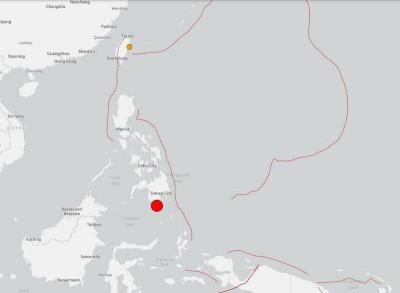
A magnitude 7.8 earthquake struck off the southern coast of Mindanao in the Philippines at 7:38am today, prompting the US Tsunami Warning System to issue an alert for neighboring countries, including Taiwan. The system issued a purple alert indicating a "tsunami threat." The potential threat zone includes Taiwan, the Philippines, Papua New Guinea, Yap and Palau. Philippine authorities were assessing the damage from the quake, with the office of civil defense seeking to verifying initial reports that 15 people had been killed and 129 injured in the region, mostly from falling debris. Arlene Hollero, disaster chief of Maasim town in the Philippines' Sarangani Province,

‘GRAY ZONE’ PRESSURE: Beijing’s activities are intended to create the deceitful impression that China has jurisdiction over the area around Taiwan, the CGA said Taiwan’s rights over its territorial waters and exclusive economic zone must not be violated by any country, the Mainland Affairs Council said yesterday, adding that it will not accept any unprovoked actions. The council issued the remarks in response to the China Coast Guard conducting maritime enforcement drills near eastern Taiwan and claiming to fully exercise China’s maritime administrative law enforcement authority. The Coast Guard Administration (CGA) has been closely monitoring the situation and is taking concrete steps to defend the nation’s sovereignty and secure its waters, the council said. China has no sovereign rights over the waters off eastern

RESILIENCE: Taiwan plays a key role in semiconductors, energy, information infrastructure and advanced manufacturing, AIT Director Raymond Greene said Taiwan’s continued investment in deterrence and resilience remains vital, especially in uncrewed systems and other emerging technologies, American Institute in Taiwan (AIT) Director Raymond Greene said yesterday. Greene made the remarks at the annual National Strategic Summit on Supply Chain Resilience held by the Research Institute for Democracy, Society and Emerging Technology (DSET), a government-backed think tank. As Taiwan last year became the US’ fourth-largest trading partner and supply chain security is becoming more important, cooperation in emerging technologies continues to deepen between the two countries, he said. The US is committed to accelerating innovation, building key infrastructure, strengthening cooperation

RIGHT DIRECTION: Taiwan’s efforts to prevent forced labor include a proposal to ‘fully prohibit’ employers from withholding workers’ documents, an official said Taiwan is to establish a mechanism to restrict imports of goods linked to forced labor, the Executive Yuan said yesterday, after the US proposed imposing additional tariffs on Taiwanese goods over labor concerns. “The Ministry of Labor and the Ministry of Economic Affairs are to establish an interministerial review procedure,” Executive Yuan spokesperson Michelle Lee (李慧芝) said at a news briefing in Taipei. “The government is to use the Foreign Trade Act [貿易法] as the legal basis to restrict imports of goods produced with forced labor” and bring its supply chain governance more in line with international standards on human rights, resilience


 RSS
RSS