


US Secretary of Defense Pete Hegseth on Saturday defended strikes on alleged drug cartel boats during remarks at the Ronald Reagan Presidential Library in Simi Valley, California, saying that US President Donald Trump has the power to take military action “as he sees fit” to defend the nation.
Hegseth dismissed criticism of the strikes, which have killed more than 80 people and face intense scrutiny over concerns that they contravened international law.
Saying the strikes are justified to protect Americans, Hegseth likened the fight to the “war on terror” following the Sept. 11, 2001, attacks.
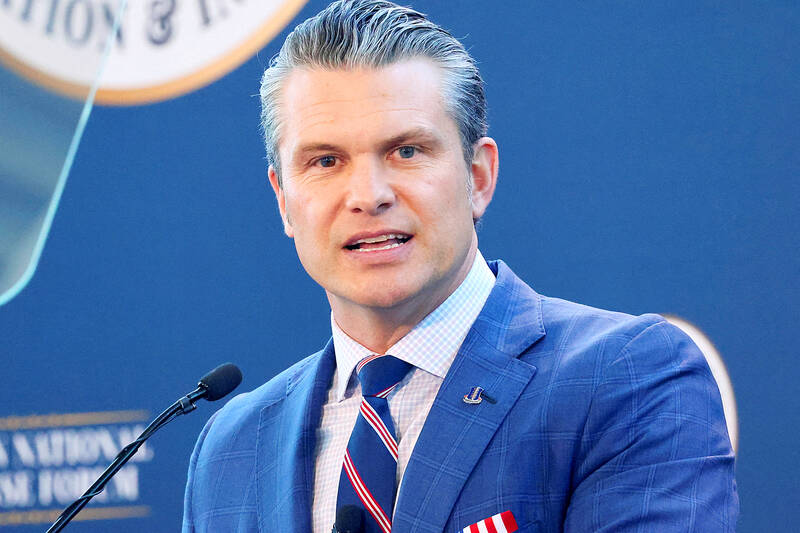
Photo: REUTERS
“If you’re working for a designated terrorist organization and you bring drugs to this country in a boat, we will find you, and we will sink you. Let there be no doubt about it,” Hegseth said during his keynote address at the Reagan National Defense Forum. “President Trump can and will take decisive military action as he sees fit to defend our nation’s interests. Let no country on earth doubt that for a moment.”
The most recent strike brings the death toll of the campaign to at least 87 people. Lawmakers have sought more answers about the attacks and their legal justification, and whether US forces were ordered to launch a follow-up strike following a September attack even after the Pentagon knew of survivors.
Although Hegseth compared the alleged drug smugglers to al-Qaeda, experts have said there are significant differences between the two and the efforts to combat them.
Hegseth’s remarks came after the Trump administration released its new National Security Strategy report, which paints European allies as weak and aims to reassert US dominance in the Western Hemisphere.
During the speech, Hegseth also repeated Trump’s vow to resume nuclear testing on an equal basis as China and Russia — a goal that has alarmed many nuclear arms experts.
China and Russia have not conducted explosive tests in decades, although the Kremlin said it would follow the US if Trump restarted tests.
The event in California brought together top national security experts from around the country. Hegseth used the visit to argue that Trump is Reagan’s “true and rightful heir” when it comes to muscular foreign policy.
By contrast, Hegseth criticized Republican leaders in the years since Reagan for supporting wars in the Middle East and democracy-building efforts that did not work. He also blasted those who have argued that climate change poses serious challenges to military readiness.
“The war department will not be distracted by democracy building, interventionism, undefined wars, regime change, climate change, woke moralizing and feckless nation building,” he said.
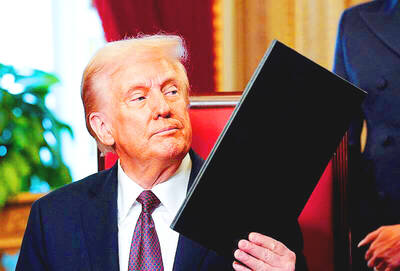
MILESTONE: The foreign minister called the signing ‘a major step forward in US-Taiwan relations,’ while the Presidential Office said it was a symbol of the nations’ shared values US President Donald Trump on Tuesday signed into law the Taiwan Assurance Implementation Act, which requires the US Department of State to regularly review and update guidelines governing official US interactions with Taiwan. The new law is an amendment to the Taiwan Assurance Act of 2020 focused on reviewing guidelines on US interactions with Taiwan. Previously, the state department was required to conduct a one-time review of its guidance governing relations with Taiwan, but under the new bill, the agency must conduct a review “not less than every five years.” It must then submit an updated report based on its findings “not later
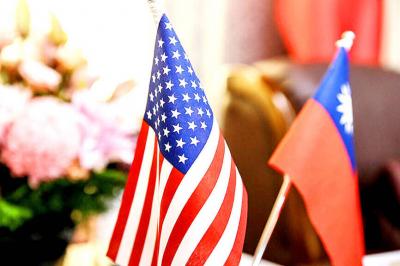
The Presidential Office today thanked the US for enacting the Taiwan Assurance Implementation Act, which requires the US Department of State to regularly review and update guidelines governing official US interactions with Taiwan. The new law, signed by US President Donald Trump yesterday, is an amendment to the Taiwan Assurance Act of 2020 focused on reviewing guidelines on US interactions with Taiwan. Previously, the department was required to conduct a one-time review of its guidance governing relations with Taiwan, but under the new bill, the agency must conduct such a review "not less than every five years." It must then submit an updated
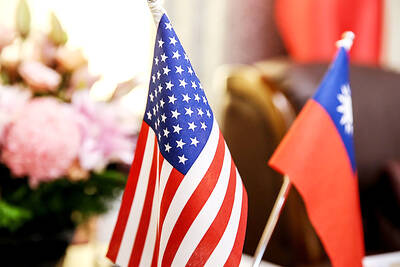
STAYING ALERT: China this week deployed its largest maritime show of force to date in the region, prompting concern in Taipei and Tokyo, which Beijing has brushed off Deterring conflict over Taiwan is a priority, the White House said in its National Security Strategy published yesterday, which also called on Japan and South Korea to increase their defense spending to help protect the first island chain. Taiwan is strategically positioned between Northeast and Southeast Asia, and provides direct access to the second island chain, with one-third of global shipping passing through the South China Sea, the report said. Given the implications for the US economy, along with Taiwan’s dominance in semiconductors, “deterring a conflict over Taiwan, ideally by preserving military overmatch, is a priority,” it said. However, the strategy also reiterated

Taiwanese prosecutors charged Tokyo Electron Ltd for failing to prevent staff from allegedly stealing Taiwan Semiconductor Manufacturing Co (TSMC, 台積電) trade secrets, escalating a dispute involving two Asian linchpins of a chip industry increasingly vital to national and economic security. Prosecutors indicted the Japanese company on four counts of contravening the Trade Secrets Act (營業秘密法) and the National Security Act (國家安全法), they said in a statement yesterday. They’re asking a local court to rule in favor of their request for Tokyo Electron pay a fine of up to NT$120 million (US$3.8 million) for failing in its duty to prevent the alleged


 RSS
RSS