


Australia is to take China before the WTO over Beijing’s imposition of crippling tariffs on Australian wine exports, it announced yesterday, in the latest sign of worsening tensions between the two countries.
The decision “to defend Australia’s winemakers” comes six months after Australia lodged a separate protest at the WTO over tariffs on Australian barley and is in line with the government’s “support for the rules-based trading system,” it said in a statement.
However, it added that “Australia remains open to engaging directly with China to resolve this issue.”
It is the latest incident in an escalating tussle between Australia and its largest trading partner, and follows warnings by Australian Prime Minister Scott Morrison that his government would respond forcefully to countries trying to use “economic coercion” against it.
China in November last year slapped tariffs of up to 218 percent on Australian wines, which it said were being “dumped” on the Chinese market at subsidized prices.
The crackdown virtually closed what had been Australia’s biggest overseas wine market, with sales falling from A$1.1 billion (US$822.9 million) to just A$20 million, official figures showed.
“The actions taken by the Chinese government have caused serious harm to the Australian wine industry,” Australian Minister for Trade, Tourism and Investment Tehan told a news conference announcing the decision to lodge a formal dispute with the WTO.
“We would love to be able to sit down and be able to resolve these disputes” directly with the Chinese, he said.
However, lower-level official contacts had failed to make progress, he added.
“We will use every other mechanism to try and resolve this dispute and other disputes that we have with the Chinese government,” he said.
Tehan said the dispute process within the WTO was difficult and estimated that it would take two to four years to resolve the matter.
Beijing has imposed tough economic sanctions on a range of Australian products in the past few months, ranging from high tariffs to disruptive practices across several agricultural sectors, coal, wine and tourism.
The measures are widely seen in Australia as punishment for pushing back against Beijing’s operations to impose influence in Australia, rejecting Chinese investment in sensitive areas and publicly calling for an investigation into the origins of the COVID-19 pandemic.
Yesterday’s move came just a week after a G7 summit echoed Australia’s call for a tougher stand against China’s trade practices and its more assertive stance globally.
The G7 summit ended on Saturday last week with the announcement of US-led plans to counter China’s Belt and Road Initiative, the hallmark of its efforts to extend economic influence around the world.
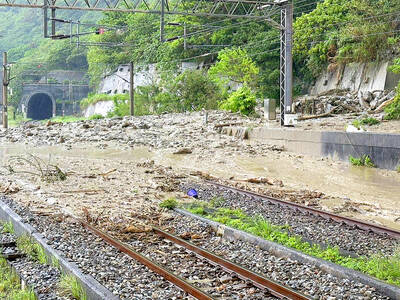
ROLLER-COASTER RIDE: More than five earthquakes ranging from magnitude 4.4 to 5.5 on the Richter scale shook eastern Taiwan in rapid succession yesterday afternoon Back-to-back weather fronts are forecast to hit Taiwan this week, resulting in rain across the nation in the coming days, the Central Weather Administration said yesterday, as it also warned residents in mountainous regions to be wary of landslides and rockfalls. As the first front approached, sporadic rainfall began in central and northern parts of Taiwan yesterday, the agency said, adding that rain is forecast to intensify in those regions today, while brief showers would also affect other parts of the nation. A second weather system is forecast to arrive on Thursday, bringing additional rain to the whole nation until Sunday, it
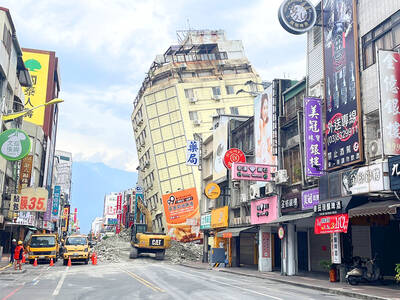
LANDSLIDES POSSIBLE: The agency advised the public to avoid visiting mountainous regions due to more expected aftershocks and rainfall from a series of weather fronts A series of earthquakes over the past few days were likely aftershocks of the April 3 earthquake in Hualien County, with further aftershocks to be expected for up to a year, the Central Weather Administration (CWA) said yesterday. Based on the nation’s experience after the quake on Sept. 21, 1999, more aftershocks are possible over the next six months to a year, the agency said. A total of 103 earthquakes of magnitude 4 on the local magnitude scale or higher hit Hualien County from 5:08pm on Monday to 10:27am yesterday, with 27 of them exceeding magnitude 5. They included two, of magnitude
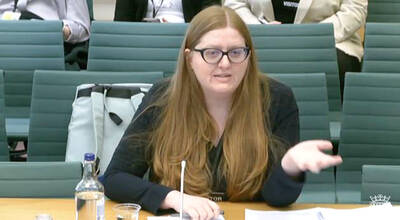
CONDITIONAL: The PRC imposes secret requirements that the funding it provides cannot be spent in states with diplomatic relations with Taiwan, Emma Reilly said China has been bribing UN officials to obtain “special benefits” and to block funding from countries that have diplomatic ties with Taiwan, a former UN employee told the British House of Commons on Tuesday. At a House of Commons Foreign Affairs Committee hearing into “international relations within the multilateral system,” former Office of the UN High Commissioner for Human Rights (OHCHR) employee Emma Reilly said in a written statement that “Beijing paid bribes to the two successive Presidents of the [UN] General Assembly” during the two-year negotiation of the Sustainable Development Goals. Another way China exercises influence within the UN Secretariat is

Taiwan’s first drag queen to compete on the internationally acclaimed RuPaul’s Drag Race, Nymphia Wind (妮妃雅), was on Friday crowned the “Next Drag Superstar.” Dressed in a sparkling banana dress, Nymphia Wind swept onto the stage for the final, and stole the show. “Taiwan this is for you,” she said right after show host RuPaul announced her as the winner. “To those who feel like they don’t belong, just remember to live fearlessly and to live their truth,” she said on stage. One of the frontrunners for the past 15 episodes, the 28-year-old breezed through to the final after weeks of showcasing her unique


 RSS
RSS