


The New Taiwan dollar yesterday closed at its highest level since 1997 and more gains are likely on the way as the central bank eases its grip on the currency.
The NT dollar gained 0.5 percent to NT$28.521 against the US dollar at the close, stronger than its NT$28.632 high in 2011.
The currency rose 1 percent over the past five sessions, advancing for a fifth week, the longest run since July.
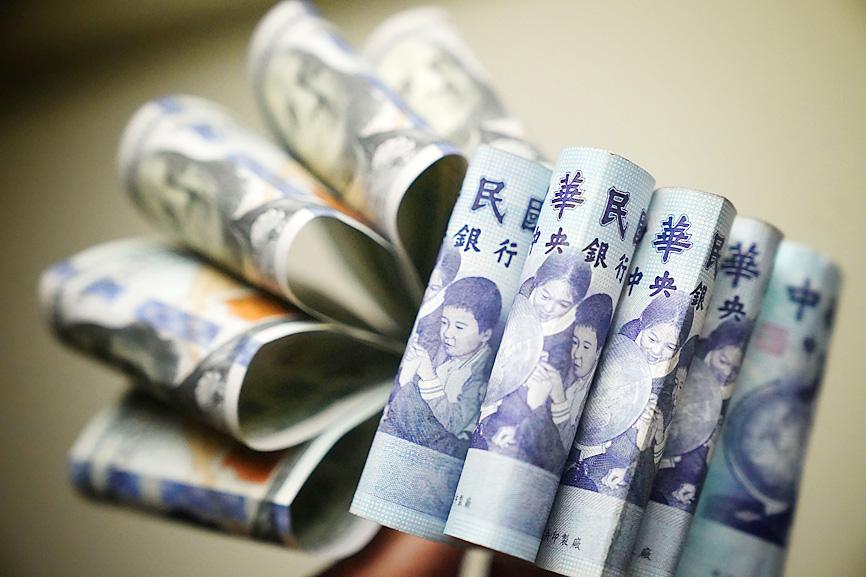
Photo: CNA
Surging fund inflows that sent the TAIEX to a record of 14,132.44 yesterday and the resilient economy are putting pressure on the currency to appreciate.
One-month forwards on the NT dollar are at an all-time low, signaling further gains ahead.
Analysts predict that the currency will continue its ascent, climbing to 28.4 by the end of next quarter, according to the median estimate in a Bloomberg survey.
“This could be the trigger point,” said Stephen Chiu (趙志軒), a strategist for Bloomberg Intelligence. “As long as broad US dollar weakness continues and Taiwan’s multilateral exchange rates are still not overvalued in the eyes of Taiwan’s central bank, then the exchange rate may head further downward.”
After trading ended for the day, Yen Hui-huang (顏輝煌), director of the Department of Foreign Exchange at the central bank, said that there is “no so-called line of defense” for the currency.
“The exchange rate is decided by the market’s supply and demand,” Yen said.
The central bank said in a statement after the close of trading that foreign exchange reserves last month rose US$12.2 billion from a month earlier to US$513.4 billion, due in part to its measures to “smooth” the currency market after large capital inflows caused volatility.
The monthly increase was the biggest on record, according to central bank data going back to 2003.
The NT dollar’s new high came after central bank Governor Yang Chin-long (楊金龍) this week promised lawmakers that he would provide more information about efforts to curb the currency’s advance.
Such intervention can draw the unwelcome attention of the US Department of the Treasury.
The local currency on Thursday breached a key intraday resistance level that is closely watched in Taiwan. That level is at NT$28.5 and is called the “Perng Fai-nan line” (彭淮南防線), after the central bank governor from 1998 to 2018.
Perng is credited with mostly keeping the currency from appreciating past that mark from the Asian Financial Crisis to his last day on the job, primarily to protect exporters.
Recent stability in the local currency meant that it had fallen behind neighboring exporters.
Now the question for traders is where Perng’s successor and long-time deputy Yang will draw the next line in the sand and how long that will hold.
There are “very strong expectations” that Taiwan’s currency will advance, said Zhou Hao (周浩), senior emerging markets economist at Commerzbank AG. “It will be very difficult for there to be any significant retreat in the near term.”
RETHINK? The defense ministry and Navy Command Headquarters could take over the indigenous submarine project and change its production timeline, a source said Admiral Huang Shu-kuang’s (黃曙光) resignation as head of the Indigenous Submarine Program and as a member of the National Security Council could affect the production of submarines, a source said yesterday. Huang in a statement last night said he had decided to resign due to national security concerns while expressing the hope that it would put a stop to political wrangling that only undermines the advancement of the nation’s defense capabilities. Taiwan People’s Party Legislator Vivian Huang (黃珊珊) yesterday said that the admiral, her older brother, felt it was time for him to step down and that he had completed what he
Taiwan has experienced its most significant improvement in the QS World University Rankings by Subject, data provided on Sunday by international higher education analyst Quacquarelli Symonds (QS) showed. Compared with last year’s edition of the rankings, which measure academic excellence and influence, Taiwanese universities made great improvements in the H Index metric, which evaluates research productivity and its impact, with a notable 30 percent increase overall, QS said. Taiwanese universities also made notable progress in the Citations per Paper metric, which measures the impact of research, achieving a 13 percent increase. Taiwanese universities gained 10 percent in Academic Reputation, but declined 18 percent
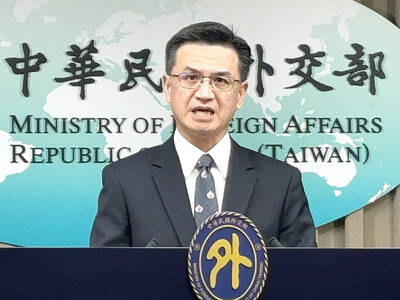
BULLY TACTICS: Beijing has continued its incursions into Taiwan’s airspace even as Xi Jinping talked about Taiwan being part of the Chinese family and nation China should stop its coercion of Taiwan and respect mainstream public opinion in Taiwan about sovereignty if its expression of goodwill is genuine, the Ministry of Foreign Affairs (MOFA) said yesterday. Ministry spokesman Jeff Liu (劉永健) made the comment in response to media queries about a meeting between former president Ma Ying-jeou (馬英九) and Chinese President Xi Jinping (習近平) the previous day. Ma voiced support for the so-called “1992 consensus,” while Xi said that although the two sides of the Taiwan Strait have “different systems,” this does not change the fact that they are “part of the same country,” and that “external

UNDER DISCUSSION: The combatant command would integrate fast attack boat and anti-ship missile groups to defend waters closest to the coastline, a source said The military could establish a new combatant command as early as 2026, which would be tasked with defending Taiwan’s territorial waters 24 nautical miles (44.4km) from the nation’s coastline, a source familiar with the matter said yesterday. The new command, which would fall under the Naval Command Headquarters, would be led by a vice admiral and integrate existing fast attack boat and anti-ship missile groups, along with the Naval Maritime Surveillance and Reconnaissance Command, said the source, who asked to remain anonymous. It could be launched by 2026, but details are being discussed and no final timetable has been announced, the source


 RSS
RSS