


The government is to revisit the “Kuan Hung Pilot Project” after 152 of 153 Vietnamese visitors in tour groups went missing last week, the largest group of runaway tourists since the project began in 2015, the Tourism Bureau said yesterday.
The project to issue electronic visas is designed to increase the number of quality tour groups visiting from India, Indonesia, Vietnam, Myanmar, Cambodia and Laos — nations targeted by the New Southbound Policy.
The tourists were able to travel to Taiwan because of the project, bureau Director-General Chou Yung-hui (周永暉) said, adding that the agency would strengthen visa reviews.
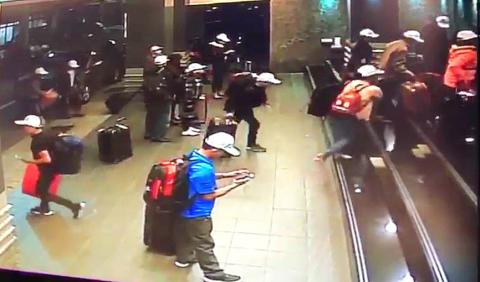
Photo copied by Huang Liang-chieh, Taipei Times
It would also work with the National Immigration Agency (NIA) and the Ministry of Foreign Affairs’ (MOFA) Bureau of Consular Affairs to randomly select applications for additional inspection, Chou added.
Asked if the government would consider revising the project, Chou said that the Tourism Bureau has been notified that it should soon attend a meeting of the Executive Yuan’s Tourism Development and Promotion Committee to discuss problems facing the project.
“What happened last week was an isolated case. There are still quality tour groups and we should not view the project with so much negativity,” the Tourism Bureau said. “The NIA still needs to investigate details involving this incident and we will propose complementary measures accordingly to handle similar situations.”
The tour groups were formed by Vietnamese travel agency International Holidays Trading Travel, then were taken over by ETHoliday (東森國際旅行社) upon arrival.
After the incident, the Bureau of Consular Affairs canceled the visas granted to 182 tourists who had booked trips with International Holidays Trading Travel, but have not yet entered the country, the Tourism Bureau said, adding that it has also stopped reviewing visa applications filed by the agency.
Travel agents said that the incident is an example of how human traffickers are able to exploit loopholes in the project.
ETHoliday last week handled five tour groups from Vietnam, Taiwan International Tourist Aid Rescue Association chairman Roget Hsu (許高慶) said.
The first group of 23 people arrived in Kaohsiung on Friday for a five-day tour, while the four other groups with a total of 130 tourists entered through Tainan Airport on Sunday for a four-day tour, he said, adding that all five groups spent the night at two hotels in Kaohsiung.
Human traffickers reportedly arranged cars to pick the visitors up at the airports, Hsu said.
The first group’s Taiwanese tour guide resisted and called the police, who said they could not make any arrests, as the tourists had valid tourist visas, he said.
Seven visitors in the first group had left by Monday morning, while the remaining 16 went missing by Tuesday morning, he said.
Of the 130 tourists who arrived on Sunday, 128 went missing by Monday morning, while one other had left by Tuesday, Hsu said.
Tourists from the countries included in the program are not required to present a financial statement when applying for a visa, so Vietnamese travel agencies should help by running preliminary checks, he said, adding that it is unreasonable that Taiwanese travel agencies should have to pay for the deportation cost of every runaway tourist.
The one remaining visitor was the only real tourist, meaning that even the tour guides were disingenuous, the Tourism Bureau said.
All of the visitors had purchased round-trip tickets, it added.
The NIA has obtained the list of tourists from ETHoliday and are searching for the missing people.
MOFA said it has revoked the visas of the missing travelers and has asked the NIA to locate and deport them.
It also urged the Executive Yuan to call a meeting to discuss ways to tighten visa application reviews.
Since 2015, 414 tourists arriving through the project have been reported missing, 409 of whom were Vietnamese, while five were Cambodian, Tourism Bureau data showed.
Additional reporting by Lu Yi-hsuan

ROLLER-COASTER RIDE: More than five earthquakes ranging from magnitude 4.4 to 5.5 on the Richter scale shook eastern Taiwan in rapid succession yesterday afternoon Back-to-back weather fronts are forecast to hit Taiwan this week, resulting in rain across the nation in the coming days, the Central Weather Administration said yesterday, as it also warned residents in mountainous regions to be wary of landslides and rockfalls. As the first front approached, sporadic rainfall began in central and northern parts of Taiwan yesterday, the agency said, adding that rain is forecast to intensify in those regions today, while brief showers would also affect other parts of the nation. A second weather system is forecast to arrive on Thursday, bringing additional rain to the whole nation until Sunday, it

CONDITIONAL: The PRC imposes secret requirements that the funding it provides cannot be spent in states with diplomatic relations with Taiwan, Emma Reilly said China has been bribing UN officials to obtain “special benefits” and to block funding from countries that have diplomatic ties with Taiwan, a former UN employee told the British House of Commons on Tuesday. At a House of Commons Foreign Affairs Committee hearing into “international relations within the multilateral system,” former Office of the UN High Commissioner for Human Rights (OHCHR) employee Emma Reilly said in a written statement that “Beijing paid bribes to the two successive Presidents of the [UN] General Assembly” during the two-year negotiation of the Sustainable Development Goals. Another way China exercises influence within the UN Secretariat is
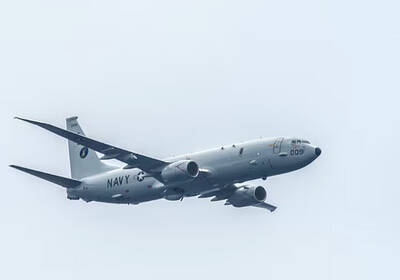
CHINA REACTS: The patrol and reconnaissance plane ‘transited the Taiwan Strait in international airspace,’ the 7th Fleet said, while Taipei said it saw nothing unusual The US 7th Fleet yesterday said that a US Navy P-8A Poseidon flew through the Taiwan Strait, a day after US and Chinese defense heads held their first talks since November 2022 in an effort to reduce regional tensions. The patrol and reconnaissance plane “transited the Taiwan Strait in international airspace,” the 7th Fleet said in a news release. “By operating within the Taiwan Strait in accordance with international law, the United States upholds the navigational rights and freedoms of all nations.” In a separate statement, the Ministry of National Defense said that it monitored nearby waters and airspace as the aircraft

Taiwan’s first drag queen to compete on the internationally acclaimed RuPaul’s Drag Race, Nymphia Wind (妮妃雅), was on Friday crowned the “Next Drag Superstar.” Dressed in a sparkling banana dress, Nymphia Wind swept onto the stage for the final, and stole the show. “Taiwan this is for you,” she said right after show host RuPaul announced her as the winner. “To those who feel like they don’t belong, just remember to live fearlessly and to live their truth,” she said on stage. One of the frontrunners for the past 15 episodes, the 28-year-old breezed through to the final after weeks of showcasing her unique


 RSS
RSS