


A document cited by the Chinese Nationalist Party (KMT) when it accused Democratic Progressive Party (DPP) Chairperson Tsai Ing-wen (蔡英文) of improper involvement in a biotechnology company was altered twice with a “vicious motive” before it went public, the DPP said yesterday.
Council for Economic Planning and Development (CEPD) Minister Christina Liu (劉憶如) on Dec. 12 disclosed a document dated March 31, 2007, which the KMT used to accuse Tsai of wrongdoing in the formation of Yu Chang Biologics Co (宇昌生技股份有限公司), now known as TaiMed Biologics Inc (中裕新藥股份有限公司), when Tsai served as vice premier.
Liu apologized the next day for “confusing the dates” of the document, which was actually from Aug. 19, 2007, but denied that she had forged the document.
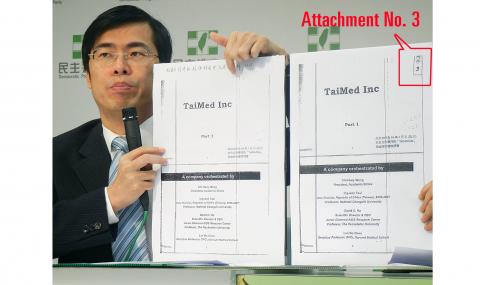
Photo: Li Hsin-fang, Taipei Times
DPP spokesperson Chen Chi-mai (陳其邁) told a press conference yesterday that Liu and the KMT were suspected of not only altering the date on the document, but also erasing the marking tag of “Attachment No. 3” to cover up the fact that it was one of six attachments to that document.
Liu said her agency confused the date because the document’s Attachment No. 2 was missing, an excuse that Chen described as weak.
The minister — or the KMT — could have intentionally altered the date and removed the attachment marking on the document, which stated that Tsai would be one of Yu Chang’s core leaders, so people would assume Tsai had planned to make an improper profit when she was in government, Chen said.
Tsai served as vice premier from 2006 to 2007 and resigned on May 20, 2007, before being named as Yu Chang’s chairperson in August that year.
“What they did was simple. Whoever did this — Liu or the KMT ... took out Attachment No. 3 from the Aug. 19 document, removed the marking and said it was a March 31 presentation, so the public would believe that Tsai [was guilty of] improper conduct as vice premier,” Chen said. “We wonder who made the alterations. Was it Liu or the KMT legislative caucus?”
“The DPP strongly condemns the forgery,” Chen added , demanding that Liu disclose all six attachments of the Aug. 19 document and explain who altered the document, as well as when and where the document was forged.
Chen also urged the Supreme Prosecutor’s Office Special Investigation Division (SID) and Prosecutor-General Huang Shyh-ming (黃世銘) to disclose all the documents related to the so-called “Yu Chang case,” which had been seized by the SID, for the public to examine.
Chen reiterated that Tsai’s role in the case was clear — that she wanted to do her best to help with the development of Taiwan’s biotechnology industry and that she never imagined that she would be persuaded by scientists to serve as the company’s chair.
“Liu claimed that the case was complicated because she sees the world through stained glasses,” Chen said.
The evidence that the DPP has provided showed that this was a KMT smear campaign and there could be someone behind the scenes who manipulated the entire case in an effort to discredit Tsai’s presidential campaign, DPP spokesperson Chuang Ruei-hsiung (莊瑞雄) added.
“Our question for Liu is a simple one: Why did she pull the attachment from the Aug. 19 document and change the date to March 31?” he said.
At a separate setting yesterday, KMT Legislator Hung Hsiu-chu (洪秀柱) rebutted the DPP’s allegation, saying the KMT caucus did not alter the copy of the document provided by the CEPD in any way.

ROLLER-COASTER RIDE: More than five earthquakes ranging from magnitude 4.4 to 5.5 on the Richter scale shook eastern Taiwan in rapid succession yesterday afternoon Back-to-back weather fronts are forecast to hit Taiwan this week, resulting in rain across the nation in the coming days, the Central Weather Administration said yesterday, as it also warned residents in mountainous regions to be wary of landslides and rockfalls. As the first front approached, sporadic rainfall began in central and northern parts of Taiwan yesterday, the agency said, adding that rain is forecast to intensify in those regions today, while brief showers would also affect other parts of the nation. A second weather system is forecast to arrive on Thursday, bringing additional rain to the whole nation until Sunday, it

CONDITIONAL: The PRC imposes secret requirements that the funding it provides cannot be spent in states with diplomatic relations with Taiwan, Emma Reilly said China has been bribing UN officials to obtain “special benefits” and to block funding from countries that have diplomatic ties with Taiwan, a former UN employee told the British House of Commons on Tuesday. At a House of Commons Foreign Affairs Committee hearing into “international relations within the multilateral system,” former Office of the UN High Commissioner for Human Rights (OHCHR) employee Emma Reilly said in a written statement that “Beijing paid bribes to the two successive Presidents of the [UN] General Assembly” during the two-year negotiation of the Sustainable Development Goals. Another way China exercises influence within the UN Secretariat is

LANDSLIDES POSSIBLE: The agency advised the public to avoid visiting mountainous regions due to more expected aftershocks and rainfall from a series of weather fronts A series of earthquakes over the past few days were likely aftershocks of the April 3 earthquake in Hualien County, with further aftershocks to be expected for up to a year, the Central Weather Administration (CWA) said yesterday. Based on the nation’s experience after the quake on Sept. 21, 1999, more aftershocks are possible over the next six months to a year, the agency said. A total of 103 earthquakes of magnitude 4 on the local magnitude scale or higher hit Hualien County from 5:08pm on Monday to 10:27am yesterday, with 27 of them exceeding magnitude 5. They included two, of magnitude

Taiwan’s first drag queen to compete on the internationally acclaimed RuPaul’s Drag Race, Nymphia Wind (妮妃雅), was on Friday crowned the “Next Drag Superstar.” Dressed in a sparkling banana dress, Nymphia Wind swept onto the stage for the final, and stole the show. “Taiwan this is for you,” she said right after show host RuPaul announced her as the winner. “To those who feel like they don’t belong, just remember to live fearlessly and to live their truth,” she said on stage. One of the frontrunners for the past 15 episodes, the 28-year-old breezed through to the final after weeks of showcasing her unique


 RSS
RSS