


Newly-discovered electrical circuit problems with the Taurus rocket which will be used to launch ROCSAT-2, Taiwan's second satellite, have delayed the scheduled liftoff from Jan. 17 to Feb. 26, according to the National Space Program Office (NSPO) yesterday.
According to Lee Luo-chuan (李羅權), the president of the National Applied Research laboratories and NSPO director, US Orbital Sciences Corp (OSC), the operator of the Taurus launch vehicle, sent an official letter yesterday morning informing the office that it would take five more weeks to solve the electrical problems.
"The unexpected delay can be entirely attributed to OSC instead of NSPO, which has done its best for the launch," Lee said yesterday at a press conference.
According to Lee, OSC Chairman and CEO David Thompson discussed the electrical problems with him via telephone Tuesday, suggesting that the launch should be postponed.
Lee immediately demanded an official letter describing problems and possible solutions.
Last Thursday, technicians found abnormal electrical current levels when a newly-repaired electronic control unit (ECU) installed in the launch vehicle was switched on for the first time.
Lee said it remains uncertain if the ECU, which was temporarily overloaded, can still function properly.
The ECU plays a key role in adjusting the direction of a satellite blasted into orbit on a rocket.
Abnormal vibration of the ECU installed on the rocket previously postponed the launch from the end of this month to Jan. 17.
"Under the circumstances, OSC will have to either revise the circuit design or use a new ECU," Lee said.
Based on the contract, OSC will have to pay US$36,000 for each day caused by the delay.
Lee said he still had faith in the reliability of OSC because the Taurus rocket, a four-stage, ground-launched vehicle, had successfully launched several satellites this year.
"We agreed to the delay in order to ensure the successful of liftoff of ROCSAT-2 and its future normal operation in space," Lee said.
NSPO scientists said that similar electric circuit problems have been seen before. Abnormal electrical current caused malfunction of the solar panels of a Japanese satellite, resulting in the failure of the satellite in space, they said.
NSPO deputy director Chen Shao-shing (陳紹興), said the delay of ROCSAT-2's launch was an unexpected because electrical circuit design was a very basic task, which should have been easily managed.
Chen said that ROCSAT-2 arrived at Vandenberg Air Force Base in California on Dec. 2. A three-day test conducted by an NSPO team suggested that the satellite itself was in excellent condition.
The satellite should be coupled with the Taurus launch vehicle at least 13 days prior to liftoff.
Chen said that the NSPO would soon recall most of its staff, who arrived at Vandenberg Air Force Base earlier this month to conduct pre-preparation for the launch.
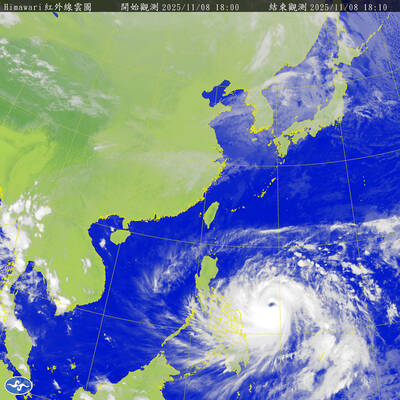
The Central Weather Administration (CWA) yesterday said it expected to issue a sea warning for Typhoon Fung-Wong tomorrow, which it said would possibly make landfall near central Taiwan. As of 2am yesterday, Fung-Wong was about 1,760km southeast of Oluanpi (鵝鑾鼻), Taiwan’s southernmost point, moving west-northwest at 26kph. It is forecast to reach Luzon in the northern Philippines by tomorrow, the CWA said. After entering the South China Sea, Typhoon Fung-Wong is likely to turn northward toward Taiwan, CWA forecaster Chang Chun-yao (張峻堯) said, adding that it would likely make landfall near central Taiwan. The CWA expects to issue a land
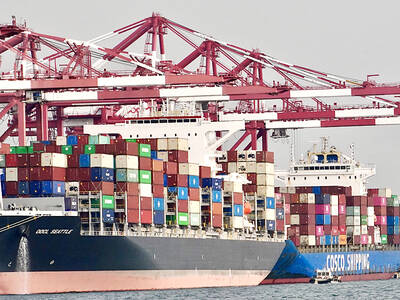
Taiwan’s exports soared to an all-time high of US$61.8 billion last month, surging 49.7 percent from a year earlier, as the global frenzy for artificial intelligence (AI) applications and new consumer electronics powered shipments of high-tech goods, the Ministry of Finance said yesterday. It was the first time exports had exceeded the US$60 billion mark, fueled by the global boom in AI development that has significantly boosted Taiwanese companies across the international supply chain, Department of Statistics Director-General Beatrice Tsai (蔡美娜) told a media briefing. “There is a consensus among major AI players that the upcycle is still in its early stage,”
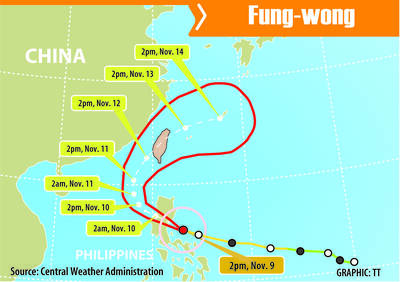
The Central Weather Administration (CWA) yesterday said it is expected to issue a sea warning for Typhoon Fung-wong this afternoon and a land warning tomorrow. As of 1pm, the storm was about 1,070km southeast of Oluanpi (鵝鑾鼻), Taiwan’s southernmost point, and was moving west-northwest at 28 to 32kph, according to CWA data. The storm had a radius of 250km, with maximum sustained winds of 173kph and gusts reaching 209kph, the CWA added. The storm is forecast to pass near Luzon in the Philippines before entering the South China Sea and potentially turning northward toward Taiwan, the CWA said. CWA forecaster Chang Chun-yao (張峻堯) said

Japanese Prime Minister Sanae Takaichi yesterday said that China using armed force against Taiwan could constitute a "survival-threatening situation" for Japan, allowing the country to mobilize the Japanese armed forces under its security laws. Takaichi made the remarks during a parliamentary session while responding to a question about whether a "Taiwan contingency" involving a Chinese naval blockade would qualify as a "survival-threatening situation" for Japan, according to a report by Japan’s Asahi Shimbun. "If warships are used and other armed actions are involved, I believe this could constitute a survival-threatening situation," Takaichi was quoted as saying in the report. Under Japan’s security legislation,


 RSS
RSS