


Chanel went back to the timeless glamor of black and white Hollywood movies while Louis Vuitton embraced a gender neutral future on the last day of Paris fashion week Tuesday.
An army of the world’s top supermodels walked under a huge Hollywood-style sign spelling out Chanel’s name in its biggest catwalk spectacle since designer Virginie Viard took over the fabled French house from Karl Lagerfeld after his death last year.
They included the body positive pin-up, Jill Kortleve, the Dutch model who is a voluptuous size 16 (US size 12).
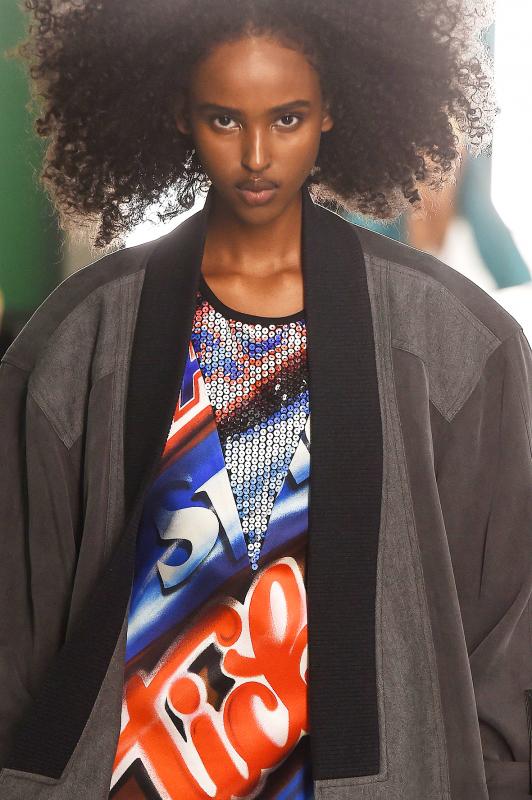
Photo: AFP
COVID-19 restrictions may have limited the number of fashionistas allowed into the immense Grand Palais in central Paris, but like the decor, Viard wrote her ambitions large.
Her collection was no less than a grand sweep through the long history of the label founded by Gabrielle “Coco” Chanel, with a giant nod to Chanel’s time in Tinseltown in the 1930s when she dressed stars like Greta Garbo, Katharine Hepburn, Marlene Dietrich and Gloria Swanson.
“I was thinking of actresses on the red carpet... some of whom we haven’t seen in a long time... their faces a little somewhere else as the photographers call out to them,” Viard said afterwards.
The show — dominated by black and white interspersed with splashes of bold color — coincides with the first-ever museum exhibition dedicated to Coco Chanel in the French capital, which opened last week to rave reviews.
BIG SCREEN GLAMOR
Viard recreated and updated some of Coco’s most beloved looks, with a nod to her predecessor Lagerfeld’s more street fashion sensibility with logos a gogo.
“Gabrielle Chanel and Karl Lagerfeld dressed so many actresses in their films and in their lives,” Viard added. “They made us dream.”
“Without redoing clothes exactly and falling into vintage, I wanted it to be very joyous and colourful and full of life.”
With Paris fashion week forced largely online by the coronavirus, Chanel streamed the show live for fashion fans.
“Lights, cameras, action!” it declared on Instagram as it aped the opening of a silent black and white film, placing a huge Chanel sign on the Hollywood Hills.
Viard kept up the theme of the brand’s long association with the silver screen with video clips of models reclining in luxury hotels like movie idols about to attend premieres.
The brand’s association with Hollywood began in 1930 when studio mogul Sam Goldwyn begged Coco Chanel to come to Los Angeles to give his stable of stars some “class”, offering her US$1 million to come twice a year.
VUITTON’S STILETTO CLOGS
While Chanel looked back, Nicolas Ghesquiere’s Louis Vuitton could not be more resolutely now, with the opening look a sweater emblazoned with “Vote”, a rallying call for the liberal left in the upcoming US presidential election.
But that was as conventionally political as it got, with the highly rated French designer insisting that his eyes were set firmly on the possibilities that gender fluid clothes might offer in the future.
“What cut might dissolve the masculine and the feminine?” he asked. “What wardrobe might make them come together in one?”
Ghesquiere said he wanted to bring the world’s richest luxury label on a “voyage of exploration... to discover and abolish the last [gender] frontiers.”
The bravura show was held in the long-closed La Samaritaine department store, which is due to reopen next year.
As always with Ghesquiere, it was all in the cut, with classic business and streetwear uniforms given surprising turns. But perhaps the most eye-catching thing about his spring-summer 2021 collection were the shoes, with a line of pointed clog stilettos sending Instagram into spasms.

In late October of 1873 the government of Japan decided against sending a military expedition to Korea to force that nation to open trade relations. Across the government supporters of the expedition resigned immediately. The spectacle of revolt by disaffected samurai began to loom over Japanese politics. In January of 1874 disaffected samurai attacked a senior minister in Tokyo. A month later, a group of pro-Korea expedition and anti-foreign elements from Saga prefecture in Kyushu revolted, driven in part by high food prices stemming from poor harvests. Their leader, according to Edward Drea’s classic Japan’s Imperial Army, was a samurai
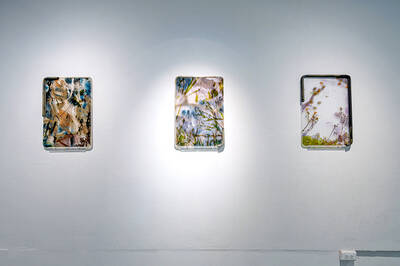
Located down a sideroad in old Wanhua District (萬華區), Waley Art (水谷藝術) has an established reputation for curating some of the more provocative indie art exhibitions in Taipei. And this month is no exception. Beyond the innocuous facade of a shophouse, the full three stories of the gallery space (including the basement) have been taken over by photographs, installation videos and abstract images courtesy of two creatives who hail from the opposite ends of the earth, Taiwan’s Hsu Yi-ting (許懿婷) and Germany’s Benjamin Janzen. “In 2019, I had an art residency in Europe,” Hsu says. “I met Benjamin in the lobby
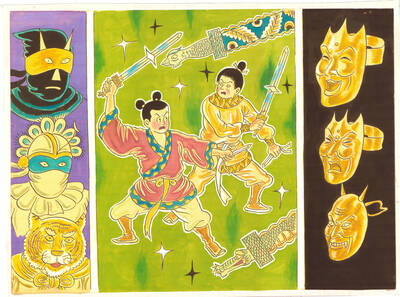
April 22 to April 28 The true identity of the mastermind behind the Demon Gang (魔鬼黨) was undoubtedly on the minds of countless schoolchildren in late 1958. In the days leading up to the big reveal, more than 10,000 guesses were sent to Ta Hwa Publishing Co (大華文化社) for a chance to win prizes. The smash success of the comic series Great Battle Against the Demon Gang (大戰魔鬼黨) came as a surprise to author Yeh Hung-chia (葉宏甲), who had long given up on his dream after being jailed for 10 months in 1947 over political cartoons. Protagonist

Peter Brighton was amazed when he found the giant jackfruit. He had been watching it grow on his farm in far north Queensland, and when it came time to pick it from the tree, it was so heavy it needed two people to do the job. “I was surprised when we cut it off and felt how heavy it was,” he says. “I grabbed it and my wife cut it — couldn’t do it by myself, it took two of us.” Weighing in at 45 kilograms, it is the heaviest jackfruit that Brighton has ever grown on his tropical fruit farm, located


 RSS
RSS