


The consumer price index (CPI) rose 1.23 percent last month from a year earlier, the lowest rate of increase in 56 months as easing international crude oil and commodity prices along with stable weather helped contain food prices, the Directorate-General of Budget, Accounting and Statistics (DGBAS) said yesterday.
The reading has been below the central bank’s 2 percent target for seven consecutive months, theoretically giving policymakers room to lower interest rates.
However, the central bank is widely expected to keep policy unchanged at its board meeting next week, given projections that Taiwan’s stronger-than-expected GDP growth of more than 7 percent this year would lower the need for monetary easing.
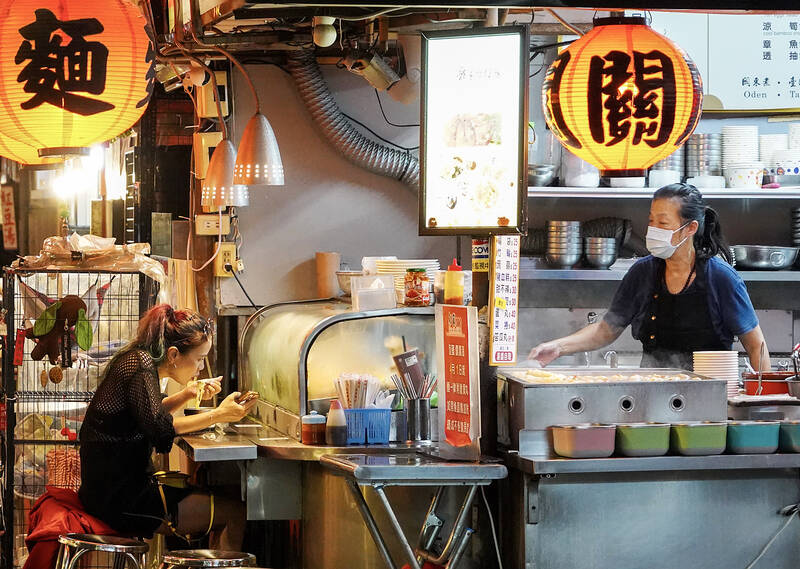
Photo: CNA
DGBAS official Tsao Chih-hung (曹志弘) said that although egg and pork prices posted sizeable annual increases, the effect was offset by greater vegetable supply and slower growth in rents.
Inflation this month is likely to be below 1.5 percent, as last year’s vegetable prices were elevated by bad weather, creating a high comparison base.
Core CPI — the central bank’s favored measure of underlying inflation as it excludes volatile food and energy prices — this month is expected to stay near last month’s 1.72 percent annual increase, Tsao said.
Despite easing headline inflation, prices for key consumer staples climbed 2.76 percent from a year earlier, rising for the sixth consecutive month and hitting a 21-month high, he said.
Egg prices surged 15.33 percent, the fastest pace in nearly 31 months, due to weather effects and a low base last year, while pork prices increased 8.7 percent, slower than October, but still elevated, he said.
Meanwhile, prices of more than 60 percent of items in the CPI basket increased, Tsao said.
Dining-out costs have risen more than 3 percent for each of the past 13 months, contributing to the public’s perception of persistent inflation, he said.
By category, food, housing, medical care and miscellaneous goods all posted modest annual increases, he said.
Housing costs inched up due to rents and electricity fees, while medical and personal services also had mild gains, he said.
Transportation and communications remained the main source of deflation, with falling global oil prices pushing fuel and vehicle costs down, despite higher maintenance expenses and train fares, he said.
Overall, most categories showed only limited increases, reinforcing the view that price pressures are softening, Tsao said, citing the rental component, which rose 2.02 percent, the smallest gain in 27 months.
Tsao attributed the slowdown to softer property prices filtering into the rental market, easing the upward pressure created by consumer prices, maintenance costs and home prices.
Separately, the producer price index (PPI) fell 2.8 percent last month from a year earlier, dragged down by lower prices for agricultural products, chemicals, pharmaceuticals, petroleum and basic metals, the DGBAS said.
For the first 11 months of this year, the CPI grew 1.69 percent, while the PPI declined 1.79 percent, the agency added.

TECH TITANS: Amazon’s latest chip joins Google in competing for the 90 percent market share held by Nvidia, which claims it is ‘a generation ahead of the industry’ Amazon Web Services (AWS) on Tuesday launched its in-house-built Trainium3 artificial intelligence (AI) chip, marking a significant push to compete with Nvidia Corp in the lucrative market for AI computing power. The move intensifies competition in the AI chip market, where Nvidia dominates with an estimated 80 to 90 percent market share for products used in training large language models that power the likes of ChatGPT. Google last week caused tremors in the industry when it was reported that Facebook-parent Meta Platforms Inc would employ Google AI chips in data centers, signaling new competition for Nvidia. This followed the release last month of
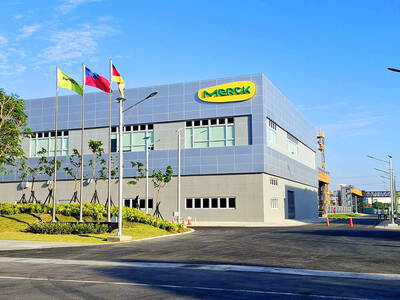
INSULATED: The company said it is less exposed to global complications, as it has built a strong footprint worldwide, and has multiple sources of rare earths and raw minerals Merck Group yesterday said it would ramp up production next year at its new flagship facility in Kaohsiung’s Lujhu District (路竹) to satisfy growing demand for advanced semiconductor materials and specialty gases, and to address supply resilience issues amid mounting geopolitical risks. Merck made the remarks during a news conference before the inauguration of its 500 million euros (US$582.1 million) facility, which is also to supply other markets in the Asia-Pacific region, it said. Merck executive board deputy chair and electronics CEO Kai Beckmann told reporters the company adopted a “local-for-local” strategy about seven years ago to address the cycle time of

Two companies wholly owned by the daughter of the founder of Hon Hai Precision Industry Co (鴻海精密) on Monday reported to the Taiwan Stock Exchange that they would dispose of all of the Hon Hai shares they hold. In filings with the exchange, Hong Wei Investment Co (鋐維) said it would sell the 2.771 million Hon Hai shares it holds and Frontier Investment Corp (承鋒投資) said it would sell its 2.409 million Hon Hai shares from tomorrow until Jan. 3 next year. The two companies are wholly owned and chaired by Shirley Gou (郭曉玲), the eldest daughter of Hon Hai founder Terry

RIDING THE WAVE: The race to build AI infrastructure has lifted the valuations of top memory makers, such as Micron, amid dwindling inventories and supply challenges Micron Technology Inc is to spend ¥1.5 trillion (US$9.6 billion) to build a plant in western Japan to make memory chips for artificial intelligence (AI) applications, the Nikkei reported on Saturday. The move comes as Micron seeks to diversify advanced chip production outside of Taiwan, the Nikkei article said, citing people familiar with the matter. The new factory will manufacture high-bandwidth memory (HBM) chips, a key component for working with AI processors such as those made by Nvidia Corp, the report said. Micron would build the facility within the compound of its Hiroshima plant, starting in May next year, with plans to launch


 RSS
RSS