


The thermometer sinks below zero as a blizzard of fine snow descends on two houses freshly built inside a massive laboratory in northern England.
Despite the icy conditions, the two energy-efficient homes remain cozy and warm due to their use of cutting-edge heating and insulation technology.
Welcome to Energy House 2.0 — a science experiment designed to help the world’s housebuilders slash carbon emissions, save energy and tackle climate change.
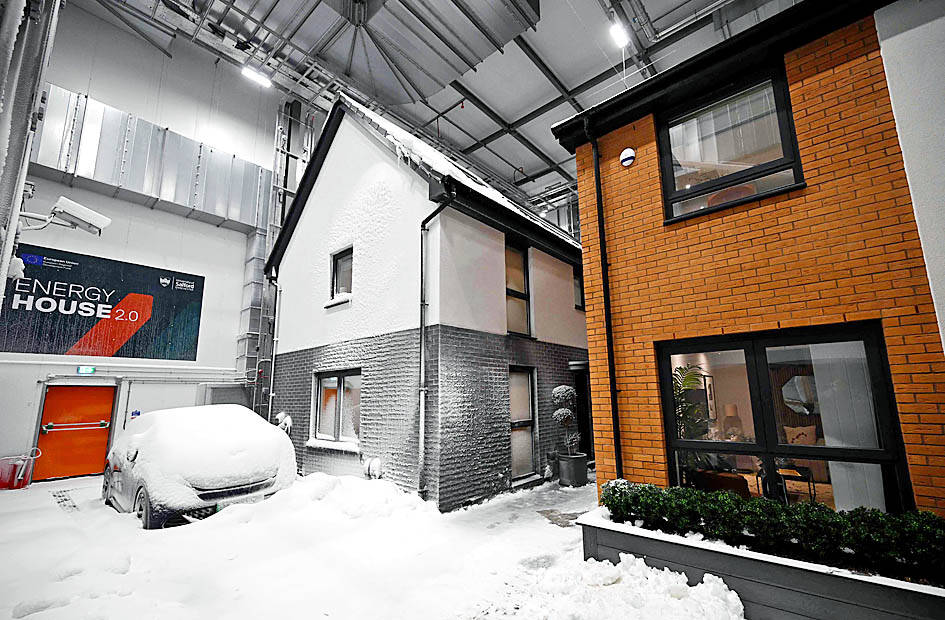
Photo: AFP
The project, based in a laboratory resembling a giant warehouse on Salford University’s campus near the center of Manchester, opened last month.
Rain, wind, sunshine and snow can be recreated in temperatures ranging from 40oC to minus-20oC, operated from a control center.
“What we’ve tried to achieve here is to be able to replicate the weather conditions that would be experienced around 95 percent of the populated Earth,” said Will Swan, a professor and head of Energy House laboratories at the university.
The facility, comprising two chambers that can experience different weather at the same time, can test types of housing from all over the world “to understand how we deliver their net zero and energy-efficient homes,” he added.
The two houses, which are quintessentially British and constructed by firms with UK operations, would remain in place for a few years.
Other builders could then rent space in the lab to put their own properties under the spotlight.
The project’s first house was built by UK property firm Barratt Developments PLC and French materials giant Saint-Gobain.
It is clad with decorative bricks over a frame of wood panels and insulation, with solar panels on the roof.
Scientists are examining the efficiency of several types of heating systems, including air-source heat pumps.
In the living room, a hot water circuit is located along the bottom of the walls, while further heat is provided via infrared technology in the molding and from a wall panel.
Mirrors also act as infrared radiators while numerous sensors monitor which rooms are in use.
Residents would manage the technology via a single control system similar to Amazon.com Inc’s voice-activated Alexa interface.
Builders estimate the cutting-edge tech could reduce energy bills to just one quarter of what the average UK home currently pays, a boon to customers reeling from sky-high energy prices.
It would also make an important contribution to the UK’s efforts to reach zero carbon emissions by 2050 to combat climate change.
A UK parliamentary report found that, in 2019, 17 percent of heating emissions from buildings came from homes — making their contribution similar to all the petrol and diesel vehicles driving on UK roads.
Environmental campaigners have long called on the UK government to increase energy efficiency and insulation support for homes across the country.
“One of the key technologies that we’re trying on this house is almost like a building management system for residential buildings,” said Tom Cox, UK technical director at Saint-Gobain.
“It’s almost like the Alexa of the home energy system — and that can be automated as much as the occupant wants,” he said.
With their mega-laboratory, scientists and companies no longer have to wait for extreme swings in the weather.
“We can test a year’s worth of weather conditions in a week,” Cox said.
The “ultimate goal is to create that environment which is comfortable and cost effective and commercially viable to deliver,” he added.
Stephen Garrett, a 27-year-old graduate student, always thought he would study in China, but first the country’s restrictive COVID-19 policies made it nearly impossible and now he has other concerns. The cost is one deterrent, but Garrett is more worried about restrictions on academic freedom and the personal risk of being stranded in China. He is not alone. Only about 700 American students are studying at Chinese universities, down from a peak of nearly 25,000 a decade ago, while there are nearly 300,000 Chinese students at US schools. Some young Americans are discouraged from investing their time in China by what they see

MAJOR DROP: CEO Tim Cook, who is visiting Hanoi, pledged the firm was committed to Vietnam after its smartphone shipments declined 9.6% annually in the first quarter Apple Inc yesterday said it would increase spending on suppliers in Vietnam, a key production hub, as CEO Tim Cook arrived in the country for a two-day visit. The iPhone maker announced the news in a statement on its Web site, but gave no details of how much it would spend or where the money would go. Cook is expected to meet programmers, content creators and students during his visit, online newspaper VnExpress reported. The visit comes as US President Joe Biden’s administration seeks to ramp up Vietnam’s role in the global tech supply chain to reduce the US’ dependence on China. Images on

New apartments in Taiwan’s major cities are getting smaller, while old apartments are increasingly occupied by older people, many of whom live alone, government data showed. The phenomenon has to do with sharpening unaffordable property prices and an aging population, property brokers said. Apartments with one bedroom that are two years old or older have gained a noticeable presence in the nation’s six special municipalities as well as Hsinchu county and city in the past five years, Evertrust Rehouse Co (永慶房產集團) found, citing data from the government’s real-price transaction platform. In Taipei, apartments with one bedroom accounted for 19 percent of deals last
US CONSCULTANT: The US Department of Commerce’s Ursula Burns is a rarely seen US government consultant to be put forward to sit on the board, nominated as an independent director Taiwan Semiconductor Manufacturing Co (TSMC, 台積電), the world’s largest contract chipmaker, yesterday nominated 10 candidates for its new board of directors, including Ursula Burns from the US Department of Commerce. It is rare that TSMC has nominated a US government consultant to sit on its board. Burns was nominated as one of seven independent directors. She is vice chair of the department’s Advisory Council on Supply Chain Competitiveness. Burns is to stand for election at TSMC’s annual shareholders’ meeting on June 4 along with the rest of the candidates. TSMC chairman Mark Liu (劉德音) was not on the list after in December last


 RSS
RSS