


BP PLC hiked its dividend and accelerated share buybacks to the fastest pace yet after profits surged.
The oil and gas industry is boosting returns to shareholders as the cash rolls in, even while the energy crisis triggered by Russia’s invasion of Ukraine threatens the global economy. BP said it expects prices to remain high and highlighted its investments in additional supplies.
“Today’s results show that BP continues to perform while transforming,” chief executive officer Bernard Looney said in a statement yesterday.

Photo: Bloomberg
The company is “providing the oil and gas the world needs today — while at the same time investing to accelerate the energy transition,” he said.
Following in the footsteps of most of its peers, the London-based company said it would repurchase US$3.5 billion of shares over the next three months, adding to the US$3.8 billion it already bought back in the first half. It also increased its dividend by 10 percent.
BP’s second-quarter adjusted net income was US$8.45 billion, the highest since 2008 and comfortably beating even the highest analyst estimate. This was not just driven by high crude and natural gas prices — the company’s refineries earned strong margins and its oil traders delivered an “exceptional” performance.
The dividend was increased to US$0.06 a share, an improvement from a previous commitment to raise the payout by about 4 percent annually through 2025. Net debt fell to US$22.82 billion at the end of the period, down from US$32.7 billion a year ago.
The oil sector’s sky-high profits come at a politically tricky time for an industry accused of profiteering from the fallout from Russian President Vladimir Putin’s aggression, while also failing to invest enough in new drilling. Alongside its earnings statement, BP published an extensive list of investments it is making in the UK, where the rising cost of energy has become a hot political issue, and the North Sea oil and gas industry has already been hit by a windfall tax.
With recession fears gathering pace, there has been speculation that the second quarter could end up marking the high point for Big Oil this year.
BP said it expects oil and natural gas prices, and refining margins, to stay high in the third quarter because of disruptions in Russian supply, relatively low inventories and reduced spare capacity.
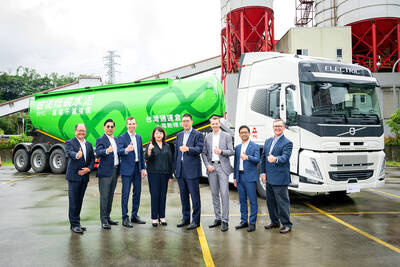
Taiwan Transport and Storage Corp (TTS, 台灣通運倉儲) yesterday unveiled its first electric tractor unit — manufactured by Volvo Trucks — in a ceremony in Taipei, and said the unit would soon be used to transport cement produced by Taiwan Cement Corp (TCC, 台灣水泥). Both TTS and TCC belong to TCC International Holdings Ltd (台泥國際集團). With the electric tractor unit, the Taipei-based cement firm would become the first in Taiwan to use electric vehicles to transport construction materials. TTS chairman Koo Kung-yi (辜公怡), Volvo Trucks vice president of sales and marketing Johan Selven, TCC president Roman Cheng (程耀輝) and Taikoo Motors Group

Among the rows of vibrators, rubber torsos and leather harnesses at a Chinese sex toys exhibition in Shanghai this weekend, the beginnings of an artificial intelligence (AI)-driven shift in the industry quietly pulsed. China manufactures about 70 percent of the world’s sex toys, most of it the “hardware” on display at the fair — whether that be technicolor tentacled dildos or hyper-realistic personalized silicone dolls. Yet smart toys have been rising in popularity for some time. Many major European and US brands already offer tech-enhanced products that can enable long-distance love, monitor well-being and even bring people one step closer to

RECORD-BREAKING: TSMC’s net profit last quarter beat market expectations by expanding 8.9% and it was the best first-quarter profit in the chipmaker’s history Taiwan Semiconductor Manufacturing Co (TSMC, 台積電), which counts Nvidia Corp as a key customer, yesterday said that artificial intelligence (AI) server chip revenue is set to more than double this year from last year amid rising demand. The chipmaker expects the growth momentum to continue in the next five years with an annual compound growth rate of 50 percent, TSMC chief executive officer C.C. Wei (魏哲家) told investors yesterday. By 2028, AI chips’ contribution to revenue would climb to about 20 percent from a percentage in the low teens, Wei said. “Almost all the AI innovators are working with TSMC to address the

Malaysia’s leader yesterday announced plans to build a massive semiconductor design park, aiming to boost the Southeast Asian nation’s role in the global chip industry. A prominent player in the semiconductor industry for decades, Malaysia accounts for an estimated 13 percent of global back-end manufacturing, according to German tech giant Bosch. Now it wants to go beyond production and emerge as a chip design powerhouse too, Malaysian Prime Minister Anwar Ibrahim said. “I am pleased to announce the largest IC (integrated circuit) Design Park in Southeast Asia, that will house world-class anchor tenants and collaborate with global companies such as Arm [Holdings PLC],”


 RSS
RSS