


US stocks closed lower on Friday, with the Dow Jones Industrial Average and S&P 500 suffering their biggest one-day percentage drops in months, and pandemic-hit sectors that had gained from a reopening falling sharply after a new SARS-CoV-2 mutation was found.
Authorities worldwide reacted with alarm on Friday to the variant found in South Africa, since named Omicron, with the EU and UK among those tightening border controls as researchers sought to establish if it was vaccine-resistant.
Cruise operators Carnival Corp, Royal Caribbean Cruises and Norwegian Cruise Line Holdings each plunged more than 10 percent, while shares in United Airlines Holdings Inc, Delta Air Lines Inc and American Airlines Group Inc also tumbled.
The New York Stock Exchange (NYSE) Arca Airline Index fell 6.45 percent in its biggest one-day percentage decline since September last year.
Retailers dropped 2.04 percent as Black Friday started the holiday shopping season with worries that the new variant would depress store traffic and curb supply.
Selling was broad, with big declines of more than 1 percent in all 11 major S&P sectors except healthcare, which fell just 0.45 percent thanks to COVID-19 vaccine makers Pfizer Inc rising 6.11 percent to close at a record high of US$54 and Moderna Inc jumping 20.57 percent.
“It is deja vu all over again for like the eighth time,” said Keith Buchanan, senior portfolio manager at Global Investments in Atlanta.
“What we understand about this variant could accelerate over the weekend, if there is more concerning news than good news, a lot of people don’t want to be holding risk assets on Monday morning, or are afraid of what that could look like Monday morning,” he said.
Despite the sell-off, market participants said the drop was likely exaggerated by the thin volume during the shortened post-Thanksgiving holiday session.
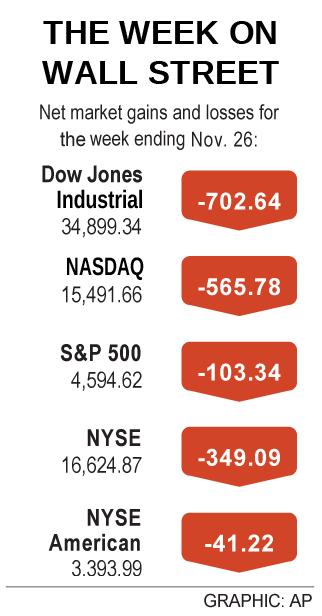
The Dow Jones Industrial Average fell 905.04 points, or 2.53 percent, to 34,899.34; the S&P 500 lost 106.84 points, or 2.27 percent, to 4,594.62; and the NASDAQ Composite dropped 353.57 points, or 2.23 percent, to 15,491.66.
For the week, the Dow fell 1.97 percent, the S&P 500 lost 2.2 percent and the NASDAQ Composite slumped 3.52 percent.
The domestically focused Russell 2000 small-cap index fell 3.67 percent on Friday. Both the S&P 500 and small cap Russell index posted their biggest one-day percentage drops since Feb. 25.
The S&P 500 banks index dropped 3.87 percent as investors dialed back expectations of faster US interest rate hikes. Energy, this year’s best performing sector, dropped 4 percent on the day, its biggest decline in more than eight months, as crude prices plunged US$10 a barrel.
Elevated US inflation, coupled with strong economic data and the renomination of Jerome Powell as US Federal Reserve chair by US President Joe Biden, had fueled expectations the central bank might hike interest rates sooner than expected.
The CBOE volatility index, popularly known as Wall Street’s fear gauge, hit its highest level since early March.
Stocks such as Netflix Inc, Peloton Interactive Inc and Zoom Video Communications Inc, known as “stay-at-home” names, all scored solid advances.
Declining issues outnumbered advancers on the NYSE by a 5.84-to-1 ratio; on NASDAQ, a 3.96-to-1 ratio favored decliners.
The S&P 500 posted seven new 52-week highs and 23 new lows; the NASDAQ Composite recorded 18 new highs and 334 new lows.

Taiwan Transport and Storage Corp (TTS, 台灣通運倉儲) yesterday unveiled its first electric tractor unit — manufactured by Volvo Trucks — in a ceremony in Taipei, and said the unit would soon be used to transport cement produced by Taiwan Cement Corp (TCC, 台灣水泥). Both TTS and TCC belong to TCC International Holdings Ltd (台泥國際集團). With the electric tractor unit, the Taipei-based cement firm would become the first in Taiwan to use electric vehicles to transport construction materials. TTS chairman Koo Kung-yi (辜公怡), Volvo Trucks vice president of sales and marketing Johan Selven, TCC president Roman Cheng (程耀輝) and Taikoo Motors Group

Among the rows of vibrators, rubber torsos and leather harnesses at a Chinese sex toys exhibition in Shanghai this weekend, the beginnings of an artificial intelligence (AI)-driven shift in the industry quietly pulsed. China manufactures about 70 percent of the world’s sex toys, most of it the “hardware” on display at the fair — whether that be technicolor tentacled dildos or hyper-realistic personalized silicone dolls. Yet smart toys have been rising in popularity for some time. Many major European and US brands already offer tech-enhanced products that can enable long-distance love, monitor well-being and even bring people one step closer to

RECORD-BREAKING: TSMC’s net profit last quarter beat market expectations by expanding 8.9% and it was the best first-quarter profit in the chipmaker’s history Taiwan Semiconductor Manufacturing Co (TSMC, 台積電), which counts Nvidia Corp as a key customer, yesterday said that artificial intelligence (AI) server chip revenue is set to more than double this year from last year amid rising demand. The chipmaker expects the growth momentum to continue in the next five years with an annual compound growth rate of 50 percent, TSMC chief executive officer C.C. Wei (魏哲家) told investors yesterday. By 2028, AI chips’ contribution to revenue would climb to about 20 percent from a percentage in the low teens, Wei said. “Almost all the AI innovators are working with TSMC to address the

Malaysia’s leader yesterday announced plans to build a massive semiconductor design park, aiming to boost the Southeast Asian nation’s role in the global chip industry. A prominent player in the semiconductor industry for decades, Malaysia accounts for an estimated 13 percent of global back-end manufacturing, according to German tech giant Bosch. Now it wants to go beyond production and emerge as a chip design powerhouse too, Malaysian Prime Minister Anwar Ibrahim said. “I am pleased to announce the largest IC (integrated circuit) Design Park in Southeast Asia, that will house world-class anchor tenants and collaborate with global companies such as Arm [Holdings PLC],”


 RSS
RSS