


While many US and European shoppers went on a spree on Black Friday, some groups hit out with boycotts and campaigns against what they deem unfair business practices and the unbridled consumerism of the end-of-year holidays.
In the US, the day after Thanksgiving — celebrated the fourth Thursday in November — is marked by frenzied deal-snagging as retailers offer sales to start holiday shopping in earnest, with European companies jumping on the bandwagon in the past few years.
Adobe Inc’s holiday season shopping forecast expects US$910 billion in global online spending this month and next, an 11 percent increase over last year, despite inflation and supply chain disruptions.
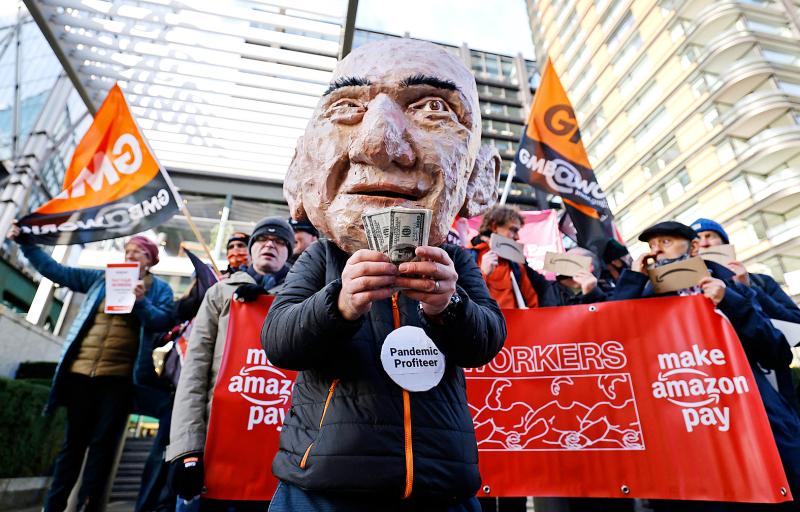
Photo: AFP
However, while shoppers opened their wallets, some workers, organizations and retailers were taking a stand against what they see as the extreme excesses of Black Friday.
“It’s ridiculous to have a day so profitable to owners where workers get paid the same as always,” said one member of a popular Reddit “anti-work” forum (r/antiwork), which has more than 1 million members.
Membership of the forum swelled this autumn. The growth coincided with a record 4.4 million Americans leaving their jobs in September, a phenomenon dubbed the “Great Resignation.”
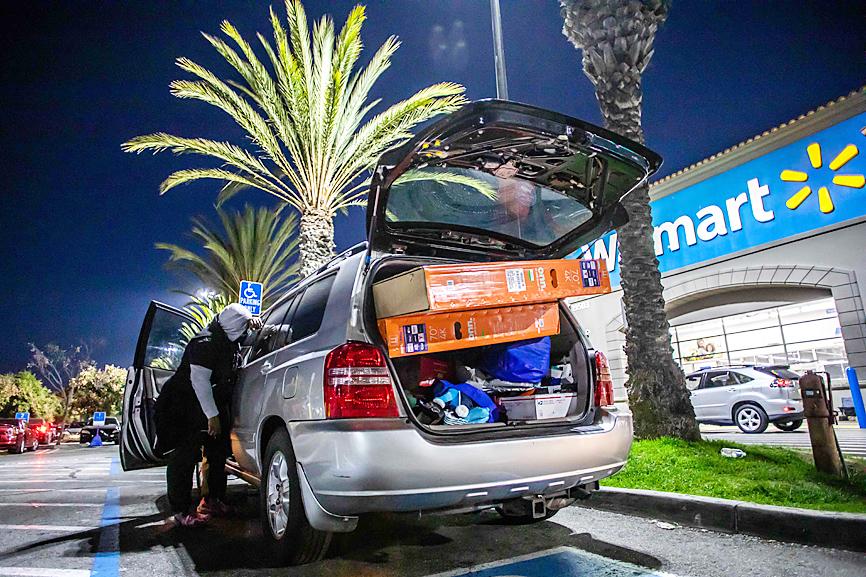
Photo: AFP
The thread sees support for the “Black Friday Blackout” campaign, which encourages Americans not to work, and especially not to buy anything, the day after Thanksgiving.
Online retail giant Amazon.com Inc, which launched its promotional campaign on Thursday and pulls in juicy profits over the winter holiday season, is a top target for anti-Black Friday actions.
Activists from environmental group Extinction Rebellion on Friday blockaded more than a dozen Amazon distribution centers in the UK, Germany and the Netherlands to protest the company’s social and environmental practices.
It blocked the entrances to the UK sites using bamboo structures and so-called lock-on devices, and displayed banners featuring slogans like “Black Friday exploits people and planet.”
An Amazon spokesperson said it took its responsibilities, including a commitment to be a net-zero carbon emitter by 2040, “very seriously.”
“We know there is always more to do, and we’ll continue to invent and invest on behalf of our employees, customers, small businesses and communities in the UK,” the spokesperson added.
“Make Amazon Pay,” an international coalition of 40-odd organizations, including Greenpeace and Oxfam, accuses the Seattle-based titan of putting profits before the well-being of its employees.
It was supporting employees who wish to demonstrate against their working conditions or go on strike on Friday.
In Britain, the federation representing independent retailers, Bira, estimated 85 percent of small retailers would boycott Black Friday to protest the “unfair” dominance of online behemoths that has been accentuated during the COVID-19 pandemic.
“Whilst we, in some ways, admire what Amazon does, the pandemic simply highlighted the unfair playing field between High Street shops and online retailers,” British Independent Retailers Association chief executive officer Andrew Goodacre said.
Amazon and major chains are also being accused of sale schemes deemed dishonest.
Internet users and groups charge retailers with inflating prices leading up to Black Friday to then lower them on the day.
A British consumer association called Which? has calculated that 99.5 percent of products sold during last year’s Black Friday at six major retailers — Amazon, AO, Argos, Currys, John Lewis and Richer Sounds — were sold at the same price or cheaper at other times of the year.
“Businesses will purposefully inflate prices prior to the sale,” one Reddit user wrote. “Then they can make the sale look better by saying ‘NOW ONLY $499 INSTEAD OF $1,299 WHAT A DEAL’ when like 3 weeks before the sale the same item was literally $499 or close to it.”
Black Friday is heavily vilified for its environmental impact.
Since 2018, the “Green Friday” collective has organized workshops and conferences to raise awareness on the issue in France and Belgium with the support of the Paris City Council.
The “Make Friday Green Again” network, launched by the clothing group Faguo, brings together 1,200 French brands in favor of “more reasonable” consumption, encouraging recycling, repairing items and buying second-hand products.
Some brands are also taking individual action, such as Swedish furniture titan Ikea and US outdoor retailer Recreational Equipment Inc (REI). Since 2015, REI has organized an #optoutside campaign during Black Friday, closing its stores against the crush of shoppers typical of the day, and encouraging employees to spend time with family and friends.

Taiwan Transport and Storage Corp (TTS, 台灣通運倉儲) yesterday unveiled its first electric tractor unit — manufactured by Volvo Trucks — in a ceremony in Taipei, and said the unit would soon be used to transport cement produced by Taiwan Cement Corp (TCC, 台灣水泥). Both TTS and TCC belong to TCC International Holdings Ltd (台泥國際集團). With the electric tractor unit, the Taipei-based cement firm would become the first in Taiwan to use electric vehicles to transport construction materials. TTS chairman Koo Kung-yi (辜公怡), Volvo Trucks vice president of sales and marketing Johan Selven, TCC president Roman Cheng (程耀輝) and Taikoo Motors Group

Among the rows of vibrators, rubber torsos and leather harnesses at a Chinese sex toys exhibition in Shanghai this weekend, the beginnings of an artificial intelligence (AI)-driven shift in the industry quietly pulsed. China manufactures about 70 percent of the world’s sex toys, most of it the “hardware” on display at the fair — whether that be technicolor tentacled dildos or hyper-realistic personalized silicone dolls. Yet smart toys have been rising in popularity for some time. Many major European and US brands already offer tech-enhanced products that can enable long-distance love, monitor well-being and even bring people one step closer to

RECORD-BREAKING: TSMC’s net profit last quarter beat market expectations by expanding 8.9% and it was the best first-quarter profit in the chipmaker’s history Taiwan Semiconductor Manufacturing Co (TSMC, 台積電), which counts Nvidia Corp as a key customer, yesterday said that artificial intelligence (AI) server chip revenue is set to more than double this year from last year amid rising demand. The chipmaker expects the growth momentum to continue in the next five years with an annual compound growth rate of 50 percent, TSMC chief executive officer C.C. Wei (魏哲家) told investors yesterday. By 2028, AI chips’ contribution to revenue would climb to about 20 percent from a percentage in the low teens, Wei said. “Almost all the AI innovators are working with TSMC to address the

Malaysia’s leader yesterday announced plans to build a massive semiconductor design park, aiming to boost the Southeast Asian nation’s role in the global chip industry. A prominent player in the semiconductor industry for decades, Malaysia accounts for an estimated 13 percent of global back-end manufacturing, according to German tech giant Bosch. Now it wants to go beyond production and emerge as a chip design powerhouse too, Malaysian Prime Minister Anwar Ibrahim said. “I am pleased to announce the largest IC (integrated circuit) Design Park in Southeast Asia, that will house world-class anchor tenants and collaborate with global companies such as Arm [Holdings PLC],”


 RSS
RSS