


The Ministry of Economic Affairs is in talks with retailers to establish “affordable areas” in stores to help counter the effect of inflation on consumers’ wallets, the ministry said yesterday.
The ministry would also help consumers find affordable food by promoting restaurants that have not increased prices, Minister of Economic Affairs Wang Mei-hua (王美花) told a legislative session in Taipei.
Asked by Democratic Progressive Party Legislator Ho Hsin-chun (何欣純) what the ministry is doing to lessen the effects of inflation on people’s wallets, Wang said: “Taiwan’s inflation is relatively mild compared with other countries. Next week, we will meet with hypermarkets, retailers and other outlets to discuss setting up affordable areas to make it easier for consumers to find items with stable prices.”
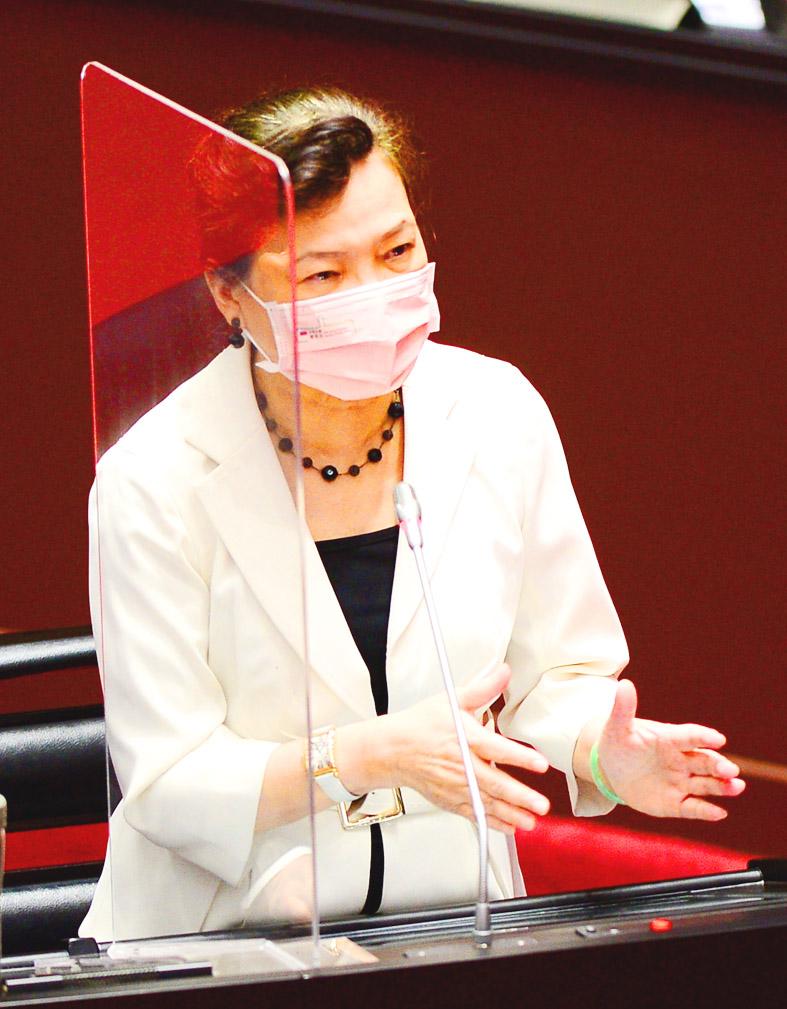
Photo: Wang Yi-sung, Taipei Times
Alhough Taiwan’s mild inflation is not caused by internal policy, but worldwide commodity price increases, Taiwanese feel it disproportionately because wages have not increased alongside prices, National Central University Research Center for Taiwan Economic Development director Dachrahn Wu (吳大任) told the Taipei Times by telephone yesterday.
“The US is seeing inflation of more than 6 percent now, whereas in Taiwan, we are still below 2 percent,” Wu said. “However, in the US wages have gone up alongside inflation, whereas in Taiwan, wages have been stagnant.”
Along with Taiwan’s high level of inequality, this means low-income households are especially vulnerable to the effects of inflation, he said.
Although central bank Governor Yang Chin-long (楊金龍) earlier this week described inflation in Taiwan as “transitory” and predicted that it would not exceed 2 percent, it would be hard to for Taiwan to control inflation if it is caused by external conditions, Wu said.
“The wholesale price index has been surging well past 10 percent since May,” Wu said. “Businesses have not been passing on the costs to consumers because of the softness of the COVID-19 economy, but if commodity prices — for example oil prices — continue to increase, businesses will not be able to absorb the costs indefinitely.”
The government is traditionally more “hands-on” with inflation than other countries, Wu said.
However, Wu doubts that the “affordable zones” would have a big effect.
“You cannot make retailers sell at a loss,” he said.
If inflation exceeds 2 percent, the central bank might have to step in with monetary measures or increase the interest rate, Wu said.
“It is a difficult choice, because a higher interest rate might also harm the have-nots in our society,” Wu said.

Stephen Garrett, a 27-year-old graduate student, always thought he would study in China, but first the country’s restrictive COVID-19 policies made it nearly impossible and now he has other concerns. The cost is one deterrent, but Garrett is more worried about restrictions on academic freedom and the personal risk of being stranded in China. He is not alone. Only about 700 American students are studying at Chinese universities, down from a peak of nearly 25,000 a decade ago, while there are nearly 300,000 Chinese students at US schools. Some young Americans are discouraged from investing their time in China by what they see

MAJOR DROP: CEO Tim Cook, who is visiting Hanoi, pledged the firm was committed to Vietnam after its smartphone shipments declined 9.6% annually in the first quarter Apple Inc yesterday said it would increase spending on suppliers in Vietnam, a key production hub, as CEO Tim Cook arrived in the country for a two-day visit. The iPhone maker announced the news in a statement on its Web site, but gave no details of how much it would spend or where the money would go. Cook is expected to meet programmers, content creators and students during his visit, online newspaper VnExpress reported. The visit comes as US President Joe Biden’s administration seeks to ramp up Vietnam’s role in the global tech supply chain to reduce the US’ dependence on China. Images on
New apartments in Taiwan’s major cities are getting smaller, while old apartments are increasingly occupied by older people, many of whom live alone, government data showed. The phenomenon has to do with sharpening unaffordable property prices and an aging population, property brokers said. Apartments with one bedroom that are two years old or older have gained a noticeable presence in the nation’s six special municipalities as well as Hsinchu county and city in the past five years, Evertrust Rehouse Co (永慶房產集團) found, citing data from the government’s real-price transaction platform. In Taipei, apartments with one bedroom accounted for 19 percent of deals last

US CONSCULTANT: The US Department of Commerce’s Ursula Burns is a rarely seen US government consultant to be put forward to sit on the board, nominated as an independent director Taiwan Semiconductor Manufacturing Co (TSMC, 台積電), the world’s largest contract chipmaker, yesterday nominated 10 candidates for its new board of directors, including Ursula Burns from the US Department of Commerce. It is rare that TSMC has nominated a US government consultant to sit on its board. Burns was nominated as one of seven independent directors. She is vice chair of the department’s Advisory Council on Supply Chain Competitiveness. Burns is to stand for election at TSMC’s annual shareholders’ meeting on June 4 along with the rest of the candidates. TSMC chairman Mark Liu (劉德音) was not on the list after in December last


 RSS
RSS