


Indonesia’s central bank yesterday left its benchmark interest rate unchanged and extended policies to boost loan growth and consumption, seeking to bolster a recovery driven by commodity exports and border reopening.
Bank Indonesia kept the seven-day reverse repurchase rate at a record-low 3.5 percent, as predicted by all 30 analysts in a Bloomberg survey, staying on pause for an eighth straight meeting.
“The decision is consistent with the need to maintain exchange rates and financial system stability amid projected low inflation and efforts to revive economic growth,” Governor Perry Warjiyo told a briefing in Jakarta.

Photo: EPA-EFE
“Economic growth in 2022 will be better than this year,” he said.
Warjiyo announced that the central bank was easing down-payment rules for home and auto loans until the end of next year, as well as extending stimulus for credit card repayments — all steps designed to augment the effects of its accommodative monetary policy.
The rupiah yesterday strengthened 0.3 percent to 14,068 rupiah to the US dollar, although it gave up some ground after the bank’s decision.
The Jakarta Stock Exchange Composite Index was down 0.04 percent as of 3:40pm yesterday.
“Steady rates may be the optimal choice as the central bank will have to continue to navigate between competing concerns — sub-par domestic demand, rupiah vulnerability and building price pressures,” ASEAN economist Tamara Mast Henderson said. “By the second half of 2022, the pressure to lift the policy rate is likely to be acute, in our view, especially if the [US] Federal Reserve unexpectedly brings forward the start of its rate hikes.”
Southeast Asia’s biggest economy is seeing early signs of recovery from the ravages of the Delta variant of SARS-CoV-2, with rebounds seen in manufacturing and consumer confidence. Indonesia has also reopened its borders to revive tourism, allowing vaccinated foreign visitors to some destinations including Bali.
Bank Indonesia “signaled its intention to not be swept along the recent hawkish tilt of more and more central bank peers, and to continue its holding stance for a while more,” Singapore-based Oversea-Chinese Banking Corp economist Wellian Wiranto said.
“Looking into next year, we see BI [Bank Indonesia] continuing to have the space to keep its policy rate unchanged in the first half, but the risk of a stronger drumbeat for a Fed funds rate hike in the second half might get harder for it to dismiss,” Wiranto added.
Soaring commodity prices are helping Indonesia, a top exporter of coal and palm oil.
While the rupiah has become Asia’s best-performing currency in the second half of the year, gaining nearly 3 percent, it could face headwinds as the Fed gets closer to tapering its asset purchases.
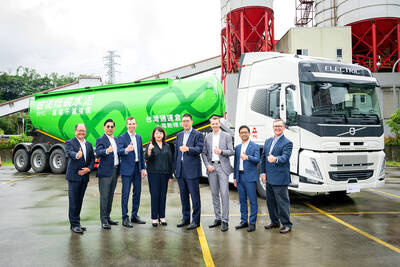
Taiwan Transport and Storage Corp (TTS, 台灣通運倉儲) yesterday unveiled its first electric tractor unit — manufactured by Volvo Trucks — in a ceremony in Taipei, and said the unit would soon be used to transport cement produced by Taiwan Cement Corp (TCC, 台灣水泥). Both TTS and TCC belong to TCC International Holdings Ltd (台泥國際集團). With the electric tractor unit, the Taipei-based cement firm would become the first in Taiwan to use electric vehicles to transport construction materials. TTS chairman Koo Kung-yi (辜公怡), Volvo Trucks vice president of sales and marketing Johan Selven, TCC president Roman Cheng (程耀輝) and Taikoo Motors Group

Among the rows of vibrators, rubber torsos and leather harnesses at a Chinese sex toys exhibition in Shanghai this weekend, the beginnings of an artificial intelligence (AI)-driven shift in the industry quietly pulsed. China manufactures about 70 percent of the world’s sex toys, most of it the “hardware” on display at the fair — whether that be technicolor tentacled dildos or hyper-realistic personalized silicone dolls. Yet smart toys have been rising in popularity for some time. Many major European and US brands already offer tech-enhanced products that can enable long-distance love, monitor well-being and even bring people one step closer to
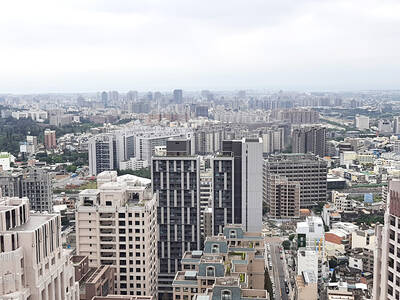
New apartments in Taiwan’s major cities are getting smaller, while old apartments are increasingly occupied by older people, many of whom live alone, government data showed. The phenomenon has to do with sharpening unaffordable property prices and an aging population, property brokers said. Apartments with one bedroom that are two years old or older have gained a noticeable presence in the nation’s six special municipalities as well as Hsinchu county and city in the past five years, Evertrust Rehouse Co (永慶房產集團) found, citing data from the government’s real-price transaction platform. In Taipei, apartments with one bedroom accounted for 19 percent of deals last

RECORD-BREAKING: TSMC’s net profit last quarter beat market expectations by expanding 8.9% and it was the best first-quarter profit in the chipmaker’s history Taiwan Semiconductor Manufacturing Co (TSMC, 台積電), which counts Nvidia Corp as a key customer, yesterday said that artificial intelligence (AI) server chip revenue is set to more than double this year from last year amid rising demand. The chipmaker expects the growth momentum to continue in the next five years with an annual compound growth rate of 50 percent, TSMC chief executive officer C.C. Wei (魏哲家) told investors yesterday. By 2028, AI chips’ contribution to revenue would climb to about 20 percent from a percentage in the low teens, Wei said. “Almost all the AI innovators are working with TSMC to address the


 RSS
RSS