


China’s factory inflation last month hit its highest level in a quarter of a century on surging commodity costs, with yesterday’s figures fanning concerns that higher prices could filter through supply chains and into the global economy.
The reopening from COVID-19 lockdowns around the world has ramped up demand for energy just as stockpiles are low, made worse by China’s drive to meet environmental goals by slashing emissions targets.
The producer price index (PPI), which measures the cost of goods at the factory gate, hit 10.7 percent, the Chinese National Bureau of Statistics said, marking the biggest jump in its data going back to October 1996.
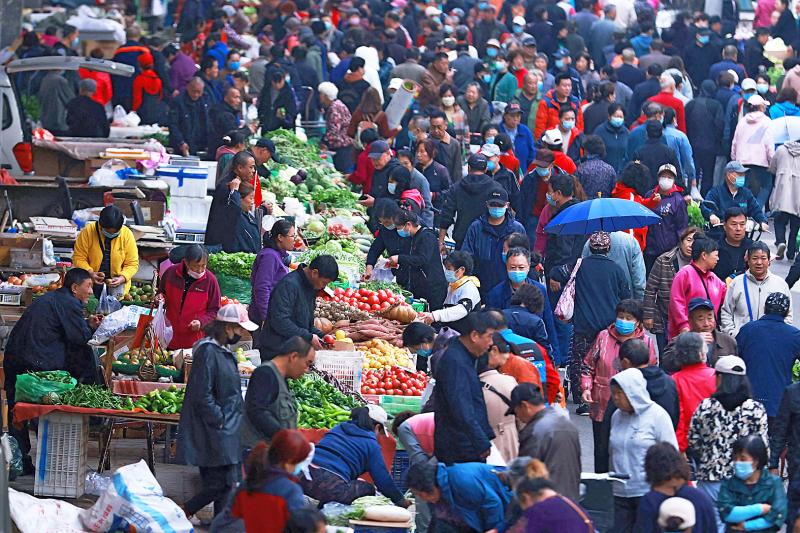
Photo: AFP
The index had already hit a 13-year high in August, reflecting a surge in commodity prices and piling pressure on businesses.
Many factories have been forced to halt operations because of power outages caused by emissions reduction targets, the surging price of coal and supply shortages.
Chinese authorities have since ordered mines to expand production, with energy firms told to ensure there are adequate fuel supplies for winter.
“In September, affected by factors such as rising prices of coal and some energy-intensive industry products, the price increase of industrial products continued to expand,” bureau statistician Dong Lijuan (董莉娟) said in a statement.
Dong said that among the 40 industrial sectors surveyed, 36 saw price hikes — including coal mining, which had a 74.9 percent rise.
The consumer price index (CPI), a key gauge of retail inflation, last month hit 0.7 percent, slightly down from August.
The bureau said that pork prices — which fueled a spike in CPI previously — fell by 46.9 percent on an annual basis.
Pinpoint Asset Management Ltd lead economist Zhang Zhiwei (張智威) said that, with prices soaring and economic growth showing signs of slowing, “the risk of stagflation is rising in China as well as the rest of the world.”
“The ambitious goal of carbon neutrality puts persistent pressure on commodity prices, which will be passed to downstream firms,” Zhang said.
Beijing has set a target of reaching peak carbon emissions by 2030 and becoming carbon neutral by 2060.
As authorities seek ways to ease the energy crisis, economists warn of the risk of worsening factory inflation.
The Chinese State Council this month said that electricity prices would be allowed to rise by up to 20 percent against a benchmark — double the level of the current cap — helping to make it profitable for electricity producers to boost supply.
However, such a move adds to inflation pressures, leaving authorities with the complicated task of trying to tame prices while also needing to boost a flagging economy.
Third-quarter GDP data is due out next week.
Australia & New Zealand Banking Group senior China strategist Xing Zhaopeng (邢兆鵬) said that the electricity price cap move was likely to boost headline PPI and warned that last month’s reading would “not be its peak,” forecasting higher numbers for this month or next.

Among the rows of vibrators, rubber torsos and leather harnesses at a Chinese sex toys exhibition in Shanghai this weekend, the beginnings of an artificial intelligence (AI)-driven shift in the industry quietly pulsed. China manufactures about 70 percent of the world’s sex toys, most of it the “hardware” on display at the fair — whether that be technicolor tentacled dildos or hyper-realistic personalized silicone dolls. Yet smart toys have been rising in popularity for some time. Many major European and US brands already offer tech-enhanced products that can enable long-distance love, monitor well-being and even bring people one step closer to

Malaysia’s leader yesterday announced plans to build a massive semiconductor design park, aiming to boost the Southeast Asian nation’s role in the global chip industry. A prominent player in the semiconductor industry for decades, Malaysia accounts for an estimated 13 percent of global back-end manufacturing, according to German tech giant Bosch. Now it wants to go beyond production and emerge as a chip design powerhouse too, Malaysian Prime Minister Anwar Ibrahim said. “I am pleased to announce the largest IC (integrated circuit) Design Park in Southeast Asia, that will house world-class anchor tenants and collaborate with global companies such as Arm [Holdings PLC],”

Sales in the retail, and food and beverage sectors last month continued to rise, increasing 0.7 percent and 13.6 percent respectively from a year earlier, setting record highs for the month of March, the Ministry of Economic Affairs said yesterday. Sales in the wholesale sector also grew last month by 4.6 annually, mainly due to the business opportunities for emerging applications related to artificial intelligence (AI) and high-performance computing technologies, the ministry said in a report. The ministry forecast that retail, and food and beverage sales this month would retain their growth momentum as the former would benefit from Tomb Sweeping Day
Thousands of parents in Singapore are furious after a Cordlife Group Ltd (康盛人生集團), a major operator of cord blood banks in Asia, irreparably damaged their children’s samples through improper handling, with some now pursuing legal action. The ongoing case, one of the worst to hit the largely untested industry, has renewed concerns over companies marketing themselves to anxious parents with mostly unproven assurances. This has implications across the region, given Cordlife’s operations in Hong Kong, Macau, Indonesia, the Philippines and India. The parents paid for years to have their infants’ cord blood stored, with the understanding that the stem cells they contained


 RSS
RSS