


The White House on Thursday signaled that it was willing to negotiate over US President Joe Biden’s pledge to increase the corporate tax rate.
Biden offered to drop his proposal to return the top corporate tax rate to 28 percent — where it had been before a tax cut in 2017 — from its current 21 percent level, the Washington Post reported.
Citing sources familiar with the discussions, the newspaper said that the offer was made in a private White House meeting on Wednesday with US Senator Shelley Moore Capito as the president looks for opposition support for his spending plans.
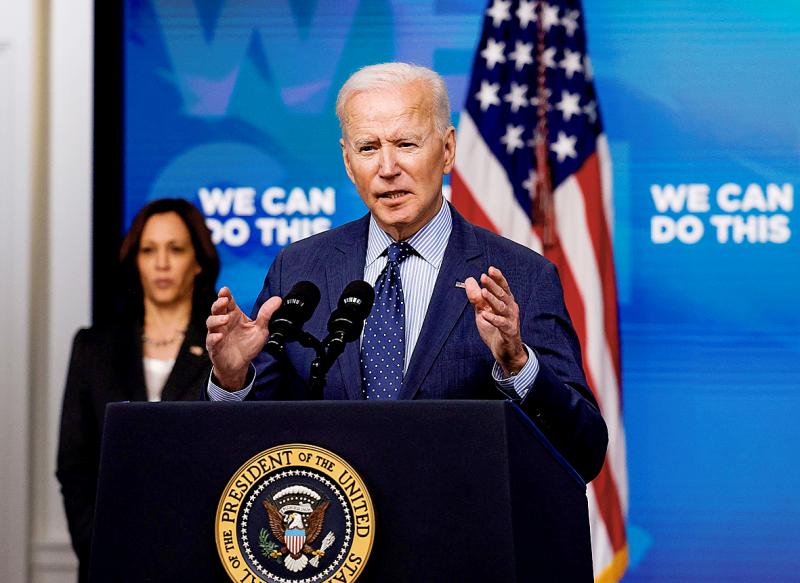
Photo: Reuters
However, White House press secretary Jen Psaki said that Biden has not entirely give up on the corporate tax increase, which he sees as “a viable pay-for.”
“Those pay-fors can be moved around,” Psaki said, signaling that there could be some flexibility in the negotiations.
“We have a range of means for moving the president’s ideas and proposals forward,” she said, adding that Biden was scheduled to talk to Capito again yesterday.
“The president remains committed to his goal of signing a bill into law ... by the summer,” she said.
However, Biden would instead focus on a 15 percent minimum tax that would target corporations that are profitable, but pay little in taxes to the federal government, the Washington Post reported.
Biden has long stressed that corporations need to “pay their fair share” and vowed not to raise taxes on Americans making less than US$400,000 a year.
Both corporate tax measures were included in his budget blueprint presented last week, which showed increasing the top tax rate would bring in at least US$86 billion starting in 2023, while a minimum tax would raise US$10 billion to US$15 billion a year.
Biden, who campaigned on his ability to work with Republicans, has proposed a more than US$2 trillion plan to create jobs through investments in roads and bridges while also funding green technology, expanding broadband Internet access and daycare, and fixing household water supplies.
However, Republicans are pushing for a smaller and more narrowly focused bill limited to traditional public works projects.
Psaki rejected the counteroffer to pay for some of the spending through increased fees.
“We’re not going to go down the road of user fees or other areas that would raise taxes on the American people,” she said.
Capito’s staff did not respond to a request for comment.
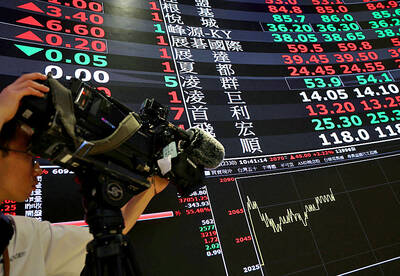
After several years flying high as Asia’s best Nvidia Corp proxy, Taiwan Semiconductor Manufacturing Co (TSMC, 台積電) is increasingly vying with other artificial intelligence (AI) stocks for investor attention. Stock traders are chasing a wider array of beneficiaries as mainstream usage of AI creates demand for hardware beyond the most-advanced chips TSMC makes for Nvidia. Subthemes from the deepening memory crunch to advances in robotics are also luring bids. At the same time, investment caps on single stocks are pushing funds to diversify, while retail investors long familiar with TSMC through its US depositary receipts are being offered a broader set of
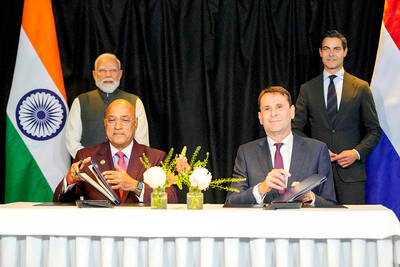
NEW MARKET: The partnership opens up India to the Dutch company, which already has a strong hold in the semiconductor market of South Korea, Taiwan and China ASML Holding NV entered into a partnership agreement with Tata Electronics Pvt Ltd aimed at ramping up India’s goal to develop domestic chip-manufacturing capabilities. The Dutch company’s technology would help power Tata Electronics’ planned 300 millimeter (mm) semiconductor foundry in Gujarat, according to a joint statement from the two companies on Saturday. The signing of a memorandum of understanding coincides with a visit by Indian Prime Minister Narendra Modi to the Netherlands, which is looking to deepen bilateral relations with New Delhi. ASML, whose top customers include Taiwan Semiconductor Manufacturing Co (台積電) and Samsung Electronics Co, makes lithography machines that can print

TECH RELIANCE: Growth is increasingly reflecting an unequal K-shaped distribution, where technology sectors outperform and other industries struggle, an expert said Standard Chartered Bank has significantly raised its forecast for Taiwan’s economic growth to 9.5 percent this year, up from 7.6 percent previously, citing surging artificial intelligence (AI) demand driving exports, semiconductor production and investment. The upgrade reflects a sustained AI supercycle that continues to fuel demand for advanced chips and technology infrastructure, which form the backbone of Taiwan’s exports, the bank said in a report this week. “We raise our 2026 growth forecast to reflect a much stronger-than-expected first-quarter GDP figure,” Standard Chartered senior economist for greater China and Asia Tommy Wu (胡東安) said in the report. Driven largely by a 35.3 percent
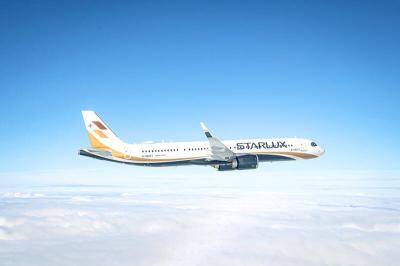
Two of Taiwan’s international carriers, Starlux Airlines Co (星宇航空) and EVA Airways Corp (長榮航空), have retained the five-star airline rating awarded by international airline review organization Skytrax. Starlux was awarded the distinction for a second consecutive year, while EVA Air received it for the 11th straight year, Skytrax said in statements released yesterday and on Thursday last week, respectively. The five-star rating is considered one of the airline industry's highest honors and is awarded following professional audits of airline product and frontline service standards, Skytrax said. The ratings are based on in-depth assessments using unified global quality standards rather than customer review scores


 RSS
RSS