


US economic growth accelerated in the first quarter as the government gave money to mostly lower-income households, fueling consumer spending and setting the course for what is expected to be the strongest performance this year in nearly four decades.
The government largesse also extended to businesses, especially in the high-contact services industry.
The massive fiscal stimulus and easing anxiety over the COVID-19 pandemic, with all adult Americans now eligible for vaccination against the virus, have resulted in a faster economic rebound in the US compared with its global rivals.
The second-fastest GDP growth since the third quarter of 2003, reported on Thursday by the US Department of Commerce, left output just 0.9 percent shy of its level at the end of 2019.
Economists expect a full recovery from the pandemic recession, which started in February last year, in late 2023.
“In early 2021, the economy was served a strong cocktail of improving health conditions and rapid vaccinations, along with a fizzy dose of fiscal stimulus and a steady flow of monetary policy support,” said Lydia Boussour, lead US economist at Oxford Economics in New York. “Looking ahead, we foresee the economy’s spring bloom turning into a summer boom.”
GDP increased at a 6.4 percent annualized rate last quarter, the government said in its advance estimate for the first three months of the year.
That followed a 4.3 percent growth rate in the fourth quarter. It was the biggest first-quarter increase in growth since 1984.
Economists polled by Reuters had forecast GDP growth would increase at a 6.1 percent pace in the January-to-March period.
Income at the disposal of households before accounting for inflation surged by US$2.36 trillion after decreasing US$402.1 billion in the fourth quarter.
As a result, consumer spending jumped at a 10.7 percent rate, boosted by purchases of motor vehicles, furniture, recreational goods and electronics.
People also dined out, stayed at hotels and gambled.
Consumer spending, which accounts for more than two-thirds of US economic activity, grew at a 2.3 percent pace in the fourth quarter. Some of the stimulus money was stashed away, with savings ballooning to US$4.12 trillion from US$2.25 trillion in the fourth quarter.
Economists estimate that households have accumulated at least US$2 trillion in excess savings during the pandemic.
The government has provided nearly US$6 trillion in COVID-19 relief over the past year. Robust demand in the first quarter pushed against supply constraints, leading businesses to draw down inventories, limiting the rise in GDP growth.
Excluding inventories, government and trade, the economy grew at a 10.6 percent rate last quarter.
The rapidly accelerating growth could revive fears about the economy overheating.
The US Federal Reserve on Wednesday acknowledged the burgeoning domestic activity, but the central bank gave no sign that it was ready to reduce its extraordinary support for the recovery.
Inflation has accelerated, but many economists, including Fed officials, expect it will be transitory, as the labor market remains 8.4 million jobs below its peak in February last year.
The labor market is gradually recovering.
In a separate report on Thursday, the US Department of Labor said that initial claims for state unemployment benefits fell 13,000 to a seasonally adjusted 553,000 during the week ended on Saturday last week.
While claims have dropped from a record 6.149 million in early April last year, they are above the range of 200,000 to 250,000 that is viewed as consistent with a healthy labor market.
There were 16.6 million people receiving unemployment benefits in the first week of last month.
“We’re still probably a couple years away from pre-pandemic employment levels, but based on the powerful economic momentum built up in the first quarter, we should return close to a fully functioning economy in the second quarter,” said Robert Frick, corporate economist at Navy Federal Credit Union in Vienna, Virginia.
Economists forecast growth this year could top 7 percent, which would be the fastest since 1984. The economy contracted 3.5 percent last year, the worst performance in 74 years.
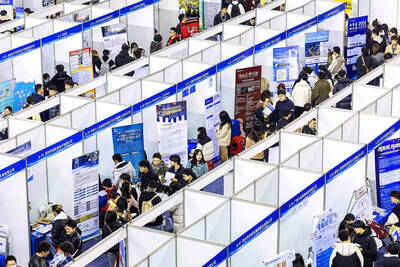
Stephen Garrett, a 27-year-old graduate student, always thought he would study in China, but first the country’s restrictive COVID-19 policies made it nearly impossible and now he has other concerns. The cost is one deterrent, but Garrett is more worried about restrictions on academic freedom and the personal risk of being stranded in China. He is not alone. Only about 700 American students are studying at Chinese universities, down from a peak of nearly 25,000 a decade ago, while there are nearly 300,000 Chinese students at US schools. Some young Americans are discouraged from investing their time in China by what they see
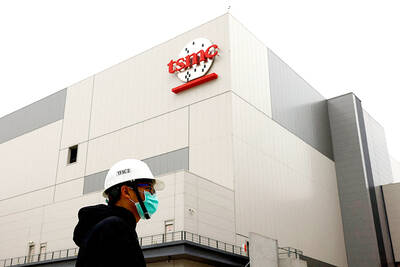
Taiwan Semiconductor Manufacturing Co (TSMC, 台積電), the world’s largest contract chipmaker, yesterday reported record sales for the first quarter, which analysts attributed to solid demand for emerging technologies. Consolidated revenue totaled NT$592.64 billion (US$18.51 billion) in the January-to-March period, up 16.5 percent from a year earlier, but down 5.26 percent from the previous quarter, TSMC said in a statement. The first-quarter revenue beat analysts’ average projection of NT$579.5 billion, Bloomberg News reported. That performance lends weight to expectations that the world’s most valuable chipmaker would return to solid growth this year after weathering a post-COVID-19-pandemic cratering of smartphone and computer sales. TSMC is budgeting
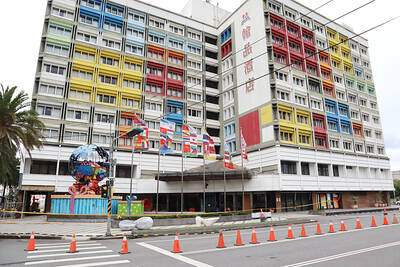
HUALIEN BRANCH: The company had been planning to rebuild the hotel before it was damaged in the quake and vowed to give affected employees the option to transfer The owner of Chateau de Chine Hualien (花蓮翰品酒店) is planning to lay off 86 workers after shutting down the hotel due to damage it sustained in a powerful earthquake on Wednesday last week, the Ministry of Labor said yesterday. The hotel has submitted a layoff report to the Hualien County Government and expects to let 69 workers go this month and 17 next month, the ministry said. LDC Hotels & Resorts Group (雲朗觀光集團), the owner of Chateau de Chine Hualien, confirmed the layoff plan in a statement yesterday. LDC said the hotel has been closed since Wednesday last week when the temblor occurred
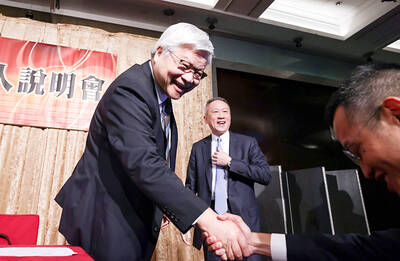
US CONSCULTANT: The US Department of Commerce’s Ursula Burns is a rarely seen US government consultant to be put forward to sit on the board, nominated as an independent director Taiwan Semiconductor Manufacturing Co (TSMC, 台積電), the world’s largest contract chipmaker, yesterday nominated 10 candidates for its new board of directors, including Ursula Burns from the US Department of Commerce. It is rare that TSMC has nominated a US government consultant to sit on its board. Burns was nominated as one of seven independent directors. She is vice chair of the department’s Advisory Council on Supply Chain Competitiveness. Burns is to stand for election at TSMC’s annual shareholders’ meeting on June 4 along with the rest of the candidates. TSMC chairman Mark Liu (劉德音) was not on the list after in December last


 RSS
RSS