


Offshore wind farm developers and the Ministry of Economic Affairs yesterday expressed hope that the establishment of a new industry group would facilitate communication between the fledgling industry and the government.
The launch of the Taiwan Offshore Wind Industry Association (TOWIA), which comprises eight major offshore wind farm developers with projects in Taiwan, comes just weeks ahead of a highly anticipated announcement of the “rules of the game” for the third phase of the nation’s wind farm development plan, dubbed “zonal development.”
Developers have since March 2019 been waiting for the announcement of the rules on zonal development, which would see 1 gigawatt’s worth of projects released every year for 10 years.
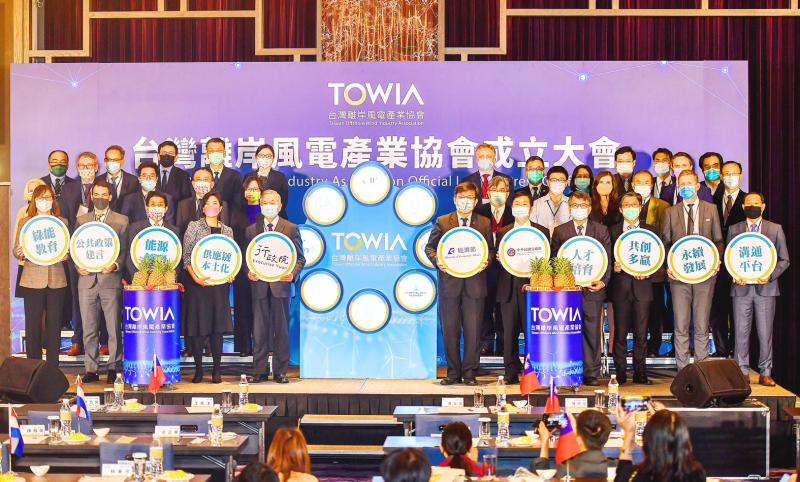
Photo: CNA
The ministry recently said the rules would be announced by the end of this month.
Whether projects would be awarded through a selection process or an auction and what the local content requirements would be are among two of the most critical issues.
TOWIA chairwoman Marina Hsu (許乃文) urged the government to retain aspects of the selection process used to award most of the phase 2 projects, as well as “provide support for new technologies,” such as floating wind turbines.
“We believe that for the good of the long-term development of offshore wind farms in Taiwan, we must learn from the selection process in phase 2,” Hsu said.
Swancor Renewable Energy Co (上緯新能源) CEO Lucas Lin (林雍堯) said that the government should support floating wind turbine technology to ensure offshore wind farms succeed in Taiwan as a source of power and as a nascent industry for export.
Many sites for zonal development are situated in waters more than 60m deep, beyond the capability of traditional fixed-bottom turbines.
As floating turbine technology is still in the experimental phase, it is a field that Taiwanese companies can develop and make their own, Lin said.
“It is hard for Taiwanese manufacturers to catch up with countries that have been making offshore wind farm equipment for decades,” Lin said. “However, floating wind is new and there is a level playing field.”
Deputy Minister of Economic Affairs Tseng Wen-sheng (曾文生), who attended the association’s inauguration, declined to reveal details about zonal development, saying only that the government is in it for the long haul when it comes to offshore wind farms.
“We are looking ahead to 2050 and how offshore wind farms can be a part of Taiwan’s carbon reduction solution,” Tseng said.
“We are already planning how to rebuild wind farms after their 20-year life span,” he added
Tseng said that he hoped the association, started at the “repeated behest” of Vice Premier Shen Jong-chin (沈榮津), would improve communication between the government and the developers.
Taiwan has attracted many international developers after President Tsai Ing-wen (蔡英文) announced an ambitious “20 percent renewable energy by 2025” goal after her 2016 inauguration.
At one point, Taiwan was on track to have 5 gigawatts of offshore wind power in the water by 2015.
However, the COVID-19 pandemic and other unforeseen difficulties have slowed projects, such as German developer Wpd’s Yunlin offshore wind farm project, which was delayed by fishers’ protests, and another Wpd project near Taoyuan, which was blocked after objections by the Civil Aeronautics Administration.
Yesterday, Danish developer Orsted A/S’ Greater Changhua South East offshore wind farm project finally passed its environmental impact assessment after six attempts.
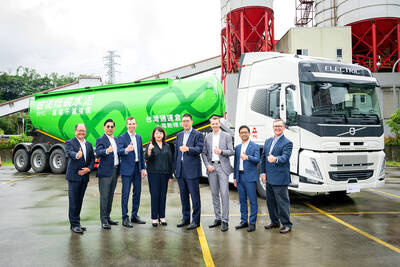
Taiwan Transport and Storage Corp (TTS, 台灣通運倉儲) yesterday unveiled its first electric tractor unit — manufactured by Volvo Trucks — in a ceremony in Taipei, and said the unit would soon be used to transport cement produced by Taiwan Cement Corp (TCC, 台灣水泥). Both TTS and TCC belong to TCC International Holdings Ltd (台泥國際集團). With the electric tractor unit, the Taipei-based cement firm would become the first in Taiwan to use electric vehicles to transport construction materials. TTS chairman Koo Kung-yi (辜公怡), Volvo Trucks vice president of sales and marketing Johan Selven, TCC president Roman Cheng (程耀輝) and Taikoo Motors Group

Among the rows of vibrators, rubber torsos and leather harnesses at a Chinese sex toys exhibition in Shanghai this weekend, the beginnings of an artificial intelligence (AI)-driven shift in the industry quietly pulsed. China manufactures about 70 percent of the world’s sex toys, most of it the “hardware” on display at the fair — whether that be technicolor tentacled dildos or hyper-realistic personalized silicone dolls. Yet smart toys have been rising in popularity for some time. Many major European and US brands already offer tech-enhanced products that can enable long-distance love, monitor well-being and even bring people one step closer to

RECORD-BREAKING: TSMC’s net profit last quarter beat market expectations by expanding 8.9% and it was the best first-quarter profit in the chipmaker’s history Taiwan Semiconductor Manufacturing Co (TSMC, 台積電), which counts Nvidia Corp as a key customer, yesterday said that artificial intelligence (AI) server chip revenue is set to more than double this year from last year amid rising demand. The chipmaker expects the growth momentum to continue in the next five years with an annual compound growth rate of 50 percent, TSMC chief executive officer C.C. Wei (魏哲家) told investors yesterday. By 2028, AI chips’ contribution to revenue would climb to about 20 percent from a percentage in the low teens, Wei said. “Almost all the AI innovators are working with TSMC to address the

Malaysia’s leader yesterday announced plans to build a massive semiconductor design park, aiming to boost the Southeast Asian nation’s role in the global chip industry. A prominent player in the semiconductor industry for decades, Malaysia accounts for an estimated 13 percent of global back-end manufacturing, according to German tech giant Bosch. Now it wants to go beyond production and emerge as a chip design powerhouse too, Malaysian Prime Minister Anwar Ibrahim said. “I am pleased to announce the largest IC (integrated circuit) Design Park in Southeast Asia, that will house world-class anchor tenants and collaborate with global companies such as Arm [Holdings PLC],”


 RSS
RSS