


The head of the French cybersecurity agency ANSSI on Sunday said that there would not be a total ban on using equipment from Huawei Technologies Co (華為) in the rollout of the French 5G telecoms network, but that it was pushing French telecoms to avoid switching to the Chinese company.
“What I can say is that there won’t be a total ban,” Guillaume Poupard told Les Echos newspaper in an interview. However, “for operators that are not currently using Huawei, we are inciting them not to go for it.”
The US government has urged its allies to exclude the Chinese telecoms giant from the West’s next-generation communications, saying that Beijing could use it for spying.
Huawei has denied the charges.
Sources in March said that France would not ban Huawei, but would seek to keep it out of the core mobile network, which carries higher surveillance risks because it processes sensitive information such as customers’ personal data.
France’s decision over Huawei’s equipment is crucial for two of the country’s four telecoms operators, Bouygues Telecom and SFR, as about half of their current mobile network is made by the Chinese group.
“For those that are already using Huawei, we are delivering authorizations for durations that vary between three and eight years,” Poupard said in the interview.
State-controlled Orange SA has already chosen Huawei’s European rivals Nokia Oyj and Ericsson AB.
Poupard said that from next week, operators that have not received an explicit authorization to use Huawei equipment for the 5G network can consider a non-response after the legal deadline as a rejection of their requests.
The choice was made to protect French independence and not as an act of hostility toward China, Poupard said.
“This is not Huawei-bashing or anti-Chinese racism,” Poupard said. “All we’re saying is that the risk is not the same with European suppliers as with non-Europeans.”
Separately, US sanctions designed to restrict the ability of Huawei to source advanced microchips for 5G equipment is likely to have a significant effect on the reliability of the supplier, British Secretary of State for Culture, Media and Sport Oliver Dowden said yesterday.
Britain in January granted Huawei a limited role in its future 5G networks, but officials at the British National Cyber Security Centre have since studied the effects of the US measures that were announced in May.
Officials are drawing up proposals to stop installing Huawei equipment in as little as six months, the Sunday Telegraph reported, in a reversal of a decision earlier this year.
Dowden told Sky News that he would not comment on the report, but said that the UK’s decision was not “not fixed in stone.”
“If the US imposes sanctions, which they have done, we believe that could have a significant impact on the reliability of Huawei equipment and whether we can use it safely,” he said.

Taiwan Transport and Storage Corp (TTS, 台灣通運倉儲) yesterday unveiled its first electric tractor unit — manufactured by Volvo Trucks — in a ceremony in Taipei, and said the unit would soon be used to transport cement produced by Taiwan Cement Corp (TCC, 台灣水泥). Both TTS and TCC belong to TCC International Holdings Ltd (台泥國際集團). With the electric tractor unit, the Taipei-based cement firm would become the first in Taiwan to use electric vehicles to transport construction materials. TTS chairman Koo Kung-yi (辜公怡), Volvo Trucks vice president of sales and marketing Johan Selven, TCC president Roman Cheng (程耀輝) and Taikoo Motors Group

Among the rows of vibrators, rubber torsos and leather harnesses at a Chinese sex toys exhibition in Shanghai this weekend, the beginnings of an artificial intelligence (AI)-driven shift in the industry quietly pulsed. China manufactures about 70 percent of the world’s sex toys, most of it the “hardware” on display at the fair — whether that be technicolor tentacled dildos or hyper-realistic personalized silicone dolls. Yet smart toys have been rising in popularity for some time. Many major European and US brands already offer tech-enhanced products that can enable long-distance love, monitor well-being and even bring people one step closer to

RECORD-BREAKING: TSMC’s net profit last quarter beat market expectations by expanding 8.9% and it was the best first-quarter profit in the chipmaker’s history Taiwan Semiconductor Manufacturing Co (TSMC, 台積電), which counts Nvidia Corp as a key customer, yesterday said that artificial intelligence (AI) server chip revenue is set to more than double this year from last year amid rising demand. The chipmaker expects the growth momentum to continue in the next five years with an annual compound growth rate of 50 percent, TSMC chief executive officer C.C. Wei (魏哲家) told investors yesterday. By 2028, AI chips’ contribution to revenue would climb to about 20 percent from a percentage in the low teens, Wei said. “Almost all the AI innovators are working with TSMC to address the
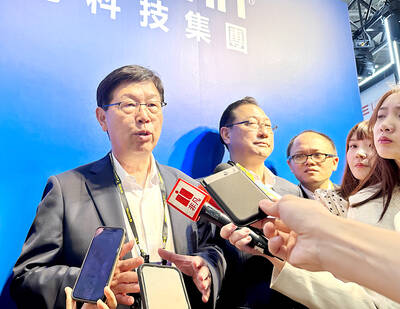
FUTURE PLANS: Although the electric vehicle market is getting more competitive, Hon Hai would stick to its goal of seizing a 5 percent share globally, Young Liu said Hon Hai Precision Industry Co (鴻海精密), a major iPhone assembler and supplier of artificial intelligence (AI) servers powered by Nvidia Corp’s chips, yesterday said it has introduced a rotating chief executive structure as part of the company’s efforts to cultivate future leaders and to enhance corporate governance. The 50-year-old contract electronics maker reported sizable revenue of NT$6.16 trillion (US$189.67 billion) last year. Hon Hai, also known as Foxconn Technology Group (富士康科技集團), has been under the control of one man almost since its inception. A rotating CEO system is a rarity among Taiwanese businesses. Hon Hai has given leaders of the company’s six


 RSS
RSS