


Embattled coffee chain Luckin Coffee Inc (瑞幸咖啡) has decided against ousting its founder and chairman, despite an internal investigation concluding that last year’s revenue included millions of dollars in fake sales.
The massive financial scandal has already cost the company two top executives, caused shares to plummet more than 70 percent and put its billionaire founder Charles Zhengyao Lu (陸正耀) in the line of fire — and would see it delisted from the NASDAQ in New York.
However, the directors decided Lu would nevertheless remain as chairman of the board, the company said in a notice, a day after an internal probe found its net revenue last year was inflated by about 2.12 billion yuan (US$300 million).

Photo: Reuters
A proposal to oust Lu failed to get the necessary two-thirds majority vote on Thursday, Luckin said in a filing to the US Securities and Exchange Commission.
The company’s shares went into freefall after it revealed in April that a top officer might have faked billions of yuan of sales.
The chain has since fired chief executive Jenny Zhiya Qian (錢治亞) and chief operating officer Liu Jian (劉劍).
On Wednesday, Luckin said in a separate filing that a special committee investigation had found the fabrication of sales traced back as early as April last year.
Apart from the inflated revenue, Luckin’s costs and expenses last year were also found to be inflated by 1.34 billion yuan.
The committee’s recommendations — which led to Qian and Liu’s removals — brought about a proposal to oust Lu as well.
While it eventually failed to garner enough support to remove Lu, the board earlier announced its decision to fire another 12 employees involved in the fake transactions.
Luckin suspended trading on Monday and is to delisted from the NASDAQ by the end of next week, having been asked to do so by the exchange.
Lu must still face a vote of confidence by shareholders tomorrow at an extraordinary general meeting, which also proposes axing several more directors.
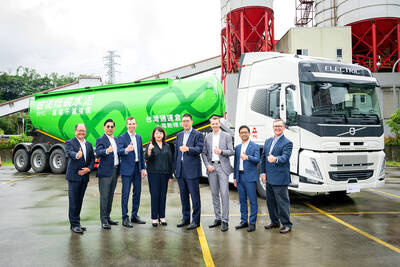
Taiwan Transport and Storage Corp (TTS, 台灣通運倉儲) yesterday unveiled its first electric tractor unit — manufactured by Volvo Trucks — in a ceremony in Taipei, and said the unit would soon be used to transport cement produced by Taiwan Cement Corp (TCC, 台灣水泥). Both TTS and TCC belong to TCC International Holdings Ltd (台泥國際集團). With the electric tractor unit, the Taipei-based cement firm would become the first in Taiwan to use electric vehicles to transport construction materials. TTS chairman Koo Kung-yi (辜公怡), Volvo Trucks vice president of sales and marketing Johan Selven, TCC president Roman Cheng (程耀輝) and Taikoo Motors Group

Among the rows of vibrators, rubber torsos and leather harnesses at a Chinese sex toys exhibition in Shanghai this weekend, the beginnings of an artificial intelligence (AI)-driven shift in the industry quietly pulsed. China manufactures about 70 percent of the world’s sex toys, most of it the “hardware” on display at the fair — whether that be technicolor tentacled dildos or hyper-realistic personalized silicone dolls. Yet smart toys have been rising in popularity for some time. Many major European and US brands already offer tech-enhanced products that can enable long-distance love, monitor well-being and even bring people one step closer to
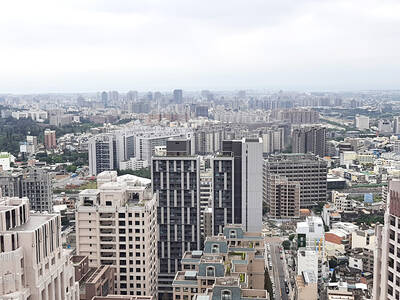
New apartments in Taiwan’s major cities are getting smaller, while old apartments are increasingly occupied by older people, many of whom live alone, government data showed. The phenomenon has to do with sharpening unaffordable property prices and an aging population, property brokers said. Apartments with one bedroom that are two years old or older have gained a noticeable presence in the nation’s six special municipalities as well as Hsinchu county and city in the past five years, Evertrust Rehouse Co (永慶房產集團) found, citing data from the government’s real-price transaction platform. In Taipei, apartments with one bedroom accounted for 19 percent of deals last
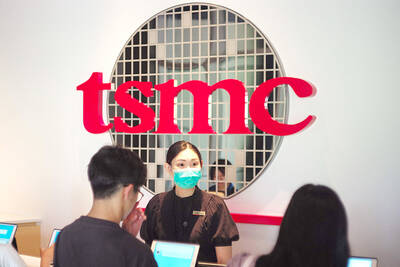
RECORD-BREAKING: TSMC’s net profit last quarter beat market expectations by expanding 8.9% and it was the best first-quarter profit in the chipmaker’s history Taiwan Semiconductor Manufacturing Co (TSMC, 台積電), which counts Nvidia Corp as a key customer, yesterday said that artificial intelligence (AI) server chip revenue is set to more than double this year from last year amid rising demand. The chipmaker expects the growth momentum to continue in the next five years with an annual compound growth rate of 50 percent, TSMC chief executive officer C.C. Wei (魏哲家) told investors yesterday. By 2028, AI chips’ contribution to revenue would climb to about 20 percent from a percentage in the low teens, Wei said. “Almost all the AI innovators are working with TSMC to address the


 RSS
RSS