


Japanese data to be released today are expected to show the country’s economy expanding at its slowest rate in three quarters, as an export-driven recovery falters amid growing fears for the global economy.
A median forecast of economists polled by Dow Jones Newswires suggests Japan will post a fifth straight quarter of growth in April-June, notching up an annualized expansion of 2.3 percent, less than half the 5 percent level posted the previous quarter.
Such data would pose a challenge for Japanese Prime Minister Naoto Kan’s government, which must balance an uncertain economic reality with an agenda dominated by the need to cut the industrialized world’s biggest public debt.
“With the need to rebuild its public finances, the Japanese government has its hands tied,” said Norinchukin Research Institute economist Takeshi Minami, who believes further stimulus is needed as the recovery loses steam.
Also hanging over policy-making is the looming prospect that China will overtake Japan as the world’s second-largest economy, underlining its growing global clout after becoming the world’s biggest exporter, auto market and steelmaker.
By contrast, Japan’s “growth has moderated significantly, and the momentum of the economic recovery is weakening,” said Yoshiki Shinke, a Dai-Ichi Life Research Institute senior economist.
In June, Japan’s unemployment rate edged higher to 5.3 percent, while production of automobiles and electronics underwent a surprise slip, amid signs that an export-driven recovery may be stalling.
Shipments of cars, electronics and components have been crucial in off-setting weaker demand at home, but concern is mounting that Japan may be hit by Beijing’s efforts to cool China’s economy, together with fragile eurozone and US demand.
Deflation and weak domestic demand have long burdened Japan, as consumers tend to put off purchases in the hope of further price falls.
The planned expiry of government incentives to purchase cars next month may also weigh on production for the domestic market just as the overseas climate worsens, analysts say, although a consumer rush before the benefit ends may boost third-quarter figures.
Meanwhile, US economic growth slowed dramatically in the second quarter, down sharply to 2.4 percent from 3.7 percent in the first quarter. Such slowing global expansion is cooling an export sector that is also anxious about the strength of the yen, which recently touched a 15-year high against the dollar.
For every one-yen rise in the currency’s value against the dollar, companies can lose tens of billions of yen earned overseas when repatriated, threatening a core part of Japan’s economy.
Kan’s hopes of capping spending and debt issuance to eventually reduce a public debt approaching 200 percent of GDP and avoid a Greek-style meltdown therefore look highly ambitious, analysts say.
“Japan needs to quickly implement measures to tackle the strong yen, including currency intervention,” Minami said. “The government will shift its focus toward financial measures through the Bank of Japan, such as currency intervention or pumping extra money. It needs to continue maintaining an easy monetary policy.”
Many analysts say this is the year China will replace Japan as the world’s second-largest economy, but the recent strength of the yen adds complexity to comparisons between the countries on a nominal basis.
Takahide Kiuchi, chief economist at Nomura Securities, estimates Japan’s nominal first-half GDP at US$2.647 trillion, using an average dollar exchange rate that saw the yen appreciate strongly toward the end of the January-June period.
That compares to China’s first-half GDP of US$2.53 trillion, calculated from government data and average monthly exchange rates given by the People’s Bank of China.
China came close to overtaking Japan last year when its GDP reached US$4.98 trillion — just behind Japan’s US$5.07 trillion.
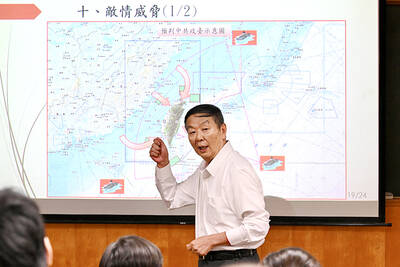
RETHINK? The defense ministry and Navy Command Headquarters could take over the indigenous submarine project and change its production timeline, a source said Admiral Huang Shu-kuang’s (黃曙光) resignation as head of the Indigenous Submarine Program and as a member of the National Security Council could affect the production of submarines, a source said yesterday. Huang in a statement last night said he had decided to resign due to national security concerns while expressing the hope that it would put a stop to political wrangling that only undermines the advancement of the nation’s defense capabilities. Taiwan People’s Party Legislator Vivian Huang (黃珊珊) yesterday said that the admiral, her older brother, felt it was time for him to step down and that he had completed what he

Taiwan has experienced its most significant improvement in the QS World University Rankings by Subject, data provided on Sunday by international higher education analyst Quacquarelli Symonds (QS) showed. Compared with last year’s edition of the rankings, which measure academic excellence and influence, Taiwanese universities made great improvements in the H Index metric, which evaluates research productivity and its impact, with a notable 30 percent increase overall, QS said. Taiwanese universities also made notable progress in the Citations per Paper metric, which measures the impact of research, achieving a 13 percent increase. Taiwanese universities gained 10 percent in Academic Reputation, but declined 18 percent
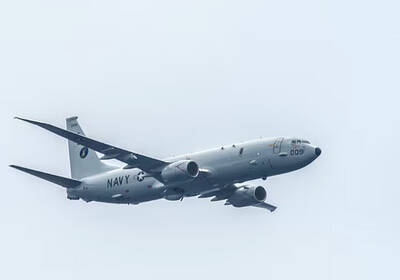
CHINA REACTS: The patrol and reconnaissance plane ‘transited the Taiwan Strait in international airspace,’ the 7th Fleet said, while Taipei said it saw nothing unusual The US 7th Fleet yesterday said that a US Navy P-8A Poseidon flew through the Taiwan Strait, a day after US and Chinese defense heads held their first talks since November 2022 in an effort to reduce regional tensions. The patrol and reconnaissance plane “transited the Taiwan Strait in international airspace,” the 7th Fleet said in a news release. “By operating within the Taiwan Strait in accordance with international law, the United States upholds the navigational rights and freedoms of all nations.” In a separate statement, the Ministry of National Defense said that it monitored nearby waters and airspace as the aircraft
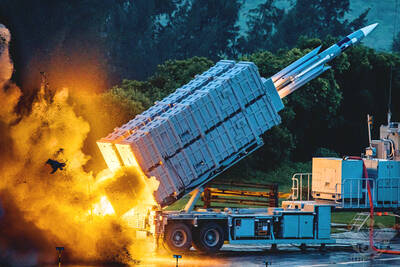
UNDER DISCUSSION: The combatant command would integrate fast attack boat and anti-ship missile groups to defend waters closest to the coastline, a source said The military could establish a new combatant command as early as 2026, which would be tasked with defending Taiwan’s territorial waters 24 nautical miles (44.4km) from the nation’s coastline, a source familiar with the matter said yesterday. The new command, which would fall under the Naval Command Headquarters, would be led by a vice admiral and integrate existing fast attack boat and anti-ship missile groups, along with the Naval Maritime Surveillance and Reconnaissance Command, said the source, who asked to remain anonymous. It could be launched by 2026, but details are being discussed and no final timetable has been announced, the source


 RSS
RSS