


The gold-colored convertible turns heads on impoverished Cambodia’s roads — not least because of creator Nhean Phaloek’s outlandish claim that it can be operated telepathically.
“I just snap my fingers and the car’s door will open. Or I just think of opening the car’s door, and the door opens immediately,” says the 51-year-old as he proudly shows off the homemade car, named the Angkor 333-2010.
Onlookers gasp as he demonstrates the trick, and with the fiber-glass vehicle having cost him US$5,000 and 19 months of labor he is in no mood to reveal the remote control system behind it.

PHOTO: AFP
But as with a handful of other Cambodians who make their own curious cars, he dreams the two-seater will help foster an automobile industry in the country, still poor after decades of conflict.
“I am very excited and proud of this car because many people admire me and keep asking me about how I can make it,” he says, adding that it reaches speeds of up to 100kph.
Kong Pharith, a 48-year-old former maths and physics teacher who has also produced his own car, says an auto industry is about to blossom in Cambodia.
“Our works will be part of a motivating force for the next generation to access new inventions and show the world that Cambodia has an ability to do what you think we cannot,” he says.
The inventor, who first came to national attention in 2005 for building a solar-powered bicycle, thinks he has now hit on a truly unique product with his orange, jeep-like vehicle with solar panels on its roof.
Kong Pharith says it took him four months to design and put the final polish on his “tribrid” car which operates on solar energy, electricity and gasoline, hitting speeds of up to 40kph with its 2,000 watt motor.
“I’m really happy about my achievement but not very satisfied with it yet,” he says, adding that Cambodia’s lack of modern technology and materials are a minor obstacle to efficient manufacturing.
The dream of building cars in Cambodia may not be far-fetched. Officials have announced plans for South Korean automaker Hyundai to open a plant in southwestern Cambodia, assembling some 3,000 vehicles per year.
Cambodia did actually assemble cars in a factory during the 1960s, before the country was caught in the maelstrom of the Vietnam War.
During the brief manufacturing run, the car known as the “Angkor” was made from imported parts and domestically-made tires.
Very basic Cambodian-assembled vehicles also still regularly rumble around the countryside, where approximately 80 percent of the country’s 14 million people live.
Farmers often depend on “robot cows,” large shop-made open-bed trucks with Chinese or Vietnamese engines, which are used to transport people and rice.
The machines, which generally cost about US$2,000, also serve as generators or water pumps when they are not heaving along pot-holed rural roads.
But in the capital Phnom Penh, elites and the nascent middle class can often be seen driving expensive imports, which are considered a symbol of status and achievement.
“[Cambodians] put more attention into their cars than the clothes they buy,” says Jean Boris Roux, who imports Ford vehicles to Cambodia as the country manager for RM Asia.
“I think it’s very important for Cambodians to show the success in their professional life through the vehicles they drive,” Roux said.
Despite the Cambodian love for cars, Roux and several other analysts say its doubtful proper domestic manufacturing will emerge here soon — especially since Thailand remains Asia’s auto assembly giant.
“It’s not just about having four walls [for a factory]. You need hundreds of companies supplying seats, steering wheels, hoods … This is not going to happen in Cambodia for a number of years,” Roux said.
Until then, Nhean Phaloek says he will keep making cars at home. The Angkor 333-2010 is the third has built, and his first to talk.
When he slams the door a voice out of the dashboard moans: “Why do you close me too strongly?”
“Dozens of local and foreign guests have come and seen my car,” Nhean Phaloek says. “One British man told me that it is the Cambodian James Bond car.”
Taiwan has experienced its most significant improvement in the QS World University Rankings by Subject, data provided on Sunday by international higher education analyst Quacquarelli Symonds (QS) showed. Compared with last year’s edition of the rankings, which measure academic excellence and influence, Taiwanese universities made great improvements in the H Index metric, which evaluates research productivity and its impact, with a notable 30 percent increase overall, QS said. Taiwanese universities also made notable progress in the Citations per Paper metric, which measures the impact of research, achieving a 13 percent increase. Taiwanese universities gained 10 percent in Academic Reputation, but declined 18 percent

Chinese President Xi Jinping (習近平) yesterday met with former president Ma Ying-jeou (馬英九) at the Great Hall of the People in Beijing, with Xi’s opening statement once more emphasizing that people on both sides of the Taiwan Strait are Chinese and that foreign intervention cannot change their inevitable unification. Xi said that 5,000 years of history of zhonghua minzu (中華民族, ethnic Chinese group) have seen their ancestors move to Taiwan to establish new lives, while also documenting them fighting side-by-side against foreign forces and finally freeing Taiwan. “Both sides are Chinese,” and there are no issues that cannot be worked through, he
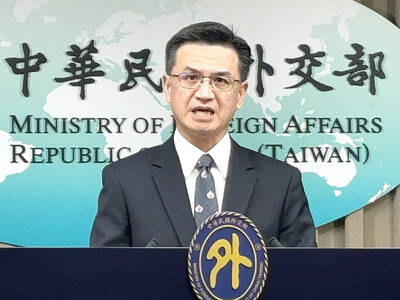
BULLY TACTICS: Beijing has continued its incursions into Taiwan’s airspace even as Xi Jinping talked about Taiwan being part of the Chinese family and nation China should stop its coercion of Taiwan and respect mainstream public opinion in Taiwan about sovereignty if its expression of goodwill is genuine, the Ministry of Foreign Affairs (MOFA) said yesterday. Ministry spokesman Jeff Liu (劉永健) made the comment in response to media queries about a meeting between former president Ma Ying-jeou (馬英九) and Chinese President Xi Jinping (習近平) the previous day. Ma voiced support for the so-called “1992 consensus,” while Xi said that although the two sides of the Taiwan Strait have “different systems,” this does not change the fact that they are “part of the same country,” and that “external

UNDER DISCUSSION: The combatant command would integrate fast attack boat and anti-ship missile groups to defend waters closest to the coastline, a source said The military could establish a new combatant command as early as 2026, which would be tasked with defending Taiwan’s territorial waters 24 nautical miles (44.4km) from the nation’s coastline, a source familiar with the matter said yesterday. The new command, which would fall under the Naval Command Headquarters, would be led by a vice admiral and integrate existing fast attack boat and anti-ship missile groups, along with the Naval Maritime Surveillance and Reconnaissance Command, said the source, who asked to remain anonymous. It could be launched by 2026, but details are being discussed and no final timetable has been announced, the source


 RSS
RSS