


Nokia, the Finnish company that is the world’s biggest maker of mobile phones, is an undisputed powerhouse in Europe, Asia and Latin America, with market share regularly topping 30 percent.
But in the US, Nokia’s signal has faded. As recently as March 2002, it led the US market with a 35 percent share. By last year, though, it slipped to 10 percent and by June of this year — the most recent figure available — Nokia’s share was only 7 percent.
Now the company is struggling to make amends in the US and its comeback effort has started to make headway. And yet, going into the crucial Christmas shopping season in the US, Nokia does not have a strong offering for the US smartphone market, the only part of the mobile industry that is growing. Three years after Apple introduced the iPhone, Nokia still has no alternative.
Many other players are struggling to compete with the iPhone, too. But because of a decade of mistakes, Nokia’s product line in the US has also been surpassed by LG, Motorola, Samsung and Research In Motion.
Among its biggest blunders, analysts and former Nokia executives say, the company failed to design many of its phones to the tastes of American consumers, instead mass producing devices for the global market to save on production costs.
Nokia did not anticipate changes in US consumer tastes, like flip phones and touch screens, said Neil Mawston, an analyst in London with Strategy Analytics. More crucially, perhaps, it also based its models on a European communications standard called GSM when roughly half the US market — including the customers of Verizon Wireless and Sprint Nextel — uses the CDMA format.
“Nokia, at the height of its success, decided not to adapt its phones for the US market. That was a mistake,” said Ari Hakkarainen, a Nokia business development executive from 1999 to 2007. “They are still trying to recover from this.”
Nokia must also contend with a global economic slowdown that has hurt its sales and earnings. Last week, Nokia reported a third-quarter loss of US$1.36 billion as sales fell 20 percent globally — and 25 percent in North America — from a year earlier.
Nokia has recently revamped its US operations to collaborate more closely with the major US operators — AT&T Mobility, AT&T’s wireless unit, Verizon, T-Mobile USA and Sprint Nextel. Together, they control 96 percent of US sales of mobile devices, according to International Data Corp, a research firm.
Starting in the middle of next month at the Best Buy retail chain, Nokia will sell a netbook, the Nokia Booklet 3G, which is a model for its new collaborative strategy.
The US$300 minilaptop will come with a US$60 monthly contract at AT&T Mobility.
“Nokia’s mobile device leadership, together with AT&T’s mobile broadband network leadership, Best Buy’s retail reach and Windows 7, is a very strong lineup,” Microsoft chief executive Steven Ballmer said last week.

ROLLER-COASTER RIDE: More than five earthquakes ranging from magnitude 4.4 to 5.5 on the Richter scale shook eastern Taiwan in rapid succession yesterday afternoon Back-to-back weather fronts are forecast to hit Taiwan this week, resulting in rain across the nation in the coming days, the Central Weather Administration said yesterday, as it also warned residents in mountainous regions to be wary of landslides and rockfalls. As the first front approached, sporadic rainfall began in central and northern parts of Taiwan yesterday, the agency said, adding that rain is forecast to intensify in those regions today, while brief showers would also affect other parts of the nation. A second weather system is forecast to arrive on Thursday, bringing additional rain to the whole nation until Sunday, it

LANDSLIDES POSSIBLE: The agency advised the public to avoid visiting mountainous regions due to more expected aftershocks and rainfall from a series of weather fronts A series of earthquakes over the past few days were likely aftershocks of the April 3 earthquake in Hualien County, with further aftershocks to be expected for up to a year, the Central Weather Administration (CWA) said yesterday. Based on the nation’s experience after the quake on Sept. 21, 1999, more aftershocks are possible over the next six months to a year, the agency said. A total of 103 earthquakes of magnitude 4 on the local magnitude scale or higher hit Hualien County from 5:08pm on Monday to 10:27am yesterday, with 27 of them exceeding magnitude 5. They included two, of magnitude
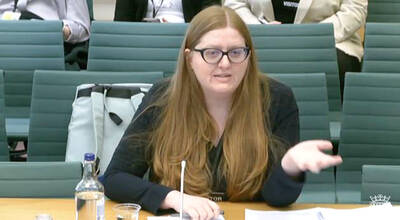
CONDITIONAL: The PRC imposes secret requirements that the funding it provides cannot be spent in states with diplomatic relations with Taiwan, Emma Reilly said China has been bribing UN officials to obtain “special benefits” and to block funding from countries that have diplomatic ties with Taiwan, a former UN employee told the British House of Commons on Tuesday. At a House of Commons Foreign Affairs Committee hearing into “international relations within the multilateral system,” former Office of the UN High Commissioner for Human Rights (OHCHR) employee Emma Reilly said in a written statement that “Beijing paid bribes to the two successive Presidents of the [UN] General Assembly” during the two-year negotiation of the Sustainable Development Goals. Another way China exercises influence within the UN Secretariat is

Taiwan’s first drag queen to compete on the internationally acclaimed RuPaul’s Drag Race, Nymphia Wind (妮妃雅), was on Friday crowned the “Next Drag Superstar.” Dressed in a sparkling banana dress, Nymphia Wind swept onto the stage for the final, and stole the show. “Taiwan this is for you,” she said right after show host RuPaul announced her as the winner. “To those who feel like they don’t belong, just remember to live fearlessly and to live their truth,” she said on stage. One of the frontrunners for the past 15 episodes, the 28-year-old breezed through to the final after weeks of showcasing her unique


 RSS
RSS