


Asian nations must cut their “over-reliance” on exports to developed countries and increase trade with each other to return to growth rates strong enough to reduce poverty, a top regional banker said yesterday.
As consumers in developed nations slash their budgets, export-oriented Asian economies are unlikely to the growth rates seen before last year’s economic crisis, Asian Development Bank (ADB) president Haruhiko Kuroda said.
“The outward-oriented Asian growth model has brought tremendous benefits to the region in the past and can continue to do so in the future,” he said at an international conference in Singapore.
“It would serve no one to turn inward and protectionism should be avoided at all cost. But the concentration on G3 markets for final product sales needs adjustment,” he said.
The G3 refers to the US, Europe and Japan, where 60 percent of Asia’s main export are sent.
OVER-RELIANCE
Kuroda said the global economic crisis that started in the US last year “exposed developing Asia’s over-reliance on extra-regional markets for both exports and capital flows.”
The region must hasten efforts to increase internal trade and stimulate domestic consumption as key growth drivers.
While Asia is rebounding from the crisis faster than other regions, it was unlikely for it to return to sustained strong growth unless key drivers are “rebalanced” to give more weight to domestic stimulants, Kuroda said.
Otherwise, economic growth will not be strong and long enough to make a dent on the large number of poor in the region, he said.
Separately, China’s economic recovery is not yet on a solid footing so the country will carry on with its fiscal stimulus for now, Chinese Vice President Xi Jinping (習近平) said yesterday.
Speaking at an economic seminar during a visit to Belgium, Xi forecast that a return to growth across the world would be slow and gradual.
“We have yet to put economic recovery on a stable and solid basis,” Xi said of China. “We will continue to implement proactive fiscal policy.”
STABILIZING
“The overall economic situation in China is stabilizing and improving,” he said.
Xi said signs of a recovery had appeared in the global economy, but any return to growth would be “long and tortuous.”
He also said China and the 27-country EU should improve their dialogue on macroeconomic and financial issues while working to oppose protectionism in trade.
“We should ... strengthen dialogue on macroeconomic and financial issues,” Xi said.
The EU countries that use the euro and the US are keen on China letting its currency, the yuan, appreciate.
“We should follow on the outcomes of the three G20 financial summits — economic financial coordination, push for reform of the international financial system, coordination on international financial supervision,” Xi said.
ROLLER-COASTER RIDE: More than five earthquakes ranging from magnitude 4.4 to 5.5 on the Richter scale shook eastern Taiwan in rapid succession yesterday afternoon Back-to-back weather fronts are forecast to hit Taiwan this week, resulting in rain across the nation in the coming days, the Central Weather Administration said yesterday, as it also warned residents in mountainous regions to be wary of landslides and rockfalls. As the first front approached, sporadic rainfall began in central and northern parts of Taiwan yesterday, the agency said, adding that rain is forecast to intensify in those regions today, while brief showers would also affect other parts of the nation. A second weather system is forecast to arrive on Thursday, bringing additional rain to the whole nation until Sunday, it

CONDITIONAL: The PRC imposes secret requirements that the funding it provides cannot be spent in states with diplomatic relations with Taiwan, Emma Reilly said China has been bribing UN officials to obtain “special benefits” and to block funding from countries that have diplomatic ties with Taiwan, a former UN employee told the British House of Commons on Tuesday. At a House of Commons Foreign Affairs Committee hearing into “international relations within the multilateral system,” former Office of the UN High Commissioner for Human Rights (OHCHR) employee Emma Reilly said in a written statement that “Beijing paid bribes to the two successive Presidents of the [UN] General Assembly” during the two-year negotiation of the Sustainable Development Goals. Another way China exercises influence within the UN Secretariat is

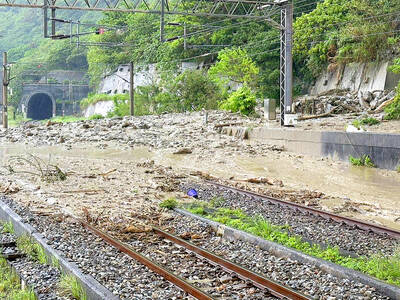
LANDSLIDES POSSIBLE: The agency advised the public to avoid visiting mountainous regions due to more expected aftershocks and rainfall from a series of weather fronts A series of earthquakes over the past few days were likely aftershocks of the April 3 earthquake in Hualien County, with further aftershocks to be expected for up to a year, the Central Weather Administration (CWA) said yesterday. Based on the nation’s experience after the quake on Sept. 21, 1999, more aftershocks are possible over the next six months to a year, the agency said. A total of 103 earthquakes of magnitude 4 on the local magnitude scale or higher hit Hualien County from 5:08pm on Monday to 10:27am yesterday, with 27 of them exceeding magnitude 5. They included two, of magnitude

Taiwan’s first drag queen to compete on the internationally acclaimed RuPaul’s Drag Race, Nymphia Wind (妮妃雅), was on Friday crowned the “Next Drag Superstar.” Dressed in a sparkling banana dress, Nymphia Wind swept onto the stage for the final, and stole the show. “Taiwan this is for you,” she said right after show host RuPaul announced her as the winner. “To those who feel like they don’t belong, just remember to live fearlessly and to live their truth,” she said on stage. One of the frontrunners for the past 15 episodes, the 28-year-old breezed through to the final after weeks of showcasing her unique


 RSS
RSS