


Whites in South Africa earn five times more than their black counterparts on average, a new study found, illustrating the enduring legacy of apartheid 14 years after its abolition.
A study done for the UASA union made waves in the Rainbow Nation last week when it showed that whites bring home 450 percent more than blacks on average and 400 percent more than their mixed race peers.
In line with the global trend, education is the single biggest determinant of earning power, it concluded, but in a country with South Africa’s history the issue has a powerful racial dimension.
“That blacks weren’t allowed on to certain beaches [during the apartheid era of whites-only rule] can be changed overnight but education has a long-lasting legacy,” said the author of the research, economist Mike Schussler. “My concern is that our current education system hasn’t overcome that legacy so we are going to be stuck with the problems for a while longer.”
Under apartheid, says Marius Roodt, researcher at the South African Institute for Race Relations, whites had access to “near world class” schools and universities.
On the other hand, “African people were seen as unworthy of an education and 14 years isn’t going to be enough to address that,” he said.
This hangover has been tackled from an economic point of view — resources for schools are now equally distributed between historically white and historically black institutions.
“Funding is pretty equal across the spectrum. The difference now lies in the fact that historically black schools are performing dismally,” says Servaas Van der Berg, an economist and wage specialist from South Africa’s University of Stellenbosch.
Underachievement can be ascribed to the lower quality of teachers in the mainly black townships as well as social issues related to attitudes to education.
Research in other countries has shown that parental achievement is critical — a child of parents who went to university is more likely to stay in the education system longer and gain a degree.
Van der Berg underlines that other factors should be taken into account when looking at current wage distribution patterns in South Africa, which reflect the racially divided past but are not necessarily indicative of discrimination today.
Whites are concentrated in urban areas, where wages are higher and skilled employment and the services industry are more prevalent. Blacks dominate agricultural, rural areas.
“During apartheid the ideology was that blacks were unnecessary in urban areas and they were supposed to go back to their homelands,” he said.
Another factor affecting the disparity in earnings is statistical because of differing birth and death rates, the white population is on average older, and therefore richer, than the black population. One of the most comprehensive studies of the labor market was published by specialists Rulof Burger and Rachel Jafta in 2006 called Returns to Race: Labour Market Discrimination in Post-Apartheid South Africa.
It concluded that wages were no longer determined by simple race discrimination — blacks being overlooked or worse paid for jobs because of their skin color — but were mostly influenced by educational attainment.
“There appears to have been a shift away from ‘pure discrimination’ and towards differential returns to education,” the study concluded.
Burger said that on average a white worker completes more years of education than the average black worker — 12.6 years as opposed to 8.8 — who also “still receives an education of inferior quality.”
“This is a remnant of the apartheid legacy which the department of education has so far been unable to rectify,” Burger said, adding the unemployment rate for blacks is five times higher than that of whites.
Policy responses to the economic inequality caused by the apartheid system have centered on increasing funding for black schools, affirmative action and land redistribution.
Burger and Jafta found affirmative action had led to a narrowing of wage differences for the top, most highly paid jobs, but had “had no observable effect on the racial employment gap.”
The key therefore to achieving a more equal distribution of wages among the white, black and mixed race population is harmonizing education standards across the country, commentators say.
But this most vital of objectives is far from being achieved.
“Former white schools are still pretty good, but we still see in African townships that schools are dysfunctional,” Roodt said.
Schussler agreed, saying: “We are spending a lot on education and we’re just not getting the results we need.”
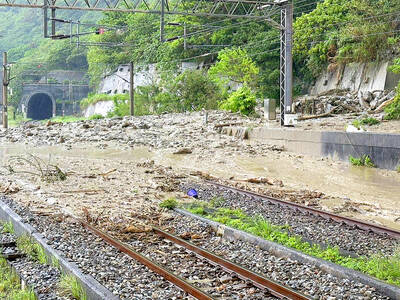
ROLLER-COASTER RIDE: More than five earthquakes ranging from magnitude 4.4 to 5.5 on the Richter scale shook eastern Taiwan in rapid succession yesterday afternoon Back-to-back weather fronts are forecast to hit Taiwan this week, resulting in rain across the nation in the coming days, the Central Weather Administration said yesterday, as it also warned residents in mountainous regions to be wary of landslides and rockfalls. As the first front approached, sporadic rainfall began in central and northern parts of Taiwan yesterday, the agency said, adding that rain is forecast to intensify in those regions today, while brief showers would also affect other parts of the nation. A second weather system is forecast to arrive on Thursday, bringing additional rain to the whole nation until Sunday, it

CONDITIONAL: The PRC imposes secret requirements that the funding it provides cannot be spent in states with diplomatic relations with Taiwan, Emma Reilly said China has been bribing UN officials to obtain “special benefits” and to block funding from countries that have diplomatic ties with Taiwan, a former UN employee told the British House of Commons on Tuesday. At a House of Commons Foreign Affairs Committee hearing into “international relations within the multilateral system,” former Office of the UN High Commissioner for Human Rights (OHCHR) employee Emma Reilly said in a written statement that “Beijing paid bribes to the two successive Presidents of the [UN] General Assembly” during the two-year negotiation of the Sustainable Development Goals. Another way China exercises influence within the UN Secretariat is

LANDSLIDES POSSIBLE: The agency advised the public to avoid visiting mountainous regions due to more expected aftershocks and rainfall from a series of weather fronts A series of earthquakes over the past few days were likely aftershocks of the April 3 earthquake in Hualien County, with further aftershocks to be expected for up to a year, the Central Weather Administration (CWA) said yesterday. Based on the nation’s experience after the quake on Sept. 21, 1999, more aftershocks are possible over the next six months to a year, the agency said. A total of 103 earthquakes of magnitude 4 on the local magnitude scale or higher hit Hualien County from 5:08pm on Monday to 10:27am yesterday, with 27 of them exceeding magnitude 5. They included two, of magnitude

Taiwan’s first drag queen to compete on the internationally acclaimed RuPaul’s Drag Race, Nymphia Wind (妮妃雅), was on Friday crowned the “Next Drag Superstar.” Dressed in a sparkling banana dress, Nymphia Wind swept onto the stage for the final, and stole the show. “Taiwan this is for you,” she said right after show host RuPaul announced her as the winner. “To those who feel like they don’t belong, just remember to live fearlessly and to live their truth,” she said on stage. One of the frontrunners for the past 15 episodes, the 28-year-old breezed through to the final after weeks of showcasing her unique


 RSS
RSS