


After receiving record orders in recent years, Airbus says it expects orders for new planes this year to drop by half from last year amid slower global growth.
John Leahy, Airbus' chief salesman, said at the Singapore Airshow on Tuesday that the European planemaker is likely to sell about 700 planes this year, down from more than 1,400 orders last year.
"The market, in terms of new orders, will be going down," Leahy told a press briefing. "We have a record backlog so I would expect to see fewer and fewer orders as the market does cool off a bit."

PHOTO: REUTERS
"By definition, the whole world is cooling down a little bit," Leahy said.
The 700 planes that Toulouse, France-based Airbus wants to sell will include more than a hundred A350s, a redesigned widebody 300-seat jet, and about 30 units of the A380, the world's largest commercial jet. Korean Air Lines Co said on Monday it would buy three more double-decker A380s on top of its existing order for five of the world's biggest commercial jets.
Leahy said that orders for planes had peaked in the past three years and manufacturers were now ramping up production to deliver them.
Airbus has about 3,600 planes in its order backlog, he said, about the same number as its US rival, Boeing.
Together, the rivals won a record 2,754 orders last year.
The biggest challenge the companies face is getting planes off their production lines fast enough to meet demand. At the end of last year, the two companies together had enough airplanes on order to keep their factories busy for about five to six years.
Both companies have faced delays in deliveries. Airbus's first A380 was delivered nearly two years late last fall -- a delay that slashed profits at parent company EADS.
Chicago-based Boeing last month said the inaugural flight for the 787 would be delayed up to three months, pushing delivery of the first plane into early next year -- the third time the airplane has been delayed.
Airbus chief executive Tom Enders said his company was learning from the mistakes that caused the A380's delay and that it was making improvements in integrating production processes.
"We're taking quite a few lessons from our own failures on the 380," Enders said.
"The core of that problem was the missing thorough integration of processes inside Airbus," he said. "We have changed that already in the last two years ... and we're on our way to improving them further."
Enders said Airbus was studying the production problems that Boeing currently faces with its supply chain and slow progress on the assembly line, but said he was confident both companies' supply chains were up to par.
"I'm sure that Boeing has taken some lessons from our failures. We are in turn studying carefully what we should take from their problems on the 787," he said. "For supply chain to come to that point is a major concern."
"But we believe we have every reason to assume that our supply chain ... can match the ramp up that we and our competitor have ahead of us," Enders said.
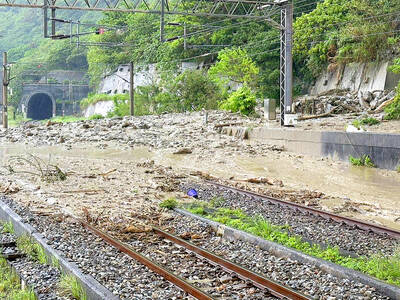
ROLLER-COASTER RIDE: More than five earthquakes ranging from magnitude 4.4 to 5.5 on the Richter scale shook eastern Taiwan in rapid succession yesterday afternoon Back-to-back weather fronts are forecast to hit Taiwan this week, resulting in rain across the nation in the coming days, the Central Weather Administration said yesterday, as it also warned residents in mountainous regions to be wary of landslides and rockfalls. As the first front approached, sporadic rainfall began in central and northern parts of Taiwan yesterday, the agency said, adding that rain is forecast to intensify in those regions today, while brief showers would also affect other parts of the nation. A second weather system is forecast to arrive on Thursday, bringing additional rain to the whole nation until Sunday, it
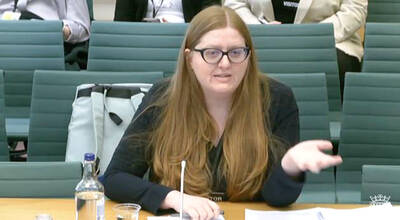
CONDITIONAL: The PRC imposes secret requirements that the funding it provides cannot be spent in states with diplomatic relations with Taiwan, Emma Reilly said China has been bribing UN officials to obtain “special benefits” and to block funding from countries that have diplomatic ties with Taiwan, a former UN employee told the British House of Commons on Tuesday. At a House of Commons Foreign Affairs Committee hearing into “international relations within the multilateral system,” former Office of the UN High Commissioner for Human Rights (OHCHR) employee Emma Reilly said in a written statement that “Beijing paid bribes to the two successive Presidents of the [UN] General Assembly” during the two-year negotiation of the Sustainable Development Goals. Another way China exercises influence within the UN Secretariat is
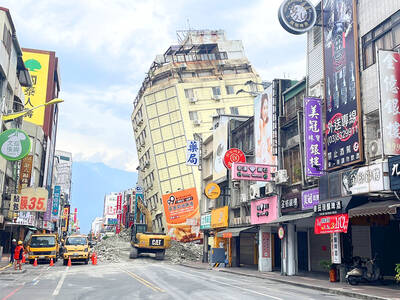
LANDSLIDES POSSIBLE: The agency advised the public to avoid visiting mountainous regions due to more expected aftershocks and rainfall from a series of weather fronts A series of earthquakes over the past few days were likely aftershocks of the April 3 earthquake in Hualien County, with further aftershocks to be expected for up to a year, the Central Weather Administration (CWA) said yesterday. Based on the nation’s experience after the quake on Sept. 21, 1999, more aftershocks are possible over the next six months to a year, the agency said. A total of 103 earthquakes of magnitude 4 on the local magnitude scale or higher hit Hualien County from 5:08pm on Monday to 10:27am yesterday, with 27 of them exceeding magnitude 5. They included two, of magnitude

Taiwan’s first drag queen to compete on the internationally acclaimed RuPaul’s Drag Race, Nymphia Wind (妮妃雅), was on Friday crowned the “Next Drag Superstar.” Dressed in a sparkling banana dress, Nymphia Wind swept onto the stage for the final, and stole the show. “Taiwan this is for you,” she said right after show host RuPaul announced her as the winner. “To those who feel like they don’t belong, just remember to live fearlessly and to live their truth,” she said on stage. One of the frontrunners for the past 15 episodes, the 28-year-old breezed through to the final after weeks of showcasing her unique


 RSS
RSS