


Faced with record inflation, the European Central Bank (ECB) is expected to resist pressure for an interest rate cut when its governing council meets this week, in the wake of moves by the US Federal Reserve.
Despite a spectacular decrease in US lending rates and growing concern over the 15-country eurozone economy, analysts say the ECB will keep its main rate at 4 percent, where it has been since June, at Thursday's meeting.
It does not feel the time has come to cut the cost of borrowing, or even to signal that a cut is in the cards -- in contrast to the Bank of England, which economists expect to ease its main rate the same day.
"ECB president Jean-Claude Trichet will show more concerns about the economy," Commerzbank chief economist Joerg Kraemer said.
But that would be it.
"At the same time, he will warn about the risks of inflation, as he did at the beginning of January and stress that the ECB is ready to act" to counter them, a way of threatening tighter monetary conditions, Kraemer said.
Eurozone inflation hit 3.2 percent last month, fueling concern at the loss of purchasing power in Europe. Trade unions, especially in Germany, see it as a good reason to press for significantly higher wages.
But the ECB, which considers inflation to be under control if it remains just below 2 percent, is worried that stiff pay increases will create long-term inflation.
Given its primary mission of guaranteeing price stability, the bank is likely to reiterate its warnings, said Holger Sandte of WestLB bank.
But words seem to be the only weapon at its disposal. Raising rates would be nearly impossible as the US flirts with recession and the eurozone begins to pay the price.
Recent drops in business and consumer sentiment are an unmistakable sign of the times.
If the ECB holds firm, it will undoubtedly be the target of more pressure, in particular from countries like France.
Luxembourg Finance Minister Jean-Claude Juncker, who chairs the Eurogroup of finance ministers, had diplomatically added his voice to those who call for a change in policy.
After formerly seeking to reassure the public about the health of the eurozone economy, Juncker now has begun to worry about risks to eurozone exports from a growing gap between US and eurozone interest rates.
The US Federal Reserve has carried out two spectacular interest rate cuts in eight days, bringing its Fed funds rate down from 4.25 percent to 3 percent and has left the door open to further decreases.
The Fed had sought to calm financial markets that fear the US economy is heading for recession.
However, maintaining its own rate at 4 percent would mean the ECB is exacerbating the euro's external value and making eurozone exports more expensive.
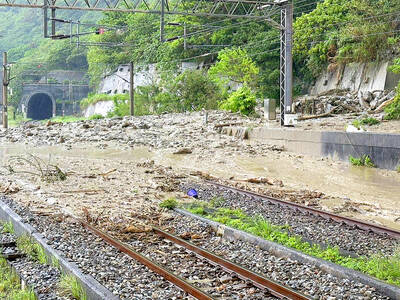
ROLLER-COASTER RIDE: More than five earthquakes ranging from magnitude 4.4 to 5.5 on the Richter scale shook eastern Taiwan in rapid succession yesterday afternoon Back-to-back weather fronts are forecast to hit Taiwan this week, resulting in rain across the nation in the coming days, the Central Weather Administration said yesterday, as it also warned residents in mountainous regions to be wary of landslides and rockfalls. As the first front approached, sporadic rainfall began in central and northern parts of Taiwan yesterday, the agency said, adding that rain is forecast to intensify in those regions today, while brief showers would also affect other parts of the nation. A second weather system is forecast to arrive on Thursday, bringing additional rain to the whole nation until Sunday, it
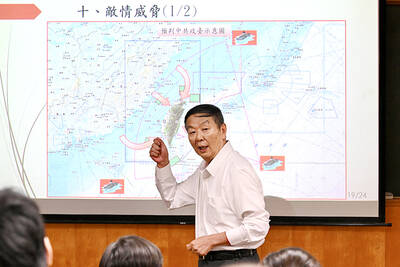
RETHINK? The defense ministry and Navy Command Headquarters could take over the indigenous submarine project and change its production timeline, a source said Admiral Huang Shu-kuang’s (黃曙光) resignation as head of the Indigenous Submarine Program and as a member of the National Security Council could affect the production of submarines, a source said yesterday. Huang in a statement last night said he had decided to resign due to national security concerns while expressing the hope that it would put a stop to political wrangling that only undermines the advancement of the nation’s defense capabilities. Taiwan People’s Party Legislator Vivian Huang (黃珊珊) yesterday said that the admiral, her older brother, felt it was time for him to step down and that he had completed what he

CONDITIONAL: The PRC imposes secret requirements that the funding it provides cannot be spent in states with diplomatic relations with Taiwan, Emma Reilly said China has been bribing UN officials to obtain “special benefits” and to block funding from countries that have diplomatic ties with Taiwan, a former UN employee told the British House of Commons on Tuesday. At a House of Commons Foreign Affairs Committee hearing into “international relations within the multilateral system,” former Office of the UN High Commissioner for Human Rights (OHCHR) employee Emma Reilly said in a written statement that “Beijing paid bribes to the two successive Presidents of the [UN] General Assembly” during the two-year negotiation of the Sustainable Development Goals. Another way China exercises influence within the UN Secretariat is

CHINA REACTS: The patrol and reconnaissance plane ‘transited the Taiwan Strait in international airspace,’ the 7th Fleet said, while Taipei said it saw nothing unusual The US 7th Fleet yesterday said that a US Navy P-8A Poseidon flew through the Taiwan Strait, a day after US and Chinese defense heads held their first talks since November 2022 in an effort to reduce regional tensions. The patrol and reconnaissance plane “transited the Taiwan Strait in international airspace,” the 7th Fleet said in a news release. “By operating within the Taiwan Strait in accordance with international law, the United States upholds the navigational rights and freedoms of all nations.” In a separate statement, the Ministry of National Defense said that it monitored nearby waters and airspace as the aircraft


 RSS
RSS