


There just isn't enough evidence to support the increasingly popular hypothesis that Asian economies are "decoupling" from a slowing US.
Markus Rosgen, who is Citigroup Inc's chief Asia strategist in Hong Kong, says the notion that the region has its own self-sustaining growth and doesn't have to sink or swim with the US "is a case of hope over reality."
The ratio of consumption in Asian nations' GDP, he says, has declined over the last five years.
While the US share of Asian exports has fallen -- to 17 percent last year from 23 percent in 1985 -- the intra-Asian trade that has replaced it moves in lockstep with US imports.
The correlation between the growth in intraregional Asian exports and US non-oil imports has increased sixfold in the past 25 years or so, Rosgen's analysis shows.
Ditto for the flow of capital: Stock indexes in Asia are more linked with US -- and European -- benchmarks now than they have been in 30 years, Rosgen says.
Even US patent records show that Asia's decoupling from the West is going to be a long-drawn process.
The flow of knowledge isn't getting the attention it deserves in the decoupling debate, which remains largely focused on movements of trade and capital. This is odd considering that throughout history the rise of new economic nerve centers has essentially been triggered by spurts of innovation.
K-WAVES
Economist Joseph Schumpeter called them K-waves, in honor of the Russian academic Nikolai Kondratiev, who devised a theory of 50-year-long business cycles of booms and busts.
George Modelski, a University of Washington political scientist, says the maturing of printing techniques in China in the 10th century was the first K-wave, while the arrival of Intel Corp's microprocessors in the early 1970s is the starting point of the 19th -- and the most recent -- one.
All the waves have started as concentrated bursts of activity that gradually spread in all directions; their primary effect has been to make the host economy rich for two generations, or about 50 or 60 years, and then dissipate.
Viewed from this prism, the brisk economic activity in Asia that is being touted as proof of decoupling may be just what one would expect to see in the diffusion phase of a disruptive technology -- such as the Internet -- - that was hosted elsewhere.
Together with excess telecommunications capacity created during the dot-com bubble, the Internet has made it possible for many tasks -- from analysis of X-ray reports to remotely monitoring the shop-floor inventory at a Detroit automaker -- to be outsourced to the Asian region cost-effectively. Yet, outsourcing is still about satisfying final Western demand.
US PATENTS
The current technological cycle won't make Asia a new economic powerhouse; it may set the stage, but the spark will have to come from within. What that innovation might be remains unknown. However, after it does arrive, it will be seen -- with the benefit of hindsight -- as a new 20th wave, or K-20.
What we are witnessing now is the buildup phase of Asia's scientific prowess. Analysis by Albert Hu, an economist at the National University of Singapore, shows that three-fifths of US patents granted to innovators in seven East Asian countries cite prior work done in the US, a figure that has actually risen a little since the early 1990s.
That isn't surprising. There are many more US patents for Asian innovators to cite from than there are Asian ones, as Hu said in a recent paper cowritten with Milan Brahmbhatt, lead economist for Asia-Pacific at the World Bank.
KNOWLEDGE HUBS
Remove that difference from the equation, and the picture begins to look brighter, especially for South Korea and Taiwan, two of the most technologically advanced countries in Asia outside Japan.
Increasingly the building blocks of South Korean or Taiwanese scientists -- the "prior art" in patenting lingo -- are coming from within their own country or from other Asian nations.
"After controlling for the fact that the potential pool of citable electrical and electronics patents is much smaller than the potential pool in the US, [South] Korean patents cite other [South]Korean patents almost five times as intensively as they do US patents," Brahmbhatt and Hu note.
To a lesser extent, the same is true of Taiwan. Apart from building on the technologies developed by their compatriots, researchers in Taiwan are also making three times more use of South Korean inventions than they are of US patents.
"These trends confirm the growing regional dimension in East Asian knowledge flows," the economists say.
The emergence of local knowledge clusters is crucial for Asia. They will lead to specialization and improve the odds of big-bang innovation, which, in Schumpeter's scheme of things, is the biggest tool any entrepreneur can lay his hands on to "creatively destruct" existing hegemonies.
Until that happens, prosperity in Asia will be subservient to Western demand. And that automatically means that another prerequisite for a decoupled economy -- freedom in setting fiscal and monetary policies -- won't be available to Asian policy makers for many years to come.
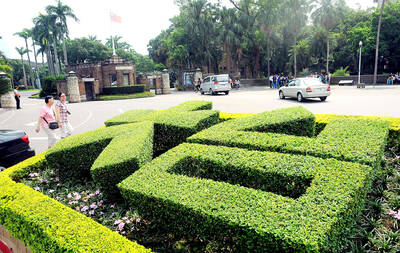
Taiwan has experienced its most significant improvement in the QS World University Rankings by Subject, data provided on Sunday by international higher education analyst Quacquarelli Symonds (QS) showed. Compared with last year’s edition of the rankings, which measure academic excellence and influence, Taiwanese universities made great improvements in the H Index metric, which evaluates research productivity and its impact, with a notable 30 percent increase overall, QS said. Taiwanese universities also made notable progress in the Citations per Paper metric, which measures the impact of research, achieving a 13 percent increase. Taiwanese universities gained 10 percent in Academic Reputation, but declined 18 percent

Chinese President Xi Jinping (習近平) yesterday met with former president Ma Ying-jeou (馬英九) at the Great Hall of the People in Beijing, with Xi’s opening statement once more emphasizing that people on both sides of the Taiwan Strait are Chinese and that foreign intervention cannot change their inevitable unification. Xi said that 5,000 years of history of zhonghua minzu (中華民族, ethnic Chinese group) have seen their ancestors move to Taiwan to establish new lives, while also documenting them fighting side-by-side against foreign forces and finally freeing Taiwan. “Both sides are Chinese,” and there are no issues that cannot be worked through, he
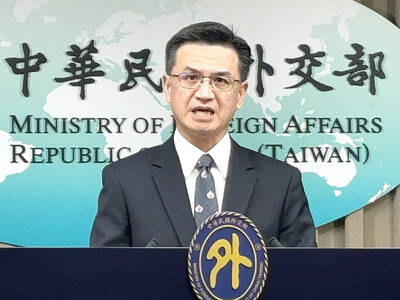
BULLY TACTICS: Beijing has continued its incursions into Taiwan’s airspace even as Xi Jinping talked about Taiwan being part of the Chinese family and nation China should stop its coercion of Taiwan and respect mainstream public opinion in Taiwan about sovereignty if its expression of goodwill is genuine, the Ministry of Foreign Affairs (MOFA) said yesterday. Ministry spokesman Jeff Liu (劉永健) made the comment in response to media queries about a meeting between former president Ma Ying-jeou (馬英九) and Chinese President Xi Jinping (習近平) the previous day. Ma voiced support for the so-called “1992 consensus,” while Xi said that although the two sides of the Taiwan Strait have “different systems,” this does not change the fact that they are “part of the same country,” and that “external
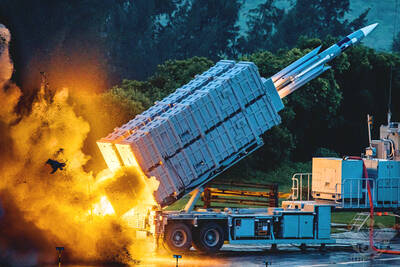
UNDER DISCUSSION: The combatant command would integrate fast attack boat and anti-ship missile groups to defend waters closest to the coastline, a source said The military could establish a new combatant command as early as 2026, which would be tasked with defending Taiwan’s territorial waters 24 nautical miles (44.4km) from the nation’s coastline, a source familiar with the matter said yesterday. The new command, which would fall under the Naval Command Headquarters, would be led by a vice admiral and integrate existing fast attack boat and anti-ship missile groups, along with the Naval Maritime Surveillance and Reconnaissance Command, said the source, who asked to remain anonymous. It could be launched by 2026, but details are being discussed and no final timetable has been announced, the source


 RSS
RSS