


The German bank IKB which was caught up in the US high-risk mortgage debacle, expects to post a loss of up to 700 million euros (US$990 million) for this fiscal year, it said yesterday.
In its first quarter which ended June 30, the specialist in loans to small and medium sized businesses showed a net profit of 12 million euros, a fall of 66 percent on an annual basis.
But the effects of the US "subprime" crisis had not yet taken their full effect, IKB acknowledged in a statement.
It was saved from bankruptcy last month when the German bank KfW, the government's financial arm, provided IKB with a line of credit worth 8.1 billion euros and other German banks agreed to add another 3.5 billion if needed.
The distressed German bank now faces a wave of shareholder legal actions as a result of the losses, with 40 complaints filed this week against IKB and its former boss, Stefan Ortseifen, and another 40 possibly being prepared.
They charged that shareholders were not warned of problems linked to the US subprime market.
The prosecutors office in Duesseldorf, Germany, has also begun to investigate possible fraud and violations of business laws at the German bank.
But after refocusing on its core activity of business lending, IKB has also begun to attract suitors, with the newspaper Die Welt reporting that regional public banks WestLB and LBBW could be interested in a 38 percent stake now owned by KfW.
Meanwhile, UK banks do not face the prospect of a crisis like that seen in the US subprime mortgage market, analysts at ratings agency Moody's Investors Service said on Thursday. They told investors on a conference call that the UK mortgage lending sector has the ability to withstand a potential downturn in asset quality and it continued to have solid financial fundamentals.
"We ... do not believe that a US subprime-like crisis for the banks is about to happen in the UK," said Adel Satel, team managing director at Moody's for banking.
He said there were three key reasons for this.
Firstly, combined loan-to-value ratios for non-conforming loans in Britain last year were around 76 percent, while the same figure for US subprime mortgages was 85 percent, he said.
Secondly, "underwriting criteria for the recent vintages of non-conforming loans in the UK are much better than older vintages and significantly better than the underwriting criteria of US subprime mortgages," he said.
And thirdly, "while the UK may experience a softening of house prices, it is unlikely that house prices would drop significantly," Satel said.
However, "clearly we are entering a period of negative sentiment with regard to the UK mortgage market," he said, with lenders reporting growing levels of arrears and problem loans even before the turmoil of the summer.
"However this growth was and is from an exceptionally low level," Satel said. "We do not anticipate adjusting mortgage lenders' ratings merely because asset-quality figures are deteriorating."
In fact, mortgage lenders' non-performing loans would have to increase by more than 300 percent on average for their financial strength ratings to be downgraded by one notch, he said.
Satel said however that Moody's would monitor closely the degree to which lenders had become reliant on the wholesale market.
He said Northern Rock, the lender that had to seek emergency funding from the Bank of England in a move that led to depositors lining up to take their money out, was an outlier in terms of its reliance on wholesale funding.
"Most UK mortgage lenders including Alliance & Leicester and Bradford & Bingley have a far greater proportion of funding in the form of retail funds than Northern Rock, and are less aggressive in terms of aggressive mortgage growth," Satel said.
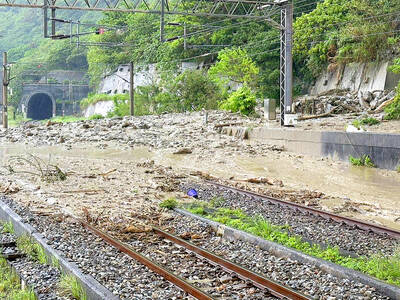
ROLLER-COASTER RIDE: More than five earthquakes ranging from magnitude 4.4 to 5.5 on the Richter scale shook eastern Taiwan in rapid succession yesterday afternoon Back-to-back weather fronts are forecast to hit Taiwan this week, resulting in rain across the nation in the coming days, the Central Weather Administration said yesterday, as it also warned residents in mountainous regions to be wary of landslides and rockfalls. As the first front approached, sporadic rainfall began in central and northern parts of Taiwan yesterday, the agency said, adding that rain is forecast to intensify in those regions today, while brief showers would also affect other parts of the nation. A second weather system is forecast to arrive on Thursday, bringing additional rain to the whole nation until Sunday, it

CONDITIONAL: The PRC imposes secret requirements that the funding it provides cannot be spent in states with diplomatic relations with Taiwan, Emma Reilly said China has been bribing UN officials to obtain “special benefits” and to block funding from countries that have diplomatic ties with Taiwan, a former UN employee told the British House of Commons on Tuesday. At a House of Commons Foreign Affairs Committee hearing into “international relations within the multilateral system,” former Office of the UN High Commissioner for Human Rights (OHCHR) employee Emma Reilly said in a written statement that “Beijing paid bribes to the two successive Presidents of the [UN] General Assembly” during the two-year negotiation of the Sustainable Development Goals. Another way China exercises influence within the UN Secretariat is
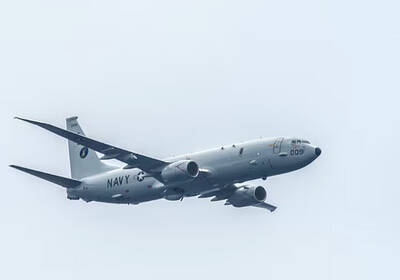
CHINA REACTS: The patrol and reconnaissance plane ‘transited the Taiwan Strait in international airspace,’ the 7th Fleet said, while Taipei said it saw nothing unusual The US 7th Fleet yesterday said that a US Navy P-8A Poseidon flew through the Taiwan Strait, a day after US and Chinese defense heads held their first talks since November 2022 in an effort to reduce regional tensions. The patrol and reconnaissance plane “transited the Taiwan Strait in international airspace,” the 7th Fleet said in a news release. “By operating within the Taiwan Strait in accordance with international law, the United States upholds the navigational rights and freedoms of all nations.” In a separate statement, the Ministry of National Defense said that it monitored nearby waters and airspace as the aircraft

Taiwan’s first drag queen to compete on the internationally acclaimed RuPaul’s Drag Race, Nymphia Wind (妮妃雅), was on Friday crowned the “Next Drag Superstar.” Dressed in a sparkling banana dress, Nymphia Wind swept onto the stage for the final, and stole the show. “Taiwan this is for you,” she said right after show host RuPaul announced her as the winner. “To those who feel like they don’t belong, just remember to live fearlessly and to live their truth,” she said on stage. One of the frontrunners for the past 15 episodes, the 28-year-old breezed through to the final after weeks of showcasing her unique


 RSS
RSS