


Japanese government and business leaders held an emergency meeting yesterday to assess the safety of imported goods amid growing global concern about Chinese products.
"People are increasingly interested in the safety of imported goods," Chief Cabinet Secretary Yasuhisa Shiozaki told reporters in announcing the meeting.
"The government and the private sector will join hands [to ensure the] safety of [imported] foodstuffs, commodities for daily use, pharmaceuticals and other goods," he said.
The one-day meeting includes officials from the health, farm, trade and foreign ministries, as well as representatives from a private-sector frozen food association, department stores and other groups.
Shiozaki did not name any country but said it would be "fully possible that we will have talks with a country if there seems to be a problem."
Japan is heavily reliant on food imports and counts China as its second-largest supplier after the US. China exported US$8.2 billion worth of food to Japan in the last fiscal year to March, accounting for 17 percent of Japan's imports, finance ministry figures show.
Bad food and medicines from China have often made headlines in Japan, which prides itself on very strict health codes.
In 2002, a Japanese firm recalled and halted sales of Chinese diet pills upon orders from a local government after the drugs were held responsible for four deaths and more than 400 injuries.
No deaths or injuries from Chinese products have been reported in Japan in the latest international round of scares, but the topic is one of the hottest in the Japanese media after toothpaste and other goods were recalled.
Chinese Premier Wen Jiabao (
The Chinese government said yesterday it had shut down several companies at the heart of food and drug safety scares.
Li Changjiang (李長江), head of the General Administration for Quality Supervision, Inspection and Quarantine, said officials were focusing on stricter market access requirements for companies, conducting random checks, and beefing up product testing.
But he stressed that China was not the only one with problems, citing comments by WHO Director-General Margaret Chan (陳馮富珍) this week that the agency receives about 200 reports of food safety problems every month from its 193 member states.
"This shows that food safety is not an issue of a particular country or region," Li said at a news conference.
In a statement released yesterday, Li's administration said it had pulled the business license of Taixing Glycerin Factory, which has been accused of exporting diethylene glycol (DEG) and fraudulently passing it off as 99.5 percent pure glycerin. The "TD glycerin" mix of 15 percent DEG and other substances eventually ended up in Panamanian medicines that killed at least 51 people.
The statement also detailed punishments imposed on Xuzhou Anying Biologic Technology Development Co and Binzhou Futian Biology Technology Co -- the two companies linked to melamine-tainted wheat gluten blamed for the deaths of dozens of dogs and cats in North America.
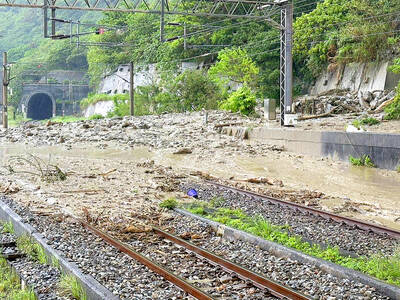
ROLLER-COASTER RIDE: More than five earthquakes ranging from magnitude 4.4 to 5.5 on the Richter scale shook eastern Taiwan in rapid succession yesterday afternoon Back-to-back weather fronts are forecast to hit Taiwan this week, resulting in rain across the nation in the coming days, the Central Weather Administration said yesterday, as it also warned residents in mountainous regions to be wary of landslides and rockfalls. As the first front approached, sporadic rainfall began in central and northern parts of Taiwan yesterday, the agency said, adding that rain is forecast to intensify in those regions today, while brief showers would also affect other parts of the nation. A second weather system is forecast to arrive on Thursday, bringing additional rain to the whole nation until Sunday, it
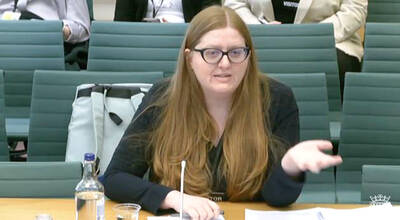
CONDITIONAL: The PRC imposes secret requirements that the funding it provides cannot be spent in states with diplomatic relations with Taiwan, Emma Reilly said China has been bribing UN officials to obtain “special benefits” and to block funding from countries that have diplomatic ties with Taiwan, a former UN employee told the British House of Commons on Tuesday. At a House of Commons Foreign Affairs Committee hearing into “international relations within the multilateral system,” former Office of the UN High Commissioner for Human Rights (OHCHR) employee Emma Reilly said in a written statement that “Beijing paid bribes to the two successive Presidents of the [UN] General Assembly” during the two-year negotiation of the Sustainable Development Goals. Another way China exercises influence within the UN Secretariat is
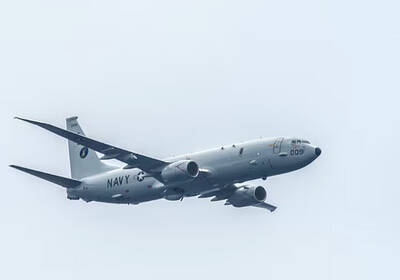
CHINA REACTS: The patrol and reconnaissance plane ‘transited the Taiwan Strait in international airspace,’ the 7th Fleet said, while Taipei said it saw nothing unusual The US 7th Fleet yesterday said that a US Navy P-8A Poseidon flew through the Taiwan Strait, a day after US and Chinese defense heads held their first talks since November 2022 in an effort to reduce regional tensions. The patrol and reconnaissance plane “transited the Taiwan Strait in international airspace,” the 7th Fleet said in a news release. “By operating within the Taiwan Strait in accordance with international law, the United States upholds the navigational rights and freedoms of all nations.” In a separate statement, the Ministry of National Defense said that it monitored nearby waters and airspace as the aircraft

Taiwan’s first drag queen to compete on the internationally acclaimed RuPaul’s Drag Race, Nymphia Wind (妮妃雅), was on Friday crowned the “Next Drag Superstar.” Dressed in a sparkling banana dress, Nymphia Wind swept onto the stage for the final, and stole the show. “Taiwan this is for you,” she said right after show host RuPaul announced her as the winner. “To those who feel like they don’t belong, just remember to live fearlessly and to live their truth,” she said on stage. One of the frontrunners for the past 15 episodes, the 28-year-old breezed through to the final after weeks of showcasing her unique


 RSS
RSS