


China's booming recycling industry is helping to slow the destruction of forests worldwide, providing a strong market for wastepaper that mostly comes from the US and Europe, a study released yesterday showed.
The report from the Washington-based Forest Trends also warns that although trees are spared though the use of wastepaper, China's growing demand for wood increasingly fuels the destruction of virgin forests in parts of Asia and Africa.
About 60 percent of the fiber used to manufacture paper and paper board products in China is derived from wastepaper, the report found. In the last decade, China's wastepaper imports increased by more than 500 percent -- from 3.1 million tonnes in 1996 to 19.6 million tonnes last year -- with most of that growth occurring between 2002 and last year.
The industry includes one of the country's richest people, Zhang Yin (
"China is by far the world's biggest consumer of wastepaper and that's a good thing, because in the last four years alone, China has prevented 65 million tonnes of wastepaper from heading to landfills in the US, Japan and Europe," Brian Stafford, the lead author of the report and an industry consultant, said in a statement.
Just last year, China's use of wastepaper instead of trees to make paper products probably saved 54 million tonnes of wood from being harvested for pulp.
But Stafford said that China continues to depend on virgin forests for its higher-quality papers, sourcing nearly 40 percent "of wood and wood pulp from countries where good forest management cannot be assured."
"The biggest environmental challenge related to China's paper industry is to prevent its growing demand for fiber from driving ever more forest destruction in places like Indonesia and Eastern Russia," he said.
"Wastepaper can only provide so much fiber and with huge new pulp mills coming on line in China, there is a legitimate concern that future growth in China's paper industry is going to happen at the expense of already stressed natural forests in the tropics," Stafford said.
A spokesman for the Chinese government could not be reached immediately for comment.
The report comes amid growing concern from environmental groups who accuse China of importing illegal timber to supply its flooring and furniture industry.
Greenpeace in April accused the country of importing thousands of cubic meters of illegal tropical hardwood from Papua New Guinea and Indonesia last year to supply its booming furniture industry and produce luxury goods for overseas markets.
Greenpeace said it found that Chinese importers were evading an Indonesian ban on the hardwood known as merbau by labeling it as sawn timber. Importers also used forged documents that claimed the logs came from Malaysia, even though most merbau has already been logged out of the Southeast Asian country.
A member of Greenpeace is on the Forest Trends board and Greenpeace China's Forests Campaign Coordinator, Tamara Stark, agreed with the Forest Trend report's findings.
"We agree with their findings that it's really positive that Chinese companies have shown entrepreneurial spirit in taking on the issue of recycling and the production of new recycled products," Stark said.
To make the industry more sustainable, Forest Trends recommends Chinese paper companies establish a chain-of-custody system allowing them to track wood all the way back through the supply chain to ensure it comes from legal sources.
Taiwan has experienced its most significant improvement in the QS World University Rankings by Subject, data provided on Sunday by international higher education analyst Quacquarelli Symonds (QS) showed. Compared with last year’s edition of the rankings, which measure academic excellence and influence, Taiwanese universities made great improvements in the H Index metric, which evaluates research productivity and its impact, with a notable 30 percent increase overall, QS said. Taiwanese universities also made notable progress in the Citations per Paper metric, which measures the impact of research, achieving a 13 percent increase. Taiwanese universities gained 10 percent in Academic Reputation, but declined 18 percent

Chinese President Xi Jinping (習近平) yesterday met with former president Ma Ying-jeou (馬英九) at the Great Hall of the People in Beijing, with Xi’s opening statement once more emphasizing that people on both sides of the Taiwan Strait are Chinese and that foreign intervention cannot change their inevitable unification. Xi said that 5,000 years of history of zhonghua minzu (中華民族, ethnic Chinese group) have seen their ancestors move to Taiwan to establish new lives, while also documenting them fighting side-by-side against foreign forces and finally freeing Taiwan. “Both sides are Chinese,” and there are no issues that cannot be worked through, he
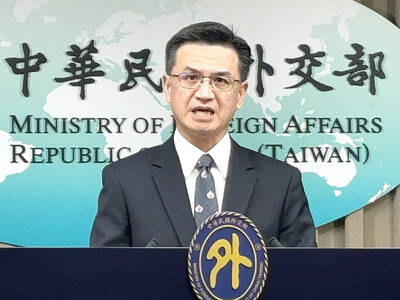
BULLY TACTICS: Beijing has continued its incursions into Taiwan’s airspace even as Xi Jinping talked about Taiwan being part of the Chinese family and nation China should stop its coercion of Taiwan and respect mainstream public opinion in Taiwan about sovereignty if its expression of goodwill is genuine, the Ministry of Foreign Affairs (MOFA) said yesterday. Ministry spokesman Jeff Liu (劉永健) made the comment in response to media queries about a meeting between former president Ma Ying-jeou (馬英九) and Chinese President Xi Jinping (習近平) the previous day. Ma voiced support for the so-called “1992 consensus,” while Xi said that although the two sides of the Taiwan Strait have “different systems,” this does not change the fact that they are “part of the same country,” and that “external

UNDER DISCUSSION: The combatant command would integrate fast attack boat and anti-ship missile groups to defend waters closest to the coastline, a source said The military could establish a new combatant command as early as 2026, which would be tasked with defending Taiwan’s territorial waters 24 nautical miles (44.4km) from the nation’s coastline, a source familiar with the matter said yesterday. The new command, which would fall under the Naval Command Headquarters, would be led by a vice admiral and integrate existing fast attack boat and anti-ship missile groups, along with the Naval Maritime Surveillance and Reconnaissance Command, said the source, who asked to remain anonymous. It could be launched by 2026, but details are being discussed and no final timetable has been announced, the source


 RSS
RSS