


In their first face-to-face meeting, the family that controls Dow Jones & Co on Monday told Rupert Murdoch, a suitor some family members mistrust deeply, that it would sell him the company only if its jewel, the Wall Street Journal, could be shielded from editorial interference from him.
Murdoch made it clear that he would not accept the terms of the Bancroft family's proposal, which would give a board of independent overseers the power to hire and fire top editors, according to people who were present or were briefed by participants, but added that Murdoch floated an alternate arrangement in the meeting, which lasted almost five hours.
"Both sides laid out the way they thought it should work, and neither side agreed with the other, but they're eager to keep talking," said a person briefed on the meeting but who was unauthorized to speak on behalf of the participants. "It was all very pleasant on both sides, but there's still plenty of distance between the two."
Monday's discussions did not include a price, although it is widely believed that the Bancrofts will be looking for Murdoch to raise his offer of US$60 a share. Murdoch has said he does not intend to increase his bid.
He and his representatives asked to meet again yesterday, but the family demurred, suggesting that some directors will discuss the negotiations by phone before the two sides get together again, as soon as today but more likely in a few days.
Critics of the elder Murdoch, 76, say that from British tabloids to the New York Post to Fox News, he has a long pattern of bending journalism to serve his business and political ends. Members of the Bancroft family and many Journal newsroom employees have expressed their fear of editorial interference.
The Bancrofts pitched their idea for a board of overseers for the Journal in a written proposal presented at the meeting. The board's initial members would be chosen by the family and, just as important, would choose their successors in perpetuity, people close to the family said.
Similar arrangements govern many of the nation's biggest philanthropic foundations, often with the result that the charities are free to pursue aims that would not please their wealthy founders.
Murdoch studied the Bancroft's document but, after some discussion, said it was not workable for him, people briefed on the meeting said.
Bringing out his own written proposal, he offered a less independent sort of governing board like the one at the Times of London when he acquired it, with some members appointed by him. The structure did not prevent him from forcing out the editor, Harry Evans, in short order.
Under the current configuration of the Times' board, he explained, he could appoint the paper's editor, but the editor would need to be approved by the independent board. Similarly, he could not remove the editor without the concurrence of the board.
Two people briefed on the meeting said Murdoch's proposal was well received by the Bancroft family representatives and Martin Lipton, a lawyer representing them.
But Dow Jones' chairman M. Peter McPherson was cool to the proposal even as it seemed to other attendees that a deal might be near, they said. McPherson called for a break so that the Bancrofts could study the News Corp proposal more closely.
Both sides caucused for more than an hour, and when they resumed in the late afternoon, McPherson was more amenable, they said.

ROLLER-COASTER RIDE: More than five earthquakes ranging from magnitude 4.4 to 5.5 on the Richter scale shook eastern Taiwan in rapid succession yesterday afternoon Back-to-back weather fronts are forecast to hit Taiwan this week, resulting in rain across the nation in the coming days, the Central Weather Administration said yesterday, as it also warned residents in mountainous regions to be wary of landslides and rockfalls. As the first front approached, sporadic rainfall began in central and northern parts of Taiwan yesterday, the agency said, adding that rain is forecast to intensify in those regions today, while brief showers would also affect other parts of the nation. A second weather system is forecast to arrive on Thursday, bringing additional rain to the whole nation until Sunday, it
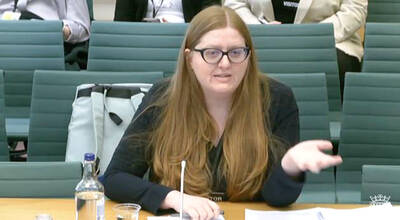
CONDITIONAL: The PRC imposes secret requirements that the funding it provides cannot be spent in states with diplomatic relations with Taiwan, Emma Reilly said China has been bribing UN officials to obtain “special benefits” and to block funding from countries that have diplomatic ties with Taiwan, a former UN employee told the British House of Commons on Tuesday. At a House of Commons Foreign Affairs Committee hearing into “international relations within the multilateral system,” former Office of the UN High Commissioner for Human Rights (OHCHR) employee Emma Reilly said in a written statement that “Beijing paid bribes to the two successive Presidents of the [UN] General Assembly” during the two-year negotiation of the Sustainable Development Goals. Another way China exercises influence within the UN Secretariat is

LANDSLIDES POSSIBLE: The agency advised the public to avoid visiting mountainous regions due to more expected aftershocks and rainfall from a series of weather fronts A series of earthquakes over the past few days were likely aftershocks of the April 3 earthquake in Hualien County, with further aftershocks to be expected for up to a year, the Central Weather Administration (CWA) said yesterday. Based on the nation’s experience after the quake on Sept. 21, 1999, more aftershocks are possible over the next six months to a year, the agency said. A total of 103 earthquakes of magnitude 4 on the local magnitude scale or higher hit Hualien County from 5:08pm on Monday to 10:27am yesterday, with 27 of them exceeding magnitude 5. They included two, of magnitude
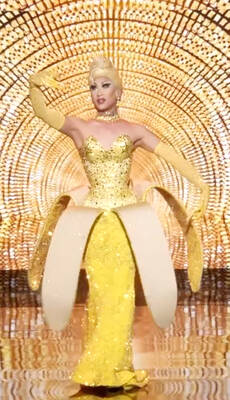
Taiwan’s first drag queen to compete on the internationally acclaimed RuPaul’s Drag Race, Nymphia Wind (妮妃雅), was on Friday crowned the “Next Drag Superstar.” Dressed in a sparkling banana dress, Nymphia Wind swept onto the stage for the final, and stole the show. “Taiwan this is for you,” she said right after show host RuPaul announced her as the winner. “To those who feel like they don’t belong, just remember to live fearlessly and to live their truth,” she said on stage. One of the frontrunners for the past 15 episodes, the 28-year-old breezed through to the final after weeks of showcasing her unique


 RSS
RSS