


The IMF needs to strengthen and modernize its currency exchange rate monitoring policies to ensure their effectiveness as globalization spreads, world finance officials agreed on Saturday.
British Chancellor of the Exchequer Gordon Brown, who is also the head of the IMF's policy steering committee, said the quality and the candor of the surveillance process need to be improved to preserve global economic stability.
Speaking at the end of a day-long session during spring meetings of the IMF and its sister institution, the World Bank, Brown said the change should be made in a way that adds "no new obligations" to IMF member countries.
The call echoed an earlier one Saturday by the administration of US President George W. Bush -- a demand that reflects US frustration with China's slow pace of financial reform.
While seeking new ways to pressure Beijing, US Treasury Secretary Henry Paulson also advocated "bold action" to overhaul the IMF.
The organization founded 62 years ago to foster economic stability "no longer looks like the economic world in which we live," he said.
Meanwhile, protesters from aid advocacy and other groups marched outside the bank's headquarters calling for the resignation of bank President Paul Wolfowitz.
Wolfowitz has said he made a mistake and has apologized for his role in his girlfriend Shaha Riza's promotion. The executive board of the 185-country bank, whose mission is to fight poverty and improve living standards for the poor, is looking into the matter.
The IMF communique on Saturday said ministers welcomed the "continued strong, broad-based expansion of the global economy," which is becoming regionally more balanced "and is expected to continue in 2007 and 2008."
They agreed that resolving global imbalances -- trade deficits and mirroring currency surpluses, particularly in Asian countries -- is a shared responsibility and agreed to resume talks on the issue when warranted.
The head of the IMF, Rodrigo de Rato, drew attention to the section of the communique that calls for China to improve its exchange rate mechanism in a gradual manner.
"Exchange rate flexibility will gradually increase, with attention paid to the value of a basket of currencies," de Rato said. "Efforts will be made to cultivate the foreign exchange market and deepen reform of foreign exchange administration."
China's currency system keeps the yuan artificially low against the US dollar, giving Chinese companies price advantages over US producers.
Perhaps miffed by the continued pressure on currency reform, China sent deputies instead of the finance minister and central bank chief to the weekend meetings.
"Let us be clear: exercising firm surveillance over members' exchange rate policies is a core function of the institution," Paulson said.
He said the IMF is working on revising its guidelines on foreign exchange monitoring. Any changes should clarify the IMF's role but not create new obligations for members.
"This should enable firmer surveillance in areas where market forces are not the prevailing paradigm, such as insufficiently flexible exchange rate regimes, or areas where macroeconomic policies and performance are poor even if the exchange rate freely floats," Paulson said.
Finance ministers from Latin America and Europe endorsed Paulson's position on currency surveillance at a meeting of the IMF's policy-steering committee.
Ministers from Argentina, Holland and Russia supported changes in currency surveillance provided they do not impose new burdens.
Argentinean Finance Minister Felisa Miceli said changes in the governance structure so far -- allowing a greater voice for South Korea, China, Turkey and Mexico -- amount to a "cosmetic change that could eventually be marketed as a milestone in improving the fund's `legitimacy.'"
It would be self-defeating for the fund to give more votes to a few emerging economy countries that no longer need IMF loans "at the expense of other developing countries that remain to be potential borrowers," Miceli said.
Paulson said prospects for the US economy were good, although activity had slowed. Growth is projected to slow to 2.2 percent this year.
Taiwan has experienced its most significant improvement in the QS World University Rankings by Subject, data provided on Sunday by international higher education analyst Quacquarelli Symonds (QS) showed. Compared with last year’s edition of the rankings, which measure academic excellence and influence, Taiwanese universities made great improvements in the H Index metric, which evaluates research productivity and its impact, with a notable 30 percent increase overall, QS said. Taiwanese universities also made notable progress in the Citations per Paper metric, which measures the impact of research, achieving a 13 percent increase. Taiwanese universities gained 10 percent in Academic Reputation, but declined 18 percent

Chinese President Xi Jinping (習近平) yesterday met with former president Ma Ying-jeou (馬英九) at the Great Hall of the People in Beijing, with Xi’s opening statement once more emphasizing that people on both sides of the Taiwan Strait are Chinese and that foreign intervention cannot change their inevitable unification. Xi said that 5,000 years of history of zhonghua minzu (中華民族, ethnic Chinese group) have seen their ancestors move to Taiwan to establish new lives, while also documenting them fighting side-by-side against foreign forces and finally freeing Taiwan. “Both sides are Chinese,” and there are no issues that cannot be worked through, he
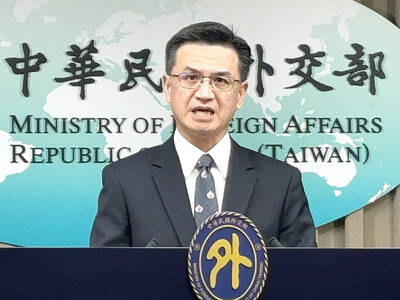
BULLY TACTICS: Beijing has continued its incursions into Taiwan’s airspace even as Xi Jinping talked about Taiwan being part of the Chinese family and nation China should stop its coercion of Taiwan and respect mainstream public opinion in Taiwan about sovereignty if its expression of goodwill is genuine, the Ministry of Foreign Affairs (MOFA) said yesterday. Ministry spokesman Jeff Liu (劉永健) made the comment in response to media queries about a meeting between former president Ma Ying-jeou (馬英九) and Chinese President Xi Jinping (習近平) the previous day. Ma voiced support for the so-called “1992 consensus,” while Xi said that although the two sides of the Taiwan Strait have “different systems,” this does not change the fact that they are “part of the same country,” and that “external

UNDER DISCUSSION: The combatant command would integrate fast attack boat and anti-ship missile groups to defend waters closest to the coastline, a source said The military could establish a new combatant command as early as 2026, which would be tasked with defending Taiwan’s territorial waters 24 nautical miles (44.4km) from the nation’s coastline, a source familiar with the matter said yesterday. The new command, which would fall under the Naval Command Headquarters, would be led by a vice admiral and integrate existing fast attack boat and anti-ship missile groups, along with the Naval Maritime Surveillance and Reconnaissance Command, said the source, who asked to remain anonymous. It could be launched by 2026, but details are being discussed and no final timetable has been announced, the source


 RSS
RSS